It’s 2:00 AM. You’re staring at a blinking cursor, your third cup of cold coffee is sitting precariously near your keyboard, and the deadline for your 15-page research paper is looming like a dark cloud. We’ve all been there. The pressure to perform academically while balancing a social life, a job, and perhaps even some much-needed sleep can feel absolutely overwhelming. You find yourself searching for "write my research paper for me" just to see what your options are, hoping for a lifeline in a sea of academic jargon and complex citations.
Writing a research paper isn't just about putting words on a page; it’s a rigorous exercise in general research methodology and critical thinking. Unfortunately, even the most dedicated students fall into common traps that can turn a potential "A" into a stressful "C." At Submit Your Assignments, we see these hurdles every day, and we’re here to act as your supportive ally.
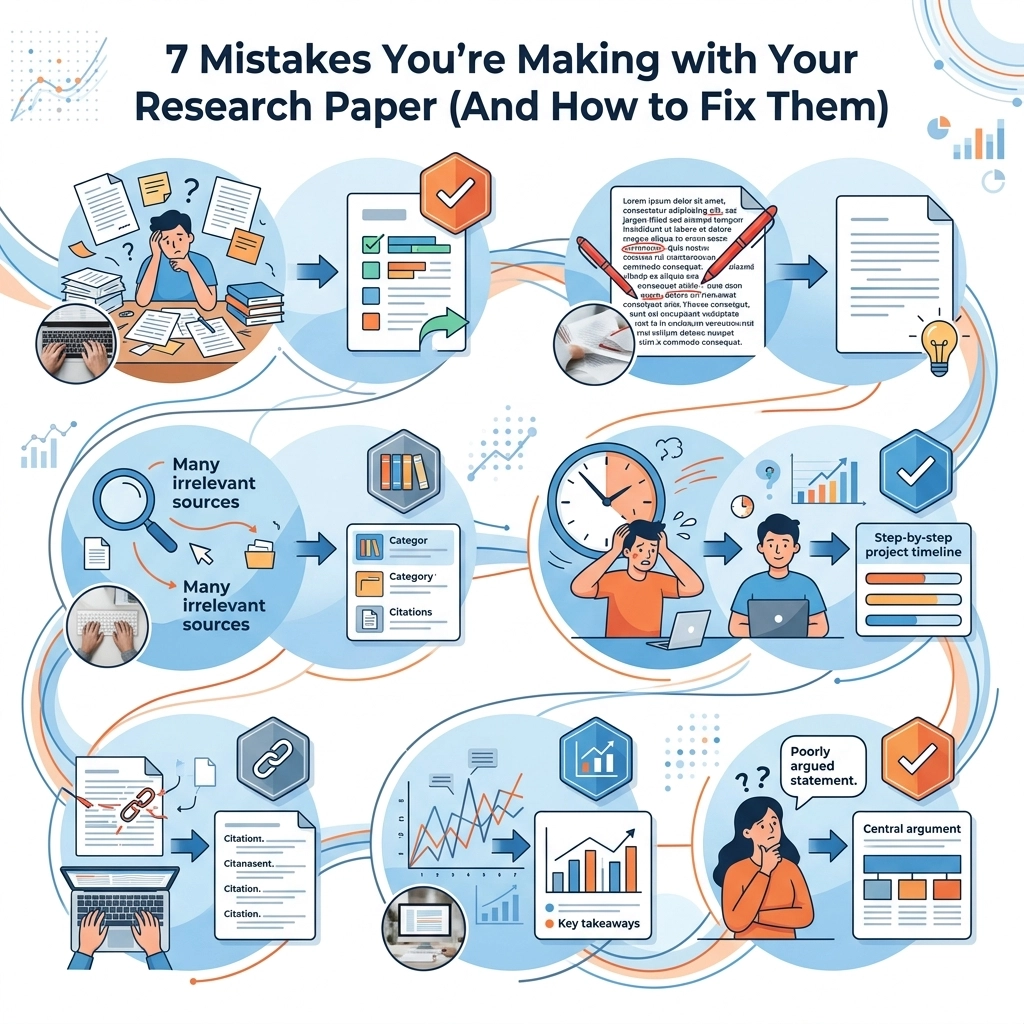
Are you ready to stop the cycle of stress and start producing work you’re actually proud of? Let’s dive into the seven most common mistakes you’re likely making with your research paper and, more importantly, how to fix them.
1. Choosing a Research Question That’s Too Broad
One of the most detrimental mistakes you can make happens before you even write your first sentence. Many students choose a topic that is far too wide. For example, trying to cover "The History of Psychology" in a ten-page paper is an impossible task. You’ll end up with a plethora of shallow information rather than a deep, meaningful analysis.
The Fix: Narrow your focus. Instead of general psychology, perhaps you need psychology essay help focusing specifically on "The Impact of Cognitive Behavioral Therapy on Social Anxiety in Adolescents." A specific question allows you to master the material and provide a nuanced argument. This precision expedites your writing process because you aren’t drowning in irrelevant data.

2. Treating the Literature Review Like a "Grocery List"
Your literature review should not be a simple list of "Author A said this, and Author B said that." This is a common pitfall in general research methodology. If your paper feels like a collection of summaries, you’re missing the point. A high-quality research paper requires you to synthesize the information.
The Fix: Look for themes, contradictions, and gaps in the existing research. How does Author A’s work support or challenge Author B? Your job is to create a conversation between the sources. By connecting the dots, you demonstrate to your professor that you truly understand the academic landscape. If you're struggling to find the right sources, our research assistance services can help guide you toward the most relevant scholarly articles.
3. Ignoring the Power of a Strong Abstract
Think of your abstract as the storefront of your paper. If the storefront is messy or confusing, no one wants to go inside. Many students treat the abstract as an afterthought, scribbling it down five minutes before submission. This is a mistake. A vague or overly technical abstract can alienate your reader before they’ve even reached your introduction.
The Fix: Write your abstract last. Ensure it clearly states your research objective, your methodology, your key findings, and the implications of your work. Keep it concise and accessible. A well-crafted abstract ensures that your reader (and your grader) knows exactly what to expect, which builds immediate confidence in your authority on the subject.

4. Getting Tangled in Citation Chaos
Nothing kills the flow of a great paper like a "Works Cited" page that looks like it was generated by a random code bot. Whether you’re using APA, MLA, or Chicago style, consistency is key. Inconsistent formatting or missing DOIs can lead to unintentional plagiarism: a risk you simply cannot afford to take.
The Fix: Use reference management tools like Zotero or Mendeley, but don’t trust them blindly. Always double-check your citations against the latest style guide. If the thought of formatting 40 references makes your head spin, remember that our editing support experts can handle the heavy lifting for you, ensuring every comma and italicized title is exactly where it needs to be.
5. Overusing Jargon and "Academic Speak"
Do you think using big words makes you sound smarter? In reality, it often does the opposite. Overloading your paper with excessive jargon can obscure your point and make your writing feel clunky. Your goal should be clarity, not complexity.
The Fix: Write as if you are explaining your research to a smart friend who isn't in your specific field. Use professional vocabulary where necessary, but don't force it. Short, punchy sentences are often more effective than long, winding ones. Remember: if a reader has to read a sentence three times to understand it, the sentence is broken.

6. Falling Into the "Last-Minute" Trap
We’ve all heard the myth of the student who wrote a masterpiece in four hours after pulling an all-nighter. In the real world, this rarely happens. Rushing through a research paper leads to sloppy grammar, weak arguments, and overlooked instructions. When you’re stressed, you’re more likely to make errors that are detrimental to your final grade.
The Fix: Break your project into smaller, manageable tasks. Set mini-deadlines for your outline, your first draft, and your final polish. If you find yourself in a genuine time crunch, don't panic. You can check our available deadlines to see how we can assist you in meeting your submission goals without the 2 AM meltdown. Trust our writers to help you regain your peace of mind.

7. Neglecting the "So What?" Factor
You’ve done the research, you’ve cited the sources, and you’ve followed the format. But have you answered the most important question: Why does this research matter? A paper that lacks a strong conclusion or fails to explain its significance feels incomplete.
The Fix: In your conclusion, move beyond just summarizing your points. Explain the real-world implications of your findings. Whether you’re writing for a class at the University of Houston or Texas A&M, your professor wants to see that you understand the "big picture." How does your research contribute to the field? Answering this question elevates your work from a simple assignment to a professional piece of academic inquiry.
Why You Deserve a Helping Hand
At Submit Your Assignments, we believe that academic success shouldn't come at the cost of your mental health. You deserve the freedom to live your life: to spend time with friends, focus on your career, or simply catch up on sleep. Our goal is to provide the research assistance and tutoring you need to excel without the soul-crushing stress.
Stop worrying about whether your methodology is sound or if your citations are perfect. Let us help you navigate the complexities of academic writing. Whether you need a full research guide or just a final edit, we’re here for you 24/7.
Ready to reclaim your time?
Download our app today and see how easy it is to get the support you need. Trust in our expertise, and let’s turn that blinking cursor into a completed masterpiece.

Fun Facts About Research & Writing
- The "Write" Environment: Did you know that some studies suggest a moderate level of ambient noise (like a coffee shop) can actually boost creativity more than total silence?
- Houston Pride: The Texas Medical Center in Houston is the largest medical complex in the world: imagine the amount of research papers produced there every year!
- Brain Power: Your brain actually uses about 20% of your body's total energy, which is why you feel so physically exhausted after a long day of academic writing.
- The Longest Paper: While most student papers are 10-20 pages, some doctoral dissertations can exceed 800 pages! (Don't worry, we won't make you write that many).
Legal Disclaimer: Submit Your Assignments is an independent academic support service and is not affiliated with, endorsed by, or partnered with the University of Houston or Texas A&M University. Our services are intended for research, tutoring, and editing purposes only.