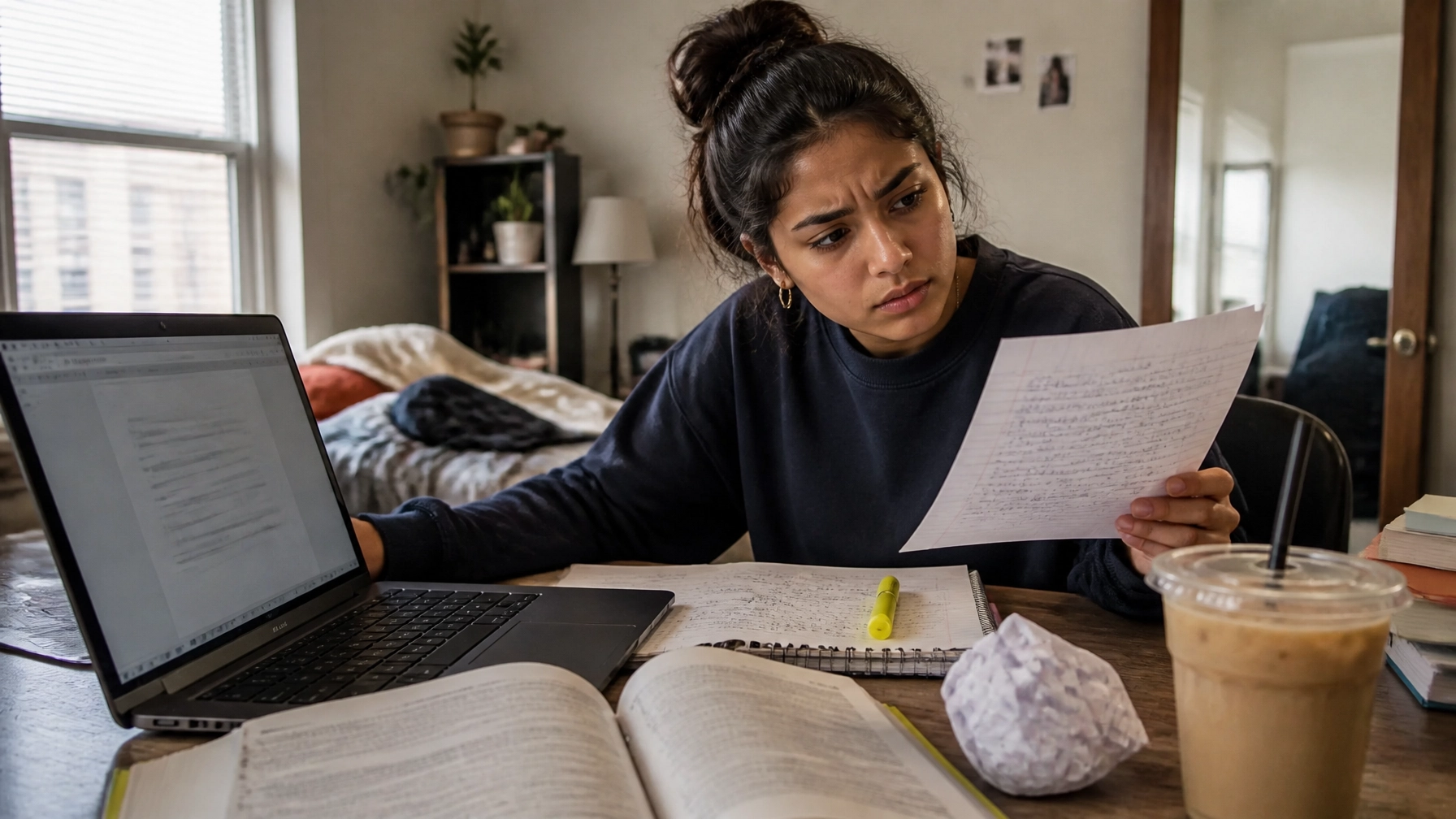
Learn why AI gives bad advice on college writing and why using it to write your paper can cause citation, accuracy, voice, and integrity problems.
Last updated: August 28, 2026
By Shannon Nicole
Table of Contents
This guide separates two questions students often blend together: why AI gives bad advice on college writing and why asking AI to produce academic work can create even bigger problems.
- Why AI gives bad advice on college writing
- Why AI-written academic work creates bigger problems
- AI advice versus AI-written work
- How to fact-check AI advice
- How human academic writing support protects quality
- Deep Dive: Why confident wrong answers are dangerous
- Safe ways to use AI as a study aid
- FAQ: AI advice and academic writing
- Let’s Get You That A!
Why AI gives bad advice on college writing
AI writing advice can be inaccurate because the tool may invent details, rely on outdated information, miss your instructor’s context, or sound certain when the answer is only a guess. It does not automatically understand your course readings, grading rubric, class discussion, or professor’s preferred citation rules.
Picture this: You are in a Houston apartment after a long shift, your paper prompt is open, and your iced coffee is mostly melted. You ask an AI tool how to structure your argument. The response looks polished. The headings seem smart. But one recommendation quietly ignores the requirement to compare two primary sources.
That is the trap.
AI may:
- Invent a journal article, quotation, page number, or author
- Confuse two similar theories or historical events
- Give outdated citation or formatting advice
- Treat a broad topic as if it were your exact assignment
- Recommend a five-paragraph structure for a paper that requires a literature review
- Rewrite your thesis until it no longer reflects your actual position
- Offer a confident answer without showing what needs verification
Before trusting AI advice, run this quick checklist:
- Does the advice answer your actual prompt?
- Does it match your syllabus and rubric?
- Can you verify each factual claim?
- Are the sources real and accessible through a library database?
- Does the recommendation support your course learning goal?
- Does the wording still sound like your meaning?
AI output can be a starting point for questions. It should not be your final authority.
Quick writing tip: Copy your prompt into a document, then underline the action words: analyze, compare, evaluate, explain, synthesize, or defend. Those verbs tell you what your professor is really asking you to do.
Why AI-written academic work creates bigger problems
AI-written academic work can create problems with accuracy, voice, learning, privacy, citations, and academic integrity. Even when the prose sounds smooth, it may not show your reasoning or satisfy the specific requirements of your class. A polished paragraph is not automatically a reliable academic argument.

When you ask AI to produce the paper instead of helping you understand the assignment, you hand over decisions that matter:
- Your analysis: The tool may make connections you cannot explain during a class conversation.
- Your evidence: It may attach a real-looking citation to a claim it never verified.
- Your voice: The writing may sound generic, overly formal, or unlike your normal work.
- Your privacy: Pasting personal experiences, unpublished research, client details, or sensitive coursework into an AI platform can create unnecessary privacy concerns.
- Your policy compliance: Each school, course, and instructor may set different rules for AI use.
There is also a learning cost. If AI writes your explanation of a theory, you may recognize the words without understanding the idea. That becomes painfully obvious when the next assignment asks you to apply the theory to a new example.
And no, this is not about fearmongering. AI detectors are not perfect, and no tool can promise that a particular paper will or will not be flagged. The stronger point is simpler: submitting writing you cannot defend, verify, or explain puts your academic progress on shaky ground.
SYA does not promote an AI detector bypass, beating Turnitin, or any form of evasion. Our focus is human academic writing support, editing, research organization, and reference materials that help you work responsibly within your school’s rules.
AI advice versus AI-written work
The key difference is whether AI supports your learning or replaces your thinking. Brainstorming questions, clarifying a concept, or identifying an unclear sentence may be permitted in some classes. Outsourcing your analysis, argument, or final prose can cross a policy line and leave you unable to stand behind the submission.
| Safer support when permitted | Riskier substitution |
|---|---|
| Asking for questions to help you study | Asking for the complete paper |
| Brainstorming possible keywords | Asking AI to invent a research argument |
| Practicing an outline you created | Using an AI-generated structure without checking the prompt |
| Identifying unclear sentences in your draft | Replacing your voice with a full rewrite |
| Requesting an explanation, then verifying it | Treating the explanation as course-authorized fact |
| Formatting references you already confirmed | Trusting fabricated citations or missing source details |
Policies vary. A tool allowed in one class may be prohibited in another. Check your syllabus, assignment instructions, learning platform, and instructor guidance before using AI.
For more context, read our guide on ethical literature review support and AI limits or see how human editing improves an AI-assisted draft.
How to fact-check AI advice
You can fact-check AI advice by tracing every important claim back to your course materials, library databases, primary sources, official documentation, or instructor guidance. Treat the AI response as an unverified suggestion, not as a scholarly source, citation, or substitute for research.
Use this five-step process:
- Return to the assignment prompt. Confirm the required format, source count, length, audience, and type of analysis.
- Check your course materials. Compare the advice with the syllabus, lecture slides, assigned readings, rubric, and announcements.
- Verify sources independently. Search your library database, Google Scholar, the publisher’s website, or a recognized academic catalog. Confirm the author, title, publication, date, volume, issue, pages, and DOI when available.
- Prefer primary and official sources. For policies, use the institution’s official page. For research claims, read the original study or scholarly source whenever possible.
- Ask what is missing. Does the AI answer ignore a limitation, opposing interpretation, required theorist, or local context?
The University of Kansas offers guidance on ethical AI use in writing assignments, and LibreTexts’ discussion of AI and college writing explains why fluent feedback can still be wrong.
Remember this line: AI output is not a source. It may point you toward a keyword, but the verifiable publication is what belongs in your research trail.
How human academic writing support protects quality
Human academic writing support protects quality by checking meaning, evidence, organization, formatting, and assignment fit together. A human consultant or editor can ask follow-up questions, notice missing context, preserve your voice, and explain why a change strengthens the paper instead of silently replacing your thinking.

At Submit Your Assignments, support can include:
- Consultation about a confusing prompt
- Brainstorming possible approaches
- A practical outline built around your requirements
- Research organization and source tracking
- Citation and reference-list review
- MLA, APA, or Chicago formatting support
- Editing for clarity, flow, grammar, and natural voice
- Custom reference materials and model papers for educational use
Our writers and editors work from the details you provide instead of pretending every assignment is interchangeable. That matters when your professor wants a comparison, your nursing instructor wants evidence-based reasoning, or your Houston class uses a department-specific format.
We also keep the pricing student-friendly, yes, we charge like a bird. You can explore custom academic writing services and learn more on our About Us page. Students nationwide look at our Google reviews and 94% average customer rating when deciding whether they can trust a support team.
Need a final quality check? Turnitin/Originality Reports are available for $5.00. You can also review the originality guarantee and ask about the Price Match Blitz. With that being said, no service can promise a grade. The goal is better preparation, clearer work, and peace of mind.
Deep Dive: Why confident wrong answers are dangerous in research writing
Confidently wrong AI advice is dangerous because it can make a weak premise look reasonable, reinforce confirmation bias, collapse important context, and create a chain of false citations. Polished wording can hide unreliable reasoning, so you must inspect the argument underneath the smooth sentences.
False premises
AI may accept the assumptions inside your question without challenging them. If your prompt assumes a policy began in a certain year or a study proved a particular outcome, the response may build on that mistake.
Confirmation bias
If you ask, “Why is my argument correct?” the tool may produce supporting points instead of testing the argument. Ask a stronger question: “What evidence would challenge this claim, and what should I verify?”
Citation chains
One invented citation can lead to another. A made-up article gets summarized in a second response, then appears in your reference list with a believable title. By submission time, the paper looks researched but rests on nothing solid.
Context collapse
A general explanation may be correct in one discipline and wrong in another. “Evidence” in a literary analysis is not handled exactly like evidence in a nursing research paper or a business report.
Polished wording versus reliable reasoning
Editing a sentence cannot repair a false claim. A cleaner paragraph is still weak if the source does not say what the paragraph claims. Always check the logic, evidence, and assignment fit before celebrating the grammar.
Safe ways to use AI as a study aid
You can use AI more responsibly as a limited study aid when your course permits it, especially for generating practice questions, brainstorming search terms, clarifying confusing concepts, or identifying sentences that need your own revision. You should verify the output and never assume permission to submit generated prose.
Try these lower-risk uses:
- Ask for quiz questions based on notes you already understand.
- Request multiple definitions, then confirm them in your textbook.
- Brainstorm library-search keywords: not sources to paste into your paper.
- Practice turning your own thesis into an outline.
- Ask which sentence in your draft seems unclear, then revise it yourself.
- Use it to identify questions you should ask your instructor or librarian.
Avoid entering confidential information. Save your drafts and research notes. Follow the policy for your specific class. If AI-generated writing is forbidden, do not ask it to produce the final paper, paragraph, discussion post, or personal statement.
For another practical perspective, read why AI struggles with large research uploads. Your best academic advantage is not a clever prompt. It is reliable evidence plus human judgment.
FAQ: AI advice and academic writing
These answers summarize the safest approach: use AI cautiously when permitted, verify everything important, protect your own voice, and follow your institution’s academic-integrity rules.
Can AI give bad advice about college writing?
Yes. AI can give bad advice about college writing because it may invent facts, provide outdated information, miss your instructor’s requirements, misunderstand context, or sound confident without reliable evidence.
Why is using AI to write my paper risky?
Using AI to write your paper is risky because the work may contain unsupported claims, fabricated citations, generic analysis, privacy concerns, or writing that violates your course’s AI policy. You may also struggle to explain or defend the submitted work.
Can I use AI for brainstorming or editing?
You may be able to use AI for brainstorming or editing when your instructor and institution permit it. Use it as limited support, verify its suggestions, keep your own reasoning and voice, and follow the exact policy for your assignment.
How should I check an AI-generated citation?
Check an AI-generated citation by searching for the source in your library database, the publisher’s website, Google Scholar, or an official catalog. Confirm that the author, title, date, publication details, quotation, page number, and DOI are real and match the claim.
Does AI output count as a reliable source?
AI output does not automatically count as a reliable source. Treat it as an unverified lead or study aid, then locate and cite the original scholarly, official, or primary source required by your assignment.
Can an academic writing service guarantee my grade?
No. No provider can guarantee a grade or academic outcome. A responsible service can provide consultation, editing, research organization, formatting, and custom reference materials, but your instructor controls the grade and you must follow your institution’s policies.
Let’s Get You That A!
Stop letting a confident chatbot send your paper into an academic plot twist. Check the facts. Protect your voice. Get human support when the prompt, sources, or formatting starts feeling like too much.
Whether you’re attending college in Houston, Dallas, Los Angeles, Atlanta, Chicago, or anywhere else in the U.S., our team is available to help.
- Text your Academic Success Advisor: 832-926-5551
- WhatsApp: https://wa.me/13466176123
- Call Only: 346-603-6340
- Email: info@submityourassignments.org
Visit Submit Your Assignments or contact us to discuss consultation, outlining, editing, citation support, or custom reference materials. Affordable help should still feel thoughtful, reliable, and human. That is the SYA promise: Human Excellence, student-friendly pricing, and more freedom to live your life without abandoning your academic responsibilities.
Submit Your Assignments
Submit Your Assignments provides custom reference materials and tutoring services for research and educational purposes only. We encourage all students to follow their institution's academic integrity policies.