You’ve been there before. It’s 2:00 AM on a Tuesday, and you’re staring at a laptop screen that seems to be mocking you. You have a mountain of research notes, a dozen open tabs on JSTOR, and a complex essay prompt that feels more like a riddle than an assignment. Your brain feels like a browser with fifty tabs open, and three of them are playing music you can’t find.
The pressure to "perform" academically while managing a job, a social life, and perhaps even a family is immense. Why does it feel like the more complex the topic, the more the structure falls apart? You know the information is in your head, but getting it onto the page in a logical, persuasive flow feels like trying to herd cats in a thunderstorm. This structural breakdown is often why professors flag papers for a lack of "cohesion" or "logical progression," which can be incredibly detrimental to your final grade.
But what if you could transform that chaos into a clear, academic roadmap? At Submit Your Assignments, we believe that writing shouldn't feel like a punishment. It should be a process of discovery. We’re here to act as your supportive ally, helping you navigate the treacherous waters of complex essay writing so you can get back to what really matters: living your life.
Quick Structural Wins for Immediate Relief
Before we dive into the deep end, let’s get you some quick air. If you are in the middle of a writing crisis right now, try these three things immediately:
- The Reverse Outline: Take what you’ve already written and write one sentence for each paragraph describing its main point. If the sentences don't flow logically, your paragraphs won't either.
- The "So What?" Test: Read your thesis statement. Ask yourself "So what?" If your body paragraphs don't answer that question, they aren't working for you.
- Color-Code Your Evidence: Highlight your claims in one color and your evidence in another. If a paragraph is all one color, you either have a "claim" with no proof or a "data dump" with no analysis.
The Thesis Statement: Your Architectural Blueprint
In any complex essay, your thesis is the North Star. Without it, you are just a traveler lost in the woods. Many students make the mistake of thinking a thesis is just a summary of what they will talk about. In reality, it is a blueprint for the entire structure.
A truly sophisticated thesis statement decomposes into several main claims. For example, if you are writing about the socio-economic impacts of renewable energy in urban areas, your thesis should naturally suggest the sections of your paper: economic costs, social equity, and urban infrastructure.
As we said earlier, if you can’t see the structure in your thesis, your reader won’t see it in your essay. By breaking your thesis down into sub-claims, you create a natural "skeleton" for your paper. This ensures that every point you make has a specific "home" in the document, preventing the rambling that often leads to academic frustration.

Choosing the Right Organizational Framework
Not all essays are built the same way. Depending on your subject matter, the "standard" five-paragraph structure might be entirely insufficient. To succeed with complex topics, you need to choose a framework that fits your content like a glove.
The Hierarchical Structure (Simple to Complex)
This is a favorite for technical or theoretical papers. You start with the most widely accepted or "simple" claims to build a foundation of trust with your reader. Once the basics are established, you move into the more nuanced, contentious, or complex arguments. This progression ensures the reader isn't overwhelmed by "heavy" concepts before they have the context to understand them.
Compare-and-Contrast: Block vs. Point-by-Point
When dealing with multiple subjects, you have two main choices:
- The Block Method: You discuss everything about Subject A, then move on to Subject B. This is great for shorter papers but can be detrimental to long-form essays because the reader might forget Subject A by the time they reach the end of Subject B.
- The Point-by-Point Method: You compare Subject A and B based on specific criteria (e.g., cost, efficiency, ethics) throughout the paper. This is much more effective for complex analysis as it keeps the comparison active in the reader's mind.
Spatial Order and Chronology
Sometimes, the best way to organize is through spatial order: arranging information based on physical location or the relationship between objects. This is particularly useful in geography, architecture, or even biological sciences. Alternatively, a chronological structure works best when the progression of time is the primary driver of your argument, such as in historical analysis or process descriptions.
Building Body Paragraphs That Actually Work
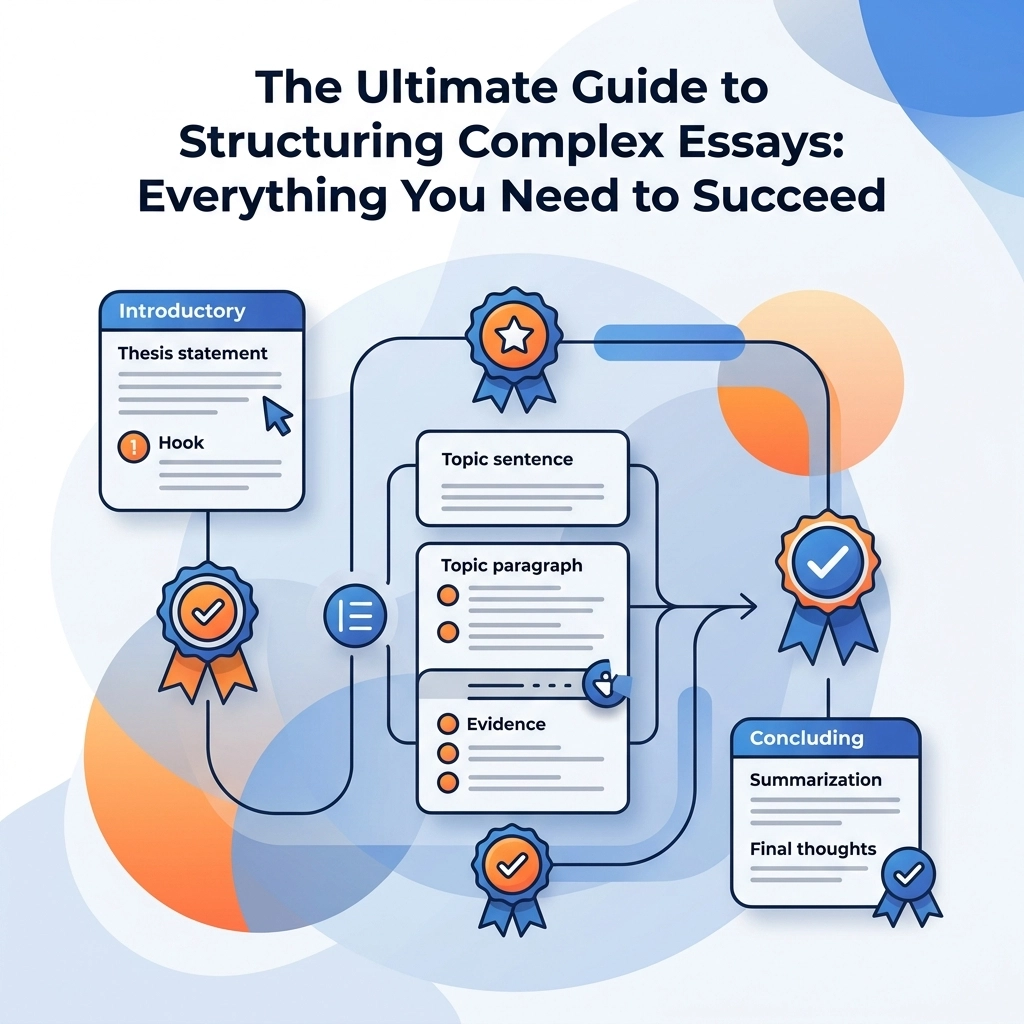
Each body paragraph in a complex essay should act as a self-contained mini-essay. If you want to ensure your paper is easy to read, follow a consistent internal structure for every paragraph.
- The Topic Sentence: This is your "mini-thesis." It should tell the reader exactly what this paragraph is proving.
- The Evidence: This is where you bring in your research, quotes, or data.
- The Analysis: This is the most important part. Why does this evidence matter? How does it prove your topic sentence?
- The Transition: Connect this idea to the next one. Use phrases like "In addition," "Conversely," or "Building upon this concept" to create a cohesive flow.
Does this sound like a lot of work? It can be! That is why many students look for foundational writing support to help them understand these patterns. Seeing a model paper or having a consultation on your outline can save you hours of trial and error.

Behind the Scenes: The "Submit Your Assignments" Workflow
You might wonder how professional writers handle these complex structures so effortlessly. It isn’t magic: it’s a disciplined workflow. When a student comes to us for a brainstorming session or asks for reference materials, our writers follow a strict process:
First, they engage in a deep-dive analysis of the prompt. They don't just read it; they deconstruct it to find the hidden requirements that professors often tuck away in the rubric. Next, they create a comprehensive outline before a single sentence of the "essay" is written. This ensures the logical flow is bulletproof.
We treat every assignment as a collaboration. We aren't just giving you a paper; we are providing a roadmap for how a high-level academic argument should be constructed. This educational approach helps you learn the "why" behind the structure, giving you the tools to tackle your next assignment with more confidence.
Managing Transitions and Flow
A plethora of great ideas can still result in a poor grade if those ideas aren't connected. Transitions are the glue of your essay. Without them, your paper feels like a collection of unrelated thoughts rather than a unified argument.
Rhetorical questions can be a powerful tool here. Ask the reader: "If these economic factors are so clear, why hasn't policy changed?" This guides the reader’s imagination toward your next section. Using a blend of conversational transitions and slightly formal vocabulary (like "consequently" or "furthermore") establishes your professional authority while keeping the text accessible.
Taking Back Your Freedom
Let’s be honest: you didn't go to school just to write essays. You went to learn, to grow, and to build a better future for yourself. When you’re buried under the weight of a complex paper, it’s easy to lose sight of that.
The goal of mastering essay structure isn't just to get an "A": it's to gain the freedom to live your life. When you know how to structure a paper efficiently, you stop staring at the screen for hours. You get your weekends back. You get your peace of mind back.
If you’re feeling overwhelmed, remember that you don’t have to do this alone. Whether you need an overview of a specific topic or help understanding how much an order might cost for a model paper, support is available. Stop worrying about the "how" and start focusing on your "why."

Checklist for Structural Success
Before you hit "submit," go through this final checklist to ensure your complex essay is ready for prime time:
- Thesis Check: Does my thesis provide a clear roadmap for the paper?
- Framework Match: Did I choose the best organizational style (e.g., chronological, point-by-point)?
- Topic Sentences: Does every paragraph start with a clear claim?
- The "So What?" Factor: Is the relevance of every paragraph explicitly stated?
- Transition Flow: Are there smooth bridges between my ideas?
- Conclusion Strength: Does my conclusion synthesize my points rather than just repeating them?
Fun Facts & Local Touches
- Did you know that the word "essay" comes from the French word "essayer," which means "to try" or "to attempt"? Every paper you write is an attempt to explore an idea!
- Our team is based near the heart of the space industry in Houston (Nassau Bay), so we know a thing or two about complex systems and precision!
- Research shows that taking a 15-minute walk can increase creative output by up to 60%: so if you’re stuck on your structure, go outside!

Writing a complex essay is a challenge, but with the right structure, it becomes a manageable task. Trust your voice, follow your blueprint, and remember that we are always here to help you bridge the gap between "stuck" and "succeeding."
Submit Your Assignments provides custom reference materials and tutoring services for research and educational purposes only. We encourage all students to follow their institution's academic integrity policies.