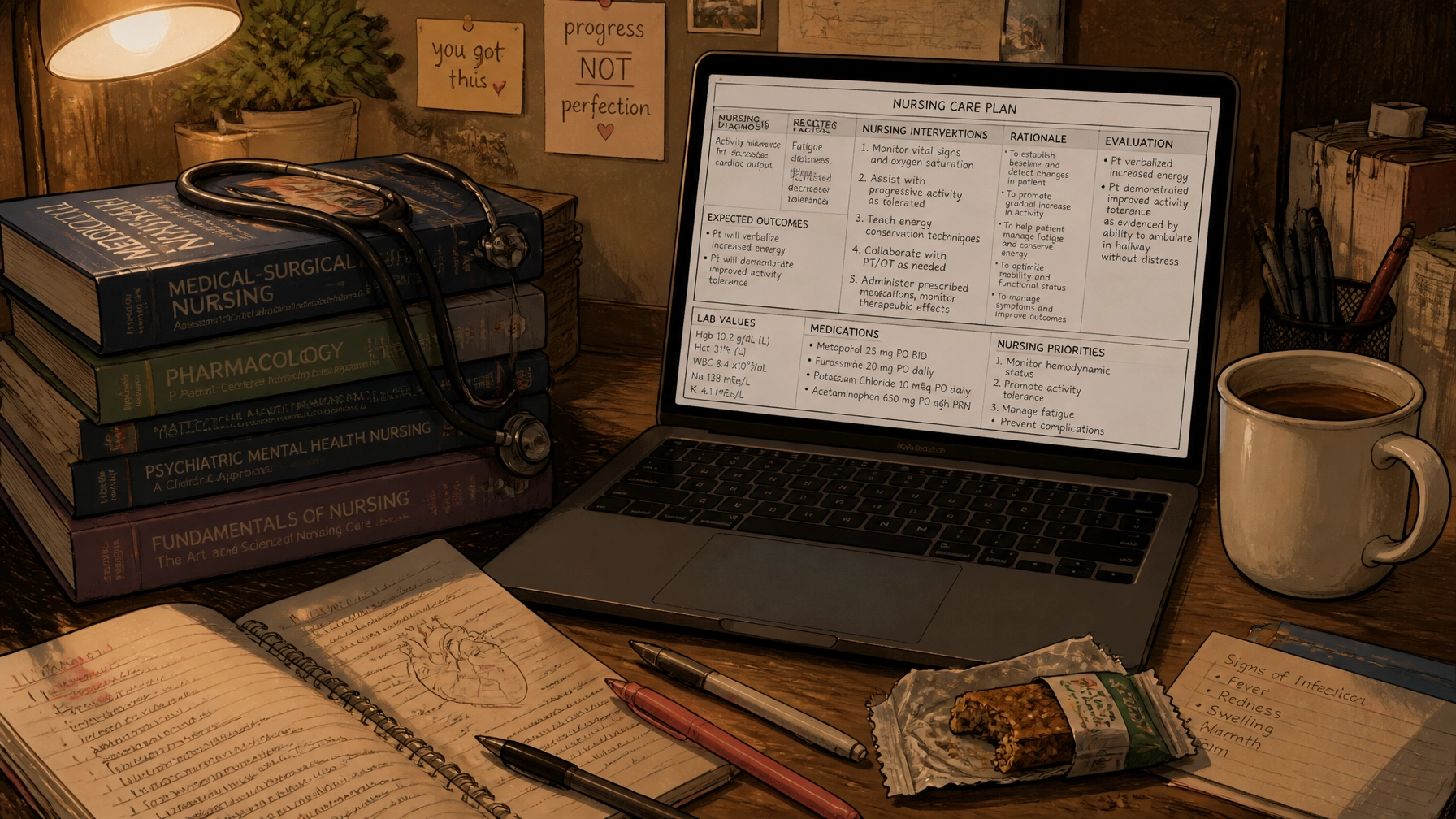
You’ve had a twelve-hour clinical shift at John Sealy Hospital. Your feet are throbbing, you’ve probably inhaled more hand sanitizer than actual oxygen, and your brain feels like it’s been through a blender. All you want to do is collapse into bed and scroll TikTok until you pass out. But then you remember: the Care Plan is due.
We’ve all been there. The ADPIE struggle is real, especially when you’re staring at a blank template trying to figure out why your patient’s fluid volume deficit is more important than their risk for falls. At the University of Texas Medical Branch (UTMB), the standards are high, and the rubrics are… well, they’re specific.
It’s easy to feel like you’re just checking boxes, but one wrong NANDA diagnosis or a vague intervention can turn an "A" into a "re-do real quick." If you’re feeling the grind, don’t worry. We’ve seen every mistake in the book.
Before we dive into the pitfalls, here are a few quick wins to keep in your back pocket:
- The "So What?" Test: For every intervention you write, ask "So what?" If the answer isn't "Because it directly helps the patient reach Goal X," delete it.
- Frequency is King: Never just write "Monitor." Write "Monitor BP every 4 hours."
- Cite or it Didn't Happen: If your rationale doesn't have a source, it's just an opinion. And professors hate opinions in care plans.
Ready to stop the grading bleed? Let’s talk about the seven most common mistakes UTMB nursing students make and how to fix them before you hit "submit."
1. The "Medical Diagnosis" Trap
This is the #1 point-killer. You see a patient with Congestive Heart Failure, so you write "Congestive Heart Failure" as your nursing diagnosis. Buzzer sound.
Nursing diagnoses aren't medical diagnoses. A doctor treats the CHF; a nurse treats the human response to the CHF. Instead of the medical label, look for the functional problem. Is the patient short of breath? That’s Impaired Gas Exchange. Are they swollen? That’s Excess Fluid Volume.
How to fix it: Always keep your NANDA-I book (or a reliable nursing diagnosis guide) open. If it’s not a recognized NANDA label, don’t use it. Frame it as: [Diagnosis] related to [Pathophysiology] as evidenced by [Your Assessment Data].
2. Vague Interventions (The "Monitor" Fever)
If I had a nickel for every time a student wrote "Monitor patient’s status" or "Educate patient on health," I’d be retired on a beach in Galveston right now.
UTMB professors want to see that you know exactly what you’re doing when you walk into that room. "Monitor" is a ghost word. It doesn’t tell the reader anything.
How to fix it: Be annoyingly specific. Instead of "Monitor vitals," try: "The nurse will assess and record apical pulse and blood pressure every 2 hours and PRN for complaints of dizziness." This shows you know the what, the who, and the how often.

3. Rationales That Lack Scientific "Vibes"
You know the feeling: you’ve written a great intervention, and now you have to explain why you’re doing it. You might be tempted to write: "Because it’s good for the patient."
Yeah… don't do that.
A rationale needs to be backed by pathophysiology or evidence-based practice. It’s the "science" part of the "art and science of nursing." If you can't explain the physiological mechanism behind why turning a patient every two hours prevents pressure ulcers, you're going to lose points.
How to fix it: Use your textbooks! Link the action to a physiological outcome. Example: "Turning the patient redistributes pressure away from bony prominences, maintaining capillary blood flow to the tissues and preventing ischemic necrosis." Now that sounds like a UTMB nurse.
4. Goals That Aren't "SMART"
We’ve all written a goal like "The patient will feel better by the end of the shift." It’s wholesome, sure, but it’s not measurable. How do we measure "better"? Is it a vibe? A smile? A thumb's up?
How to fix it: Stick to the SMART acronym: Specific, Measurable, Attainable, Relevant, and Time-bound.
- Bad Goal: Patient will walk more.
- Good Goal: “The patient will ambulate 50 feet in the hallway with the assistance of one staff member and a walker by 1400 today.”
See the difference? You can check a box on that second one.
5. Forgetting the "E" in ADPIE
You spent so much time on the Assessment and the Interventions that by the time you get to Evaluation, you're exhausted. Many students just write "Goal met" and call it a day.
But Evaluation is where you prove you’re actually thinking. If the goal was for the patient to have a pain level of 3/10 and they’re still at a 7/10, writing "Goal met" is a lie.
How to fix it: Use the data you gathered. If the goal wasn't met, explain why and what you’re going to change. "Goal partially met. Patient reported pain at 5/10 after medication. Nurse will consult with the provider regarding a change in PRN dosage." This shows clinical judgment, which is exactly what your instructors are looking for.

6. Ignoring Psychosocial and Cultural Needs
Nursing isn't just about pills and IV pumps. If your care plan only focuses on the physical, you’re missing half the patient. UTMB emphasizes holistic care. If your patient is terrified of surgery or can’t afford their meds after discharge, and you don't address that, your care plan is incomplete.
How to fix it: Throw in a diagnosis like Anxiety or Deficient Knowledge. Address their support system. If they need a translator, make that a nursing intervention. It shows you see the human, not just the room number.
7. The "Copy-Paste" AI Trap
Look, we get it. AI is tempting when it’s 3 AM and your eyes are crossing. But here’s the tea: AI-generated care plans often sound like they were written by someone who has never stepped foot in a hospital. They use generic interventions that don't match your actual patient's assessment data. Professors can spot a "ChatGPT-special" from a mile away because it lacks the specific clinical nuances of a real UTMB clinical day.
How to fix it: If you’re stuck, use a service that actually understands nursing. Our team at Submit Your Assignments includes writers with actual healthcare backgrounds. We don't just "generate" text; we help you with brainstorming clinical rationales and editing your care plans to make sure they hit every mark on that UTMB rubric.
Why the Grind is Worth It
Nursing school is a marathon, not a sprint. Every care plan you struggle through is building that "nurse brain" you’ll need when you’re finally out there on the floor. But that doesn't mean you have to do it alone.
Whether you need someone to double-check your APA citations (because those change more often than the Texas weather) or you need professional essay writers in Houston to help you structure a complex research paper, we’ve got your back. We’ve helped thousands of students in the Houston and Galveston area navigate the stress of nursing school so they can actually get some sleep.
With that being said, don't let a care plan break your spirit. You’re going to be a great nurse. Sometimes you just need a little assist on the paperwork.
Fun Facts for the Galveston Crowd:
- The Original: UTMB was the first medical school in Texas, opening in 1891.
- Survivor Status: Old Red (the iconic red brick building) survived the 1900 Great Storm. If that building can survive a hurricane, you can survive this semester.
- Coffee Fix: If you’re pulling an all-nighter, the local coffee scene in Galveston is top-tier. Mod Coffeehouse is a vibe for focused study sessions.

Stop worrying about the "perfect" wording and start focusing on your patients. If the paperwork gets to be too much, trust our writers to help you outline and research your way to success. You’ve got the heart for nursing; let us help you with the rest.
Listen up: Your GPA is important, but your mental health is vital. Take a breath, grab a coffee, and let's get this care plan done.
Submit Your Assignments provides custom reference materials and tutoring services for research and educational purposes only. We encourage all students to follow their institution's academic integrity policies.