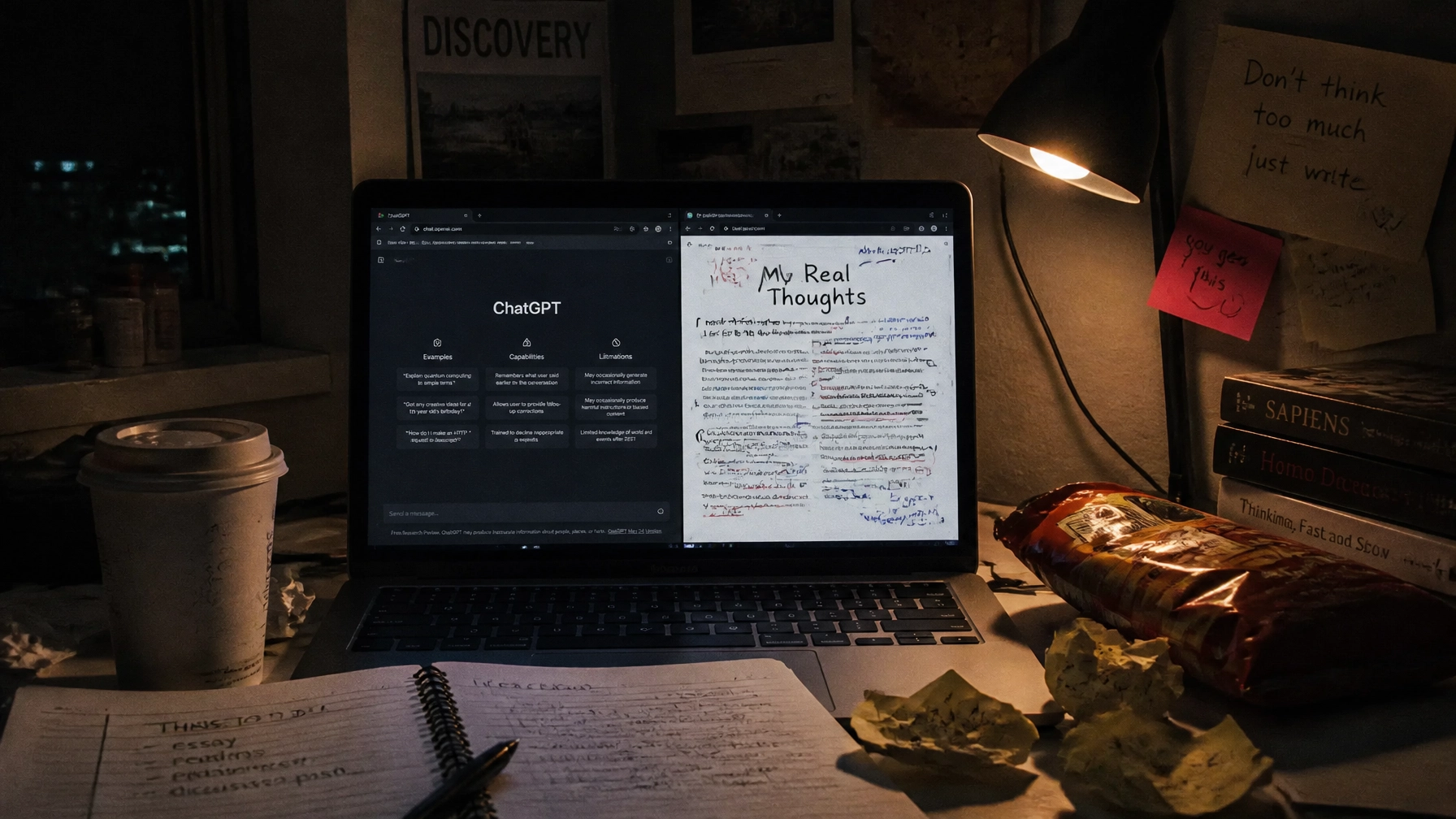
It’s 2:00 AM. You’ve been staring at a blank Google Doc for three hours, and that 2,000-word essay on "The Socioeconomic Impact of the Industrial Revolution" isn't going to write itself. In a moment of pure, caffeine-fueled desperation, you open ChatGPT.
"Write a high-level academic essay about…"
The cursor flies. The words look perfect. You copy, you paste, you submit. But then, as you’re trying to fall asleep, a cold sweat hits you. Wait, can my professor actually tell?
Short answer: Yes, they usually can. And no, it’s not just because they’re using fancy AI detectors (though they have those too). Professors read hundreds of papers every semester. They know when a student’s "voice" suddenly sounds like a polite, hyper-intelligent toaster.
Before we look at why you’re getting flagged, let’s get you some quick wins. If you're currently staring at a robotic-sounding draft, here are three things you can do right now:
- Vary your sentence length. AI loves medium-length sentences. Break them up. Use a short, punchy sentence. Then follow it with a longer, more complex one.
- Delete the "Transitions of Doom." If your paper says "In conclusion," "Furthermore," or "It is important to note," delete them. Replace them with how you’d actually transition in a conversation.
- Add a "Me" moment. Mention a specific lecture or a weirdly specific detail from your assigned reading that a bot wouldn't know.
1. The "Robo-Voice" (Voice Mismatch)
Your professor has read your emails. They’ve seen your discussion board posts. They know you don't naturally say things like "The multifaceted nature of this paradigm suggests a shift in societal norms."
When you go from writing "The economy was bad back then" in Week 1 to "The fiscal landscape suffered a catastrophic downturn" in Week 8, it’s a massive red flag. Professors aren't looking for perfection; they're looking for you. AI writing is "beige", it’s safe, it’s smooth, and it has absolutely zero personality. It’s like eating a meal replacement shake instead of a home-cooked dinner. It gets the job done, but it’s soul-less.
2. The Pattern Trap
AI doesn't "think." It predicts the next most likely word in a sequence. Because of this, it follows very predictable mathematical patterns.
Human writing is messy. We repeat ourselves sometimes. We use slang. We have weird rhythm quirks. ChatGPT, on the other hand, writes with a "Perplexity" and "Burstiness" that is unnaturally consistent. If every single paragraph is exactly five sentences long and starts with a clear topic sentence followed by three supporting points and a summary… yeah, they’re going to know.

3. "Hallucinations" (Fake Citations)
This is the big one. AI is a notorious liar. If you ask it for a source, it might give you a title that sounds real, an author that exists, and a page number that seems plausible. But when your professor goes to look it up? Poof. It doesn't exist.
There is nothing that makes a professor's detective-mode activate faster than a citation they can't find. Once they catch one fake source, they’re checking every single comma in your paper. Trust us, "The machine made it up" is not a defense that holds water in an academic integrity hearing.
4. The Vague-Book Problem
AI writing is great at summarizing broad topics, but it’s terrible at being specific. If your prompt was "Write about nursing ethics," the bot will give you a very nice, very generic overview.
What it won't include is that specific case study your professor talked about in Tuesday's Zoom call. It won't mention the "unspoken rules" of your local hospital that you were supposed to analyze. If your paper sounds like it could have been written for any university in the world, it probably wasn't written for your class.
5. AI Detectors (The Tech Factor)
And yes, there’s the tech. Turnitin, GPTZero, and Originality.ai are getting scary good. They don't just look for copied text; they look for the "DNA" of AI-generated content. Even if you use a "humanizer" tool (which, let's be real, usually just makes the grammar worse), these detectors can often sniff out the underlying structure.
How to Actually Humanize Your Work
If you want your work to be bulletproof, you have to put the "human" back into it. This means:
- Use your own research: Actually go to the library (or the digital database) and find real PDFs.
- Tell a story: Use a personal anecdote or a specific example that requires actual lived experience.
- Break the rules: Start a sentence with "And" or "But." Use a rhetorical question. Make the writing feel like a conversation between you and the reader.
With that being said, we know the grind is real. Between work, life, and trying to maintain some semblance of a social life, sometimes you just need a professional academic ally.
The SYA Human Authenticity Promise
At Submit Your Assignments, we don't believe in the "AI shortcut." We’ve seen too many students get flagged for submitting robotic, hallucinated content. That’s why we created the SYA Authenticity Promise.
When you work with us, you aren't getting a bot-generated draft. You’re getting a custom-written model paper crafted by a human writer who actually understands your assignment prompt.

Every major assignment we deliver comes with our Certificate of Human Authenticity. It’s our formal guarantee that your work is 100% human-researched, human-structured, and human-written. No bots. No hallucinations. No "beige" writing. Just real academic rigor that gives you total peace of mind.
As we said earlier, our goal is to help you "Write Like A Guru" while we "Charge Like A Bird." We keep our prices student-friendly because we know that everyone deserves a little help to get through the semester without losing their mind.

Stop worrying about Turnitin reports and start living your life. Whether you need a brainstorming partner, an outline, or a full research paper to use as a reference, we’ve got your back.
5 Fun Facts About the Student Grind
- The "All-Nighter" Myth: Research shows that your brain is actually less productive after 17 hours of being awake: about the same as being legally drunk.
- Coffee vs. Tea: Most college students prefer coffee, but green tea actually provides a more stable "caffeine high" without the jittery crash.
- The "Library Effect": You’re 40% more likely to finish a task if you’re in a dedicated study space rather than your bed.
- Pencil Power: Writing your notes by hand helps you retain 25% more information than typing them on a laptop.
- The SYA Rating: Our students love us! We have a 94% average satisfaction rating because we actually care about your success.

Ready to get that "A" without the AI anxiety? Click here to get your custom assignment today!
Submit Your Assignments provides custom reference materials and tutoring services for research and educational purposes only. We encourage all students to follow their institution's academic integrity policies.