
You know the drill. The paper is assigned. The deadline is real. You have the research, the notes, maybe even a rough idea of what you want to say. But when you sit down to write, nothing happens. Your fingers hover over the keyboard. Your brain feels like it’s buffering. You check your phone, grab a snack, reorganize your desk, and suddenly three hours have vanished. The blank page is still blank, and now you’re panicking.
Table of Contents
Why Starting Feels Impossible (And Why That’s Not Your Fault)
When You’ve Tried Everything and the Cursor Is Still Blinking
Here’s the thing: that isn’t laziness. It isn’t a character flaw. It’s how an ADHD brain often responds to a task that feels big, vague, or emotionally heavy. The good news is that there are ADHD-friendly strategies that respect how your brain actually works, not how you think it should work. We’ve gathered the ones that help most when you’re stuck in that awful gap between needing to write and being able to start.
Why Starting Feels Impossible (And Why That’s Not Your Fault)
There’s a name for that stuck feeling: task initiation paralysis. It’s the gap between wanting to do something and being able to make your brain and body actually begin. For students with ADHD, that gap can feel like a canyon. You’re not avoiding the paper because you don’t care. You’re stuck because your brain’s “go” button isn’t responding, and no amount of self-criticism will force it to work.

Part of the problem is something researchers call time blindness. Russell Barkley, a leading ADHD researcher, describes it as “temporal myopia,” or nearsightedness to time. A paper due in two weeks feels like a problem for future you, and future you is apparently a completely different person who has everything figured out. Spoiler: future you is just you, but with less time and more panic.
The shame spiral makes everything worse. Adults with ADHD are more likely to fall into self-blame and catastrophizing when they’re stressed. You tell yourself you’re irresponsible. You imagine failing the class. You decide you’re just not cut out for college. That emotional storm makes the blank page feel even more threatening. But here’s the truth: the strategies below are designed for your brain, not against it. You don’t need more willpower. You need a different approach.
Set Up Your Environment Before You Need It
Create a “Launch Pad” for Your Workspace
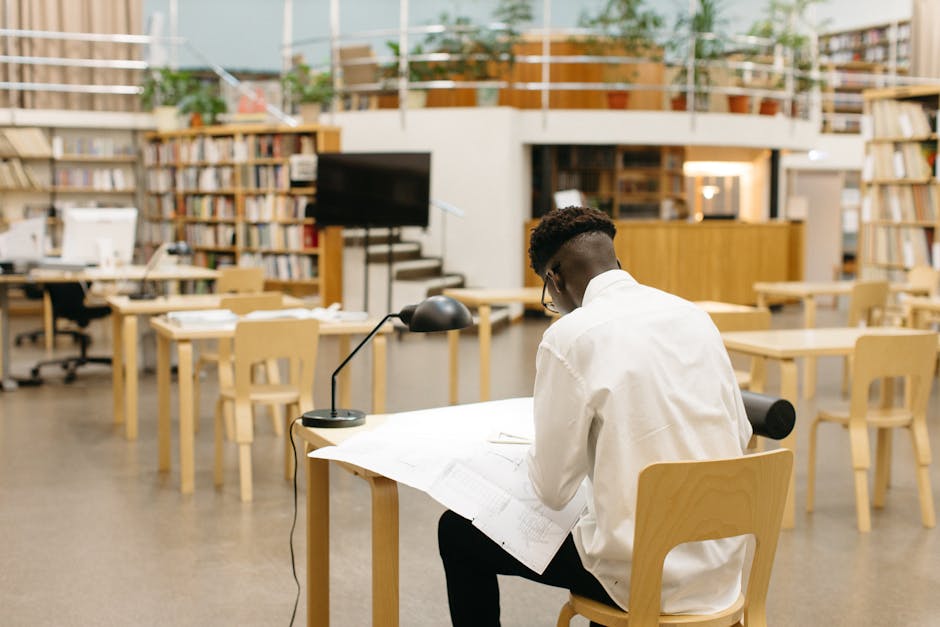
Your environment matters more than you think. If your writing spot is the same place you scroll TikTok or watch Netflix, your brain already associates that space with relaxation and distraction. Pick one physical spot for writing. Not your bed. Not the couch. A desk, a library carrel, a kitchen table, anywhere that signals “work happens here.”
Clear that space before you sit down. Not during, when you’ll get distracted by old receipts, stray pens, and that half-finished energy drink from last week. Use the “Only Handle It Once” principle, often called O.H.I.O. If you pick up a paper, deal with it right then: file it, toss it, or act on it. Don’t set it aside to deal with later, because later never comes.
Keep your launch pad stocked with everything you need. Charger, water bottle, headphones, notebooks, whatever. The goal is zero friction between sitting down and starting. If you have to hunt for a pen or search for your charger, you’ve already given your brain an excuse to wander off.
Make Your Phone Work FOR You, Not Against You
Let’s be honest: your phone is the enemy of your paper. It’s designed to hijack your attention, and it’s very good at its job. The solution isn’t willpower. It’s distance. Put your phone in another room. Not on silent. Not face down. In another room. Yes, really.
If that feels too extreme, use app blockers or switch your phone to grayscale mode. Grayscale makes the screen less visually appealing, which reduces the dopamine hit you get from scrolling. Set a single timer for 10 minutes. Not for the whole paper. Just for getting started. Ten minutes is short enough to feel safe and long enough to get a few sentences down.
The “Stepped Dopamine Path” Morning Boost
Your brain needs dopamine to initiate tasks, and ADHD brains often run low on it. That’s why starting with something enjoyable can help. Think of it as a “stepped dopamine path.” Before you tackle the hard thing, give your brain a small win. Listen to a song you love. Watch a funny video. Sit in the sunlight for a few minutes. This raises your alertness and makes the transition to work feel less jarring.
Pair that with movement. Even five minutes of stretching or a quick walk around the block increases dopamine availability in the brain. You wouldn’t run a mile without warming up. Don’t expect your brain to write a paper without a warm-up either.
Break the Paper Into Pieces So Small They’re Embarrassing
The “Just the Title” Trick
The whole paper is overwhelming. So don’t think about the whole paper. Think about one tiny piece. The title. The first sentence. A single bullet point. Make the goal so small it feels almost silly. “I’m just going to write three words.” That’s it. Three words.
Silly goals are achievable goals. And once you start, momentum often carries you further. You write three words, then five more, then a whole sentence. But if it doesn’t? If you write three words and stop? You still won. You started. That’s the hardest part, and you did it.
Use the Pomodoro Technique (But Make It ADHD-Friendly)
You’ve probably heard of the Pomodoro Technique: 25 minutes of work, 5 minutes of break. It’s a classic for a reason, but 25 minutes can feel like an eternity when your brain is fighting you. So adapt it. Try 10 minutes of writing, 5 minutes of anything you want. Repeat.
The key is the timer, not the length. Timers make time visible, which helps with time blindness. Use a physical timer or a visual one, like a Time Timer, so you can actually see time passing. When you can see the red wedge shrinking, the abstract concept of “10 minutes” becomes real.
The “Ripening Drawer” Approach to Research
Research can be its own form of paralysis. You have 12 articles to read, and you feel like you can’t write a single sentence until you’ve read them all. That’s a trap. Instead, adapt the “ripening drawer” concept. Dump all your sources into one document or folder. Skim when you can. Highlight randomly. Don’t force structure.
Let the material ripen. Your brain will do unconscious processing in the background. When you’re ready to write, the sources are there waiting, and you’ve already absorbed more than you realize. This reduces the overwhelm of “I have to read everything before I can write anything.”
Body Doubling and Other Accountability Tricks
Body doubling is exactly what it sounds like: working alongside another person who is also working. They don’t have to be doing the same thing. They just have to be present. In person or virtually, the presence of another person creates gentle accountability without pressure.
Why does it work? Because having a witness to your effort makes it harder to drift off into distraction. You don’t want to be the person scrolling Instagram while your friend is typing away. It’s not surveillance. It’s support.
Try a study group, a library session, or a virtual body-doubling platform. Or keep it simple: text a friend and say, “I’m writing from 2 to 3 PM. Check on me after.” Then send them your goal. “I’m going to write my intro paragraph.” When it’s done, text them again. The check-in text strategy works because it makes your goal external. It’s no longer just a thought in your head. Someone else knows what you’re trying to do, and that makes it real.
Work With Your Brain’s Schedule, Not Against It
Find Your “Prime Time”
ADHD brains often have irregular circadian rhythms. Your roommate might be a morning person who writes best at 8 AM. You might not. And that’s fine. Track your energy for a few days. When do you feel most alert? When does your brain feel clearest?
Schedule writing during your prime time, even if that’s 10 PM or 4 AM. Fighting your body’s natural rhythm is a losing battle. Working with it is how you win. If your brain comes alive at midnight, write at midnight. The paper doesn’t care what time it is.
The “Alternating Course Load” Principle for Daily Tasks
College advisors sometimes suggest alternating harder and easier classes across different days. You can apply the same idea to your daily tasks. Pair a hard task with an easier one. Write for 15 minutes, then do something low-effort: fold laundry, answer emails, wash a few dishes. Then write again.
This gives your brain natural breaks and small dopamine hits without the guilt of “wasting time.” The break task is still something. You’re not just scrolling. You’re moving forward, just in a different lane for a few minutes.
When You’ve Tried Everything and the Cursor Is Still Blinking
Sometimes, despite every strategy, your brain just won’t cooperate. You’ve set up your launch pad, you’ve broken the paper into tiny pieces, you’ve tried body doubling, and the cursor is still blinking at you like a tiny, judgmental metronome. That’s okay. It happens.
This is where asking for help isn’t failure. It’s smart resource management. At Submit Your Assignments, we started this service because we’ve been in those 2 AM trenches ourselves. We know what it’s like to stare at a blank page and feel your chest tighten. Sometimes you need a teammate, not another strategy. The way you’d ask a friend to help you move a couch, you can ask for help with a paper. Using a writing service isn’t cheating. It’s outsourcing a task your brain is struggling with, the same way you’d hire a tutor for calculus. If you’re stuck, Submit Your Assignments is here to help you get unstuck.
Final Thoughts: Give Yourself Some Grace
Starting is the hardest part. These ADHD-friendly strategies are designed to make starting possible, not perfect. You won’t do all of them every time, and that’s fine. Pick one. Try it. See what happens.
ADHD isn’t a character flaw. It’s a brain difference, and you can work with it instead of against it. You’ve got this. And when you don’t, we’ve got you. If you want to know more about why we started this whole thing, read our story.