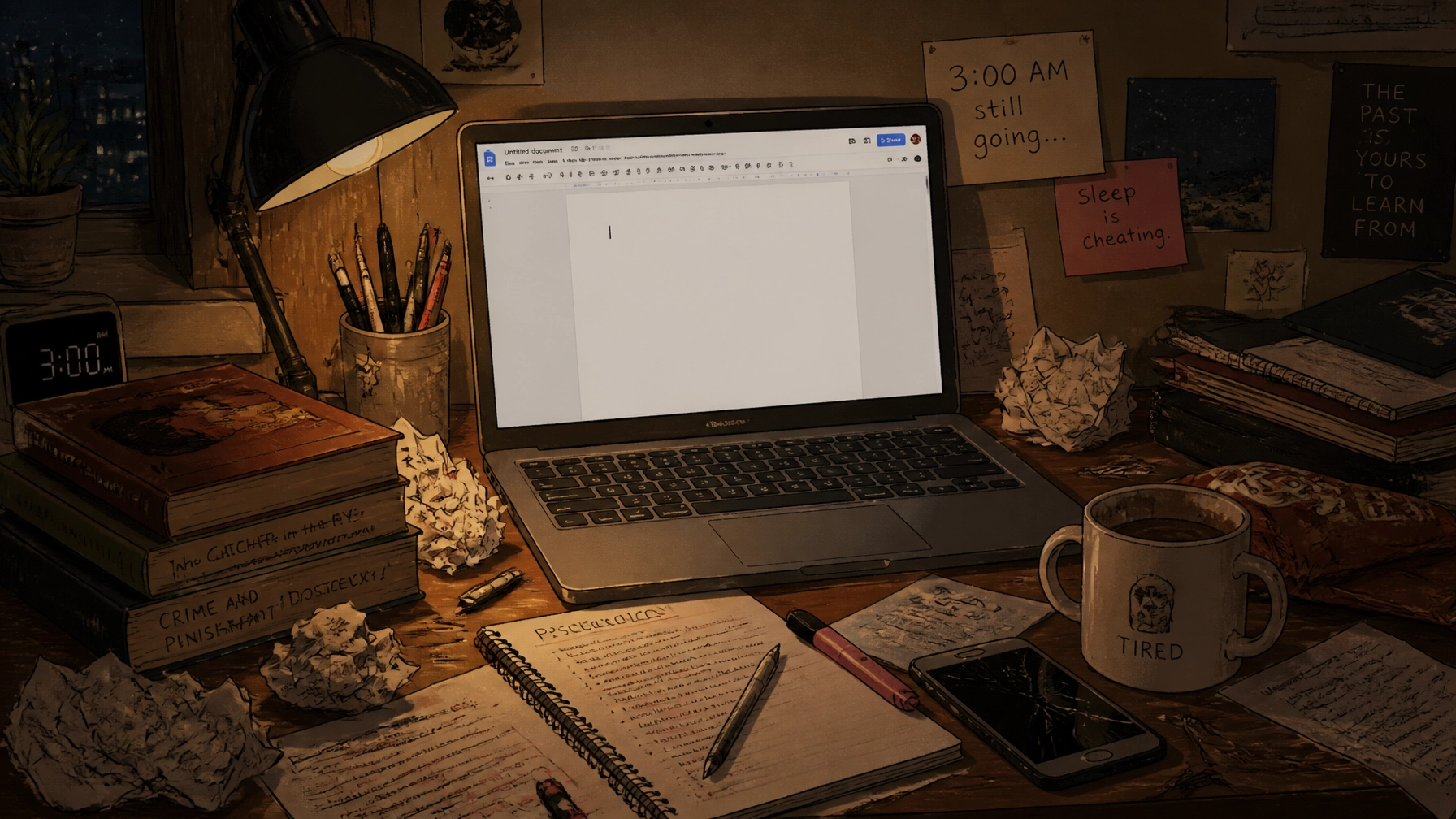
It’s 3:00 AM. You’ve been staring at that blinking cursor for forty-five minutes, and honestly? The cursor is winning. You finally managed to vomit out about a thousand words of what feels like pure, unadulterated nonsense. You read it back and think, “If my professor sees this, they’re going to call my parents.”
We’ve all been there. The "Word Vomit" phase of an essay is the most painful part of the grind. But here’s the thing: you can’t fix a blank page. A bad draft is actually a huge win because it means the hard part: getting the ideas out of your head and into the world: is over. Now, you just have to stop staring and start editing.
But how do you actually fix a mess without just deleting everything and starting over in a fit of rage?
The Quick Fix: 3 Writing Tips for the Panic-Stricken
Before we get into the deep-tissue massage of editing, here are three things you can do right now to make that draft suck less:
- Kill your darlings. If you have a sentence that sounds super fancy but makes zero sense in the context of your argument, delete it. It’s better to be clear than to sound like a 19th-century philosopher who hasn't had his coffee.
- Ctrl+F for "This." If a sentence starts with "This shows…" or "This is why…", ask yourself: what is this? Be specific. "This data shows…" or "This specific policy is why…" makes you look 10x more organized.
- Check your intro last. Most students spend three hours writing the perfect first paragraph, only to realize the rest of the paper went in a completely different direction. Skip the intro for now. Write the meat, then come back and tell us what the sandwich is about.
Editing vs. Proofreading: Why They Aren’t the Same Vibe
Most people use these words like they’re the same thing, but if you treat them that way, your grades are going to feel it.
Academic Editing is the "big brain" work. It’s about the structure, the logic, and the flow. If your essay were a house, editing is making sure the kitchen isn’t in the bathroom and that the roof isn't made of wet cardboard. It’s where you move whole paragraphs around and realize your thesis statement is actually hidden at the bottom of page three.
Proofreading is the "last coat of paint" work. This is where you fix the typos, the "its" vs "it's" disasters, and the citations that you definitely made up at 4 AM.
If you try to proofread before you edit, you’re basically painting a house while it’s still on fire. Stop worrying about commas until you know your argument actually makes sense.

The Reverse Outline: Finding the Skeleton
When your draft is a hot mess, you need to see the "skeleton" of what you actually wrote. This is called a reverse outline.
Take a separate piece of paper (or a new doc) and write down one sentence for every paragraph you’ve already written. That sentence should summarize the main point of that paragraph.
Once you’re done, look at that list.
- Does the order make sense?
- Did you talk about the same thing in paragraph two and paragraph six? (If so, mash them together!)
- Does every single point actually support your main thesis?
If a paragraph doesn’t have a clear point, it’s just filler. And professors can smell filler from a mile away. It’s usually what leads to those "vague" or "unclear" comments that make us want to scream.
Why Professors Flag AI (And How Editing Saves You)
Let's be real: everyone is talking about AI. But have you noticed how AI-generated text often feels… hollow? It’s usually full of words like "delve," "comprehensive," and "pivotal," but it says a whole lot of nothing. Professors flag papers when the "voice" doesn't sound human.
When you do a heavy academic editing pass, you’re adding your own unique human logic to the mix. You’re connecting dots that a machine doesn't see. You’re adding that specific "you" flavor. If you’re worried about your tone sounding too clinical or "AI-ish," our team specializes in AI-safe revision. We help you keep the structure solid while making sure it sounds like a real person wrote it: because a real person did.
The Rubber Duck and the Read-Aloud Test
This is the part where you’re going to look a little crazy, but trust me, it works. Read your essay out loud. Not in your head: actually move your lips and make noise.

When we read silently, our brains "auto-correct" our mistakes. We see what we meant to write, not what’s actually there. When you read out loud, your ears will catch the awkwardness. If you run out of breath in the middle of a sentence? That sentence is too long. If you stumble over a phrase? It’s confusing.
If you’re embarrassed to talk to yourself, talk to a rubber duck. (It’s an old coding trick called "Rubber Duck Debugging.") Explain your argument to the duck. If the duck doesn't get it, neither will your professor.
How We Handle the Heavy Lifting
At Submit Your Assignments, we know the struggle is real. We don't just "fix typos." Our writing assistance and coaching are about helping you find the best version of your work.
Our owner, Shannon Caldwell, started this service because her late brother, Bryan, knew that sometimes students just need a little extra support to get over the finish line. Shannon has personally helped over 600 clients, and seeing them graduate is what keeps us going.
We have 17 active writers and editors who work around the clock. They aren't robots; they’re people who actually love this stuff (weird, right?). Whether you need a full academic support overhaul or just someone to look over your research papers, we’ve got you.
And because we know you’re on a budget, we always "Charge like a bird."
What does that mean? Cheep, cheep! Our pricing is designed to be student-friendly because we believe you shouldn't have to choose between a good grade and being able to afford lunch.

A Quick Checklist for Your Next Edit
Before you hit "submit" and close your laptop with the force of a thousand suns, run through this:
- The Thesis Check: Is my main argument in the first two paragraphs?
- The "So What?" Factor: Does every paragraph explain why the information matters?
- The Flow: Are there transitions like "With that being said" or "In contrast" to help the reader follow along?
- The Citation Hunt: Did I give credit for every single idea that isn't mine? (Seriously, don't skip this).
Stop Worrying and Get Some Sleep
You don't have to do this alone. If the staring-at-the-screen phase is lasting longer than the actual writing phase, let’s talk. We provide the reference materials and the tutoring support you need to turn that "trash draft" into something you're actually proud of.
Trust our editors to give you that peace of mind. Go live your life, get some sleep, and let us help you handle the heavy lifting.
Fun Facts for the Road:
- We’ve helped over 300 students graduate in the last few years.
- Most "bad" drafts are actually 40% too long: cutting the fluff is the fastest way to a better grade.
- The "all-nighter" is a vibe, but sleeping and editing with fresh eyes is a total game-changer.
- We charge like a bird: cheep, cheep!
Submit Your Assignments provides custom reference materials and tutoring services for research and educational purposes only. We encourage all students to follow their institution's academic integrity policies.