It’s 2:00 AM on a Tuesday. You’re staring at a blank Google Doc, and the cursor is blinking back at you like a mocking heartbeat. Your prompt is a three-page "complex assignment" involving critical analysis, personal reflection, and a plethora of scholarly sources. You know what you want to say: sort of: but you have no idea how to organize the chaos in your head.
Does this sound familiar? You aren't alone. This specific brand of deadline panic is a rite of passage for almost every student. However, struggling with organization isn't just a minor annoyance; it can be truly detrimental to your grades. Without a solid structure, even the most brilliant ideas get lost in a sea of rambling paragraphs.
How do you transform that overwhelming pile of research into a polished, professional paper? The answer lies in mastering the fundamentals of essay structure. Whether you are tackling a freshman composition paper or a high-stakes senior thesis, understanding the "bones" of an assignment expedites the writing process and ensures your message hits the mark.

Quick Tips to Jumpstart Your Writing Flow
Before we dive into the nitty-gritty of formatting, let’s look at a few "emergency" tips to help you get moving when you’re feeling stuck:
- Brain Dump First: Don't worry about "academic" language yet. Write down every idea you have in plain English.
- Reverse Outline: If you’ve already started writing and things feel messy, list the main point of each paragraph you’ve already written. This reveals where your logic is breaking down.
- The "So What?" Test: After every paragraph, ask yourself, "So what?" If the paragraph doesn't help prove your thesis, it probably doesn't belong there.
- Talk it Out: Explain your argument to a friend (or your cat). If you can’t say it simply, you aren’t ready to write it yet.
The Foundation: The Three-Act Play of Academics
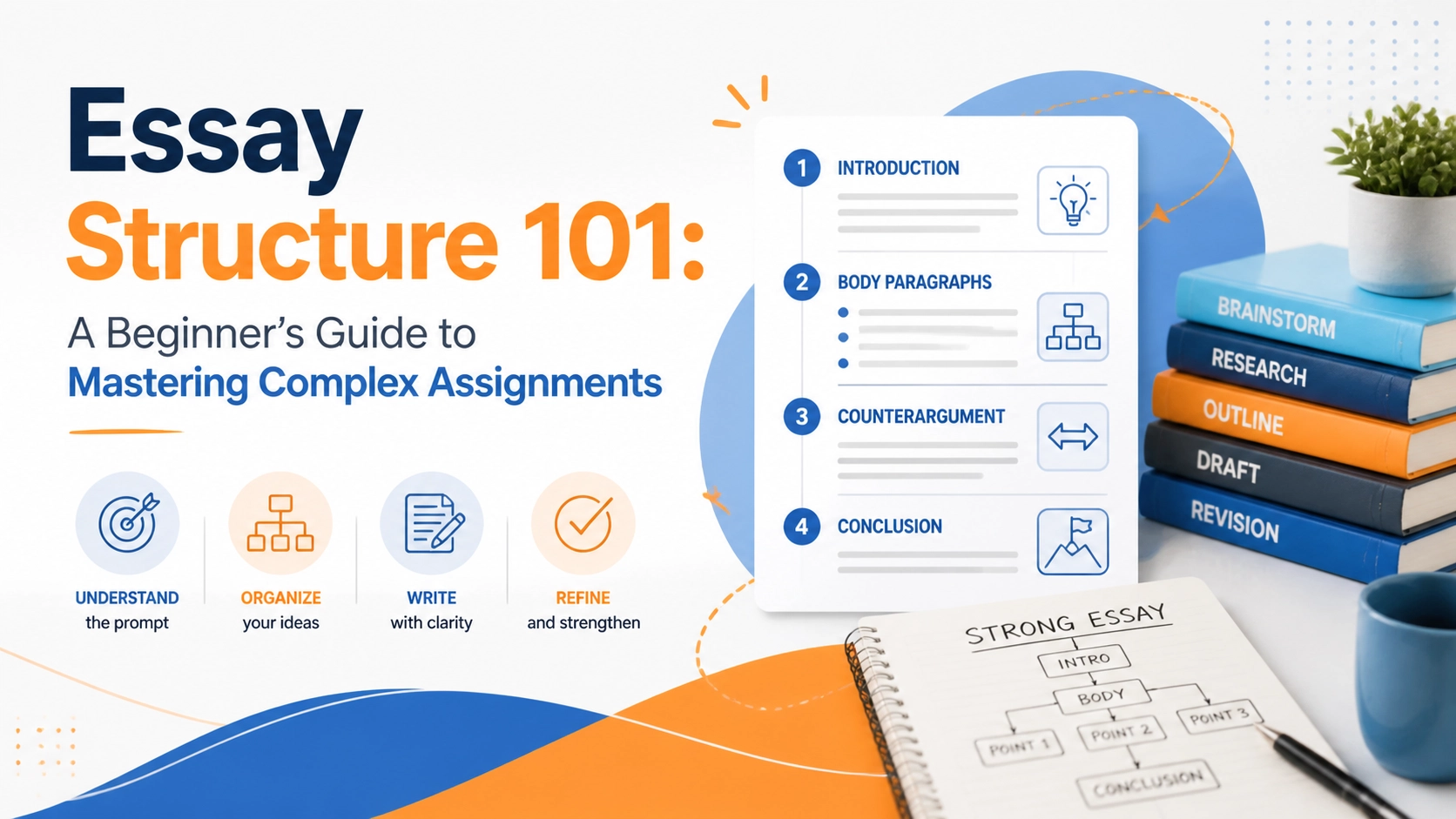
Every great essay, regardless of the subject, follows a basic tripartite structure: the Introduction, the Body, and the Conclusion. Think of it like a journey. You tell the reader where you're going (Intro), you take them there (Body), and you remind them where they’ve been (Conclusion).
1. The Introduction: Making a First Impression
Your introduction is your handshake with the reader. It needs to be firm, confident, and engaging. It generally consists of three main parts:
- The Hook: Start with something that grabs attention. This could be a startling statistic, a provocative quote, or a rhetorical question.
- Context/Background: Give the reader just enough information to understand the debate. What is the history of the topic? Why does it matter right now?
- The Thesis Statement: This is the most important sentence in your paper. It is your central argument. If your essay were a house, the thesis would be the foundation.
2. The Body: Building Your Case
The body is where the heavy lifting happens. Usually, this makes up about 60-80% of your total word count. Each paragraph should focus on one: and only one: main idea that supports your thesis. A helpful way to remember this is the TEEL method:
- T – Topic Sentence: Tell the reader what the paragraph is about.
- E – Evidence: Provide a quote, data point, or example.
- E – Explanation: Explain why that evidence supports your point.
- L – Link: Transition smoothly into the next paragraph.
3. The Conclusion: The Lasting Impact
Never just repeat your thesis word-for-word in the conclusion. Instead, synthesize your points. What is the "big picture" takeaway? Leave your reader with a final thought that makes them feel like their time was well-spent.
Mastering Spatial Order and Advanced Organization
Sometimes, a standard chronological or "importance-based" structure doesn't fit. This is where specialized organizational patterns like spatial order come into play.
In writing, spatial order is a method of organization in which details are presented as they are located in space: such as from left to right, top to bottom, or inside to outside. While often used in descriptive or creative writing, it is incredibly useful in academic papers that involve describing a piece of art, a biological system, or a geographical layout. By guiding your reader through a physical space, you create a vivid, logical progression that is easy to follow.
Are you struggling to decide which organizational pattern fits your specific prompt? It can be helpful to consult reference materials or see how experts handle similar topics.

Why Structure is Your Secret Weapon for Freedom
You might be thinking, "Penny, this sounds like a lot of work. Why can't I just write what I feel?"
Listen up: Structure isn't about following boring rules; it’s about freedom. When you know exactly where each piece of information goes, you stop wasting hours staring at the screen in a state of paralysis. A structured approach ensures you finish your work faster, which means you get to spend more time living your life.
Imagine finishing your paper by 8:00 PM on a Friday and actually being able to go out with friends without that nagging guilt in the back of your mind. Doesn't that sound better than a weekend spent in a caffeinated haze?
With that being said, we know that sometimes the semester gets the better of you. Maybe you have three finals in one week, or perhaps a family emergency has taken your focus away from your studies. In those moments, having a professional ally can provide the peace of mind you need to stay on track.
Behind the Scenes: How We Help You Succeed
At Submit Your Assignments, we don't just "get papers done." We view ourselves as your educational partners. Our process is designed to be supportive and transparent. When a student comes to us for help with a complex assignment, we don't just jump into writing.
We start by analyzing the prompt. Our writers act as consultants, looking at the rubric to ensure every structural requirement is met. We focus on creating model papers that demonstrate high-level organization, proper citation, and critical thinking.
For instance, one of our regular clients, a nursing student, recently struggled with a complex case study analysis. She had all the medical knowledge but didn't know how to structure the "patient care plan" section of her essay. Our team provided a detailed outline and a model paper that used spatial order to describe the clinical environment and chronological order for the treatment steps. She told us later that seeing the structure laid out so clearly gave her the "aha!" moment she needed to master the concept herself.

Trust the Process, Gain Your Life Back
We understand that the academic world is more competitive than ever. The pressure to be perfect is high, and the threat of "AI flagging" or plagiarism is constant. That’s why our approach is rooted in human expertise. We provide custom-written reference materials that are 100% original and tailored to your specific instructions.
If you’re wondering about the logistics, we’ve made it incredibly easy. You can check how much your order will cost before you even commit. We believe in transparency, which is why we offer 24/7 support and a direct line to your writer through our student dashboard.
Stop letting complex assignments dictate your happiness. Trust our experts to help you navigate the tricky waters of essay structure and academic expectations.
A Few Fun Facts About Writing and SYA
Before you go and conquer that assignment, here are some quick facts to lighten the mood:
- Did you know? The word "essay" comes from the French word essayer, which means "to try" or "to attempt." It’s okay if your first draft is just an "attempt!"
- Local Love: While we serve students everywhere, our heart is in Texas! If you’re ever in the Houston area, you know we appreciate a good BBQ as much as a good bibliography.
- Fastest Turnaround: We’ve helped students meet deadlines in as little as three hours. Though, we always recommend giving yourself more time for your own peace of mind!
- Most Popular Topic: Believe it or not, we see more requests for "Business Ethics" and "Healthcare Management" papers than almost anything else.
Ready to see more guides on how to ace your classes? Check out our post sitemap for a full list of our academic writing resources.

Final Thought: You have the brains to get through this. Sometimes, you just need a little help with the blueprints. Whether you’re building an essay from scratch or need a professional eye to edit your work, we are here to support your journey toward academic success and personal freedom.
Submit Your Assignments provides custom reference materials and tutoring services for research and educational purposes only. We encourage all students to follow their institution's academic integrity policies.