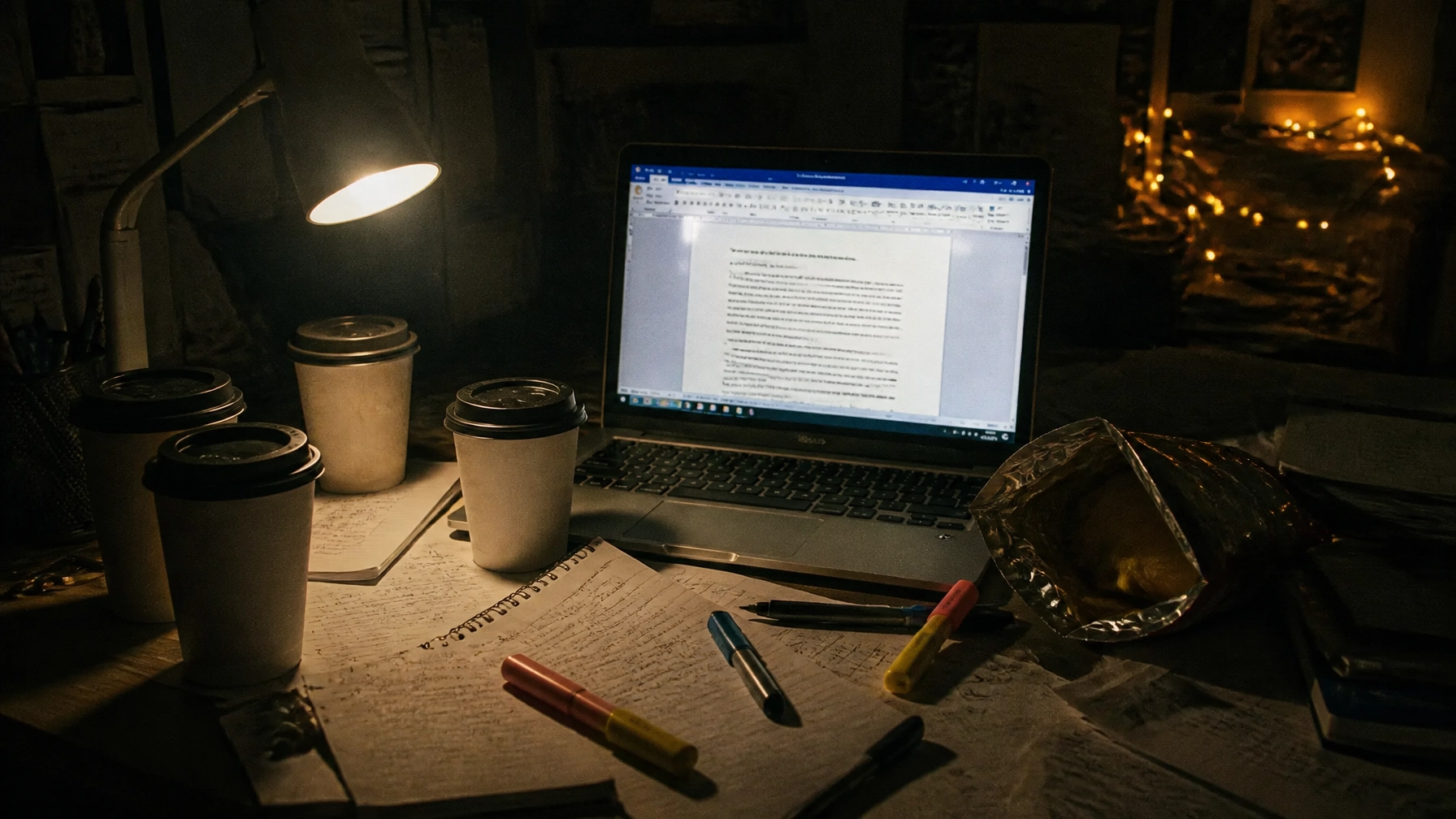
If you're wondering how to write 10 pages overnight, you're not just looking for advice: you're looking for a survival plan. The clock is ticking, the cursor is blinking, and somewhere between panic and determination, you need a system that actually delivers.
Here's the reality: 79% of college students have pulled at least one all-nighter to finish assignments. You are not alone, and more importantly, you are not doomed. Whether you spent the week "rotting" on your phone or just got buried under other classes, the grind starts now.
This guide provides a proven, step-by-step timeline, research shortcuts, drafting techniques, and quality safeguards designed to get you from a blank screen to a submitted paper by morning. A 10-page paper in standard academic formatting equals approximately 2,500 to 3,000 words. That's the mountain. Now let's climb it.
Quick Survival Tips for the Next Hour:
- Phone in the other room. Seriously. You don't have time for a "quick scroll."
- Pick a "Mid" Topic. Don't try to be revolutionary. Pick something with a mountain of existing research.
- Drink Water. Caffeine is great, but dehydration is the real brain-fog killer.
- The "Drafting" Mindset. Stop trying to sound smart. Just sound clear.
Is It Actually Possible to Write 10 Pages in One Night?
Before you ask how, you're probably asking whether this is even possible. The answer is yes, but with clear boundaries. Research shows that 69% of college students procrastinate most on papers, and nearly four out of five have faced this exact scenario.
The math is straightforward: 10 pages translates to roughly 2,500 to 3,000 words. With six to eight focused, uninterrupted hours, that word count is achievable. Think of this as strategic compression, not desperation. High-performing students sometimes use compressed timelines intentionally when circumstances demand it.
What you need to accept upfront is the quality ceiling. You will not produce your best work tonight. What you can produce is a passable, well-argued paper with a clear thesis, supporting evidence, and proper citations. That's the goal. Lower your perfectionism, raise your efficiency, and follow the timeline.

The 7-Hour Overnight Writing Timeline: Your Game Plan
This timeline condenses the proven models from successful overnight writers into a tight seven-hour window. Every minute counts. Silence your phone, close every tab that isn't research, and commit to the sequence. A 20-minute buffer is built in for unexpected delays, but do not treat it as extra break time.
Phase 1: Topic Lock and Thesis Formation (30 minutes)
Force a decision within the first 15 minutes using the three-argument framework. Pick a topic you already know something about or one with abundant online sources. Do not chase an obscure, impressive-sounding topic that will require hours of digging. Write a single-sentence thesis statement that includes your main argument and three supporting points. This sentence is your anchor. If you cannot articulate it clearly, your paper will wander. Set a timer. When 30 minutes expires, you move forward with whatever you have.
Phase 2: Rapid Research Block (90 minutes)
Open Google Scholar and sort by citation count to find the most authoritative sources first. Read only abstracts, introductions, and conclusions. Do not read full studies unless you need a specific quote for a specific paragraph. Use Wikipedia's reference sections as a citation farm: every footnote links to a real academic source you can track down and cite directly. Collect six to ten strong sources minimum. Bookmark or paste links into a running document immediately.

Phase 3: Outline Construction (30 minutes)
Build the outline backward from the page requirement. A standard double-spaced page contains roughly five to six paragraphs. Your structure should look like this:
- Introduction (1 page)
- Body Section 1 (3 pages)
- Body Section 2 (3 pages)
- Body Section 3 (3 pages)
- Conclusion (1 page)
Under each section, write one or two sentences summarizing the argument and list which sources support it. This outline is your roadmap. If you get lost during drafting, you return here. Do not skip this phase. A paper without an outline is a rambling mess waiting to happen.
Phase 4: Drafting Sprint (2 hours)
Write continuously. Do not edit, do not second-guess, do not stop to format citations. Aim for 250 to 300 words per 15-minute block. Set a timer if it helps maintain urgency. If you hit a wall, skip it and leave a bracketed note like [FILL IN ARGUMENT HERE]. Write the body paragraphs first and the introduction last. You cannot introduce an argument you haven't yet made.
Phase 5: Break and Reset (20 minutes)
Step away from the screen. Walk around, hydrate, eat something light with protein. Do not check your phone or social media. This is cognitive reset time, not entertainment time.
Phase 6: Revision and Source Integration (60 minutes)
Read the full draft once for flow and coherence. Ask yourself whether each paragraph supports your thesis. Insert proper citations where you left placeholders. Verify that each source is real and relevant. Cut any content that doesn't serve your thesis. You do not have time for fluff, and your grader will notice it anyway.
Phase 7: Final Polish and Formatting (40 minutes)
Run a grammar check. Read the paper aloud to catch awkward phrasing and run-on sentences. Format citations in APA or MLA using a citation generator for speed. Check the page count. If you're short, expand a body paragraph with an additional example. If you're long, trim redundant examples. Run a final plagiarism check if your institution requires one.
Research Shortcuts That Save Hours
Google Scholar's "Cited by" feature is your fastest path to influential papers. When you find one strong source, click "Cited by" to see every subsequent paper that referenced it. This surfaces the most relevant scholarship in seconds.
Search specifically for literature reviews on your topic. These summarize multiple studies and provide ready-made citation lists you can mine. Wikipedia's reference section remains the most underrated academic shortcut available. Every footnote is a real source you can locate and cite directly.
Limit yourself to three to five sources per body section. You do not need 30 sources for an overnight paper. One critical warning: never cite a source you haven't at least read the abstract of. Fabricated citations are easy for graders to catch and carry severe academic consequences.
Ethical AI Use for Overnight Writing: 2026 Update
AI tools are now widely accepted as thinking partners, not ghostwriters. Use them for brainstorming, outlining, and clarity checks. Ask an AI to suggest counterarguments you might have missed or to rephrase a confusing sentence you've already written.
Never ask AI to write paragraphs for you. At most institutions in 2026, this constitutes academic dishonesty and is detectable by the same institutions that now routinely use AI-detection software. If your university requires disclosure, include a statement like: "Used AI to brainstorm an outline and for post-draft clarity edits; all analysis and writing are my own."
One critical warning: AI tools can and do "hallucinate" or fabricate citations that sound plausible but don't exist. Always verify every source before including it in your bibliography. If you're worried about accidental AI patterns, our Human Authenticity Guarantee ensures everything we provide as a reference is 100% human-crafted.

Common Mistakes That Ruin Overnight Papers
- Perfectionism: Spending 30 minutes on a single paragraph is a luxury you do not have. Write it, move on, and fix it during revision.
- Weak Thesis: If your thesis is vague, every paragraph will struggle to find direction. Lock your argument early.
- Citation Errors: Rushed formatting leads to missing quotation marks and improperly attributed ideas. This is the fastest way to a plagiarism flag.
- Ignoring the Prompt: A well-written paper that doesn't answer the question gets an F regardless of its quality.
- Skipping the Outline: It’s the difference between a coherent paper and a rambling mess.
What to Do When You Wake Up: Damage Control
Accept that your cognitive function will be diminished. Plan for a low-productivity day and avoid scheduling anything that requires sharp thinking. Hydrate aggressively, eat protein, and get sunlight exposure to accelerate recovery.
If your submission deadline allows, re-read your paper with fresh eyes before hitting submit. Even 15 minutes of morning review catches errors your exhausted brain missed at 3 a.m. Submit on time, then learn from the experience. Overnight writing is a survival skill, not a study strategy. Use it sparingly, and next time, start earlier.

Frequently Asked Questions
Can you write a 10-page paper in one night?
Yes, with a structured timeline and focused execution. Expect a solid B or C paper, not a masterpiece.
How many words is a 10-page paper?
Approximately 2,500 to 3,000 words, assuming double-spaced formatting, 12-point font, and 1-inch margins.
How many sources do I need?
Six to ten strong, relevant sources is the standard recommendation for a paper of this length.
What if I can't finish in one night?
Submit a partial draft and request an extension. Honesty is always better than submitting plagiarized or AI-generated work.
Final Checklist Before Submission
- Does the paper directly answer the assignment prompt?
- Is the thesis statement clear and present in the introduction?
- Does each body paragraph support the thesis with evidence?
- Are all sources cited correctly, both in-text and in the bibliography?
- Is the formatting correct for margins, font, and spacing?
- Is the page count at least 10 full pages?
- Did you run a spell-check and read the paper aloud?
Listen up: If you're staring at that blank cursor and the panic is setting in, stop worrying. Whether you need a custom reference paper to see how a pro structures an argument or just need some emergency editing, we've got your back. Trust our writers to help you navigate the academic grind so you can actually get some sleep.
Submit Your Assignments provides custom reference materials and tutoring services for research and educational purposes only. We encourage all students to follow their institution's academic integrity policies.