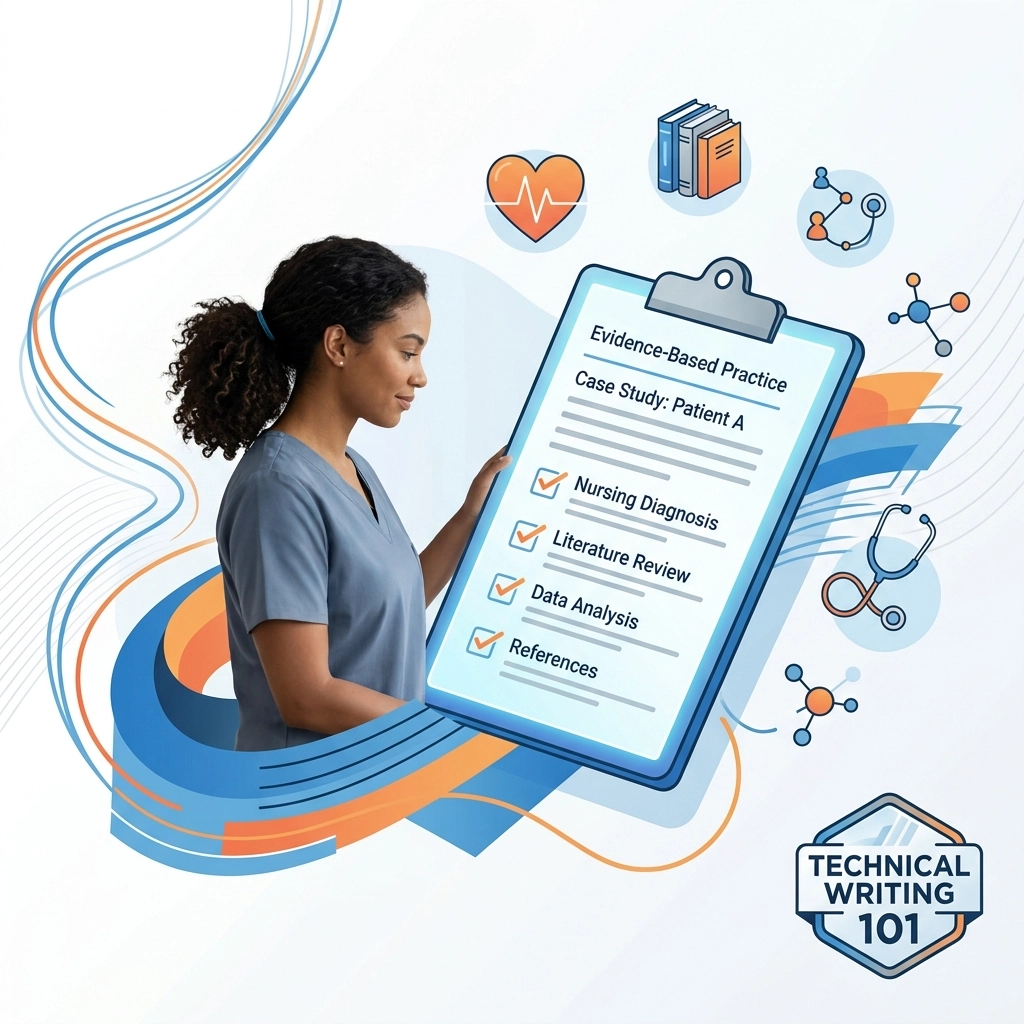
You have just finished a grueling 12-hour clinical shift. Your feet ache, your mind is saturated with patient charts, and the smell of antiseptic seems permanently etched into your scrubs. Just as you think you can finally rest, you remember the looming deadline: a 15-page Evidence-Based Practice (EBP) paper due by Sunday. Does the mere thought of synthesizing quantitative data and formatting a Nursing Care Plan make your heart race? Do you find yourself staring at a blank screen, wondering how to translate clinical expertise into a formal, technical document?
If you feel overwhelmed, you are certainly not alone. The transition from the hands-on world of the hospital ward to the rigorous world of academic technical writing is a challenge that every nursing student faces. However, mastering this skill is not just about getting a passing grade; it is about ensuring patient safety and advancing the profession through clear, clinical communication.
At Submit Your Assignments, we understand the unique pressures of the nursing curriculum. We know that your time is a precious commodity. That is why we have crafted this beginner’s guide to help you navigate the complexities of nursing technical writing with confidence and precision.
The Nature of the Beast: What is Nursing Technical Writing?
In the context of your education, technical writing isn't just about "writing a paper." It is the precise communication of clinical information, research findings, and care strategies. Whether you are seeking nursing care plan help or looking for a professional nursing essay writing service to provide research assistance, the goal remains the same: clarity, accuracy, and evidence.
Unlike a creative writing assignment, nursing writing is highly structured. It requires a clinical tone that is professional, empathetic, and objective. You aren't just sharing an opinion; you are synthesizing a plethora of data to justify a specific clinical intervention.

Stage 1: The Foundation of Evidence-Based Assignments
Before you type a single word, you must establish a solid foundation. In nursing, this almost always begins with the PICO(T) framework. Why is this necessary? Because a broad topic like "infection control" is too vague for a technical assignment. You need a focused clinical question to guide your research.
- P (Population): Who are the patients? (e.g., elderly patients in long-term care).
- I (Intervention): What is the new strategy? (e.g., silver-alloy catheters).
- C (Comparison): What is the current standard? (e.g., standard latex catheters).
- O (Outcome): What is the goal? (e.g., reduced rate of UTIs).
- T (Time): Over what period? (e.g., during a 30-day stay).
With that being said, once you have your PICO question, your search for evidence becomes significantly more efficient. Instead of drowning in thousands of irrelevant articles, you can target specific peer-reviewed journals.
Stage 2: Navigating the Hierarchy of Evidence
Not all evidence is created equal. In technical nursing writing, the "strength" of your sources determines the validity of your argument. Using outdated or non-scholarly sources can be detrimental to your grade and, more importantly, your clinical reasoning.
You should aim for the top of the evidence pyramid:
- Systematic Reviews and Meta-analyses: These are the gold standard.
- Randomized Controlled Trials (RCTs): High-level quantitative evidence.
- Cohort and Case-Control Studies: Useful for observing long-term outcomes.
- Qualitative Research: Essential for understanding the patient experience.
Are you struggling to find enough high-quality sources for your capstone? It is common for students to feel lost in the database "weeds." This is where professional research assistance becomes a game-changer. Our team can help you identify the most relevant, current peer-reviewed literature to support your claims.

Stage 3: Mastering the Nursing Care Plan (NCP)
The Nursing Care Plan is perhaps the most technical document you will ever create. It is a roadmap for patient care that follows the ADPIE process: Assessment, Diagnosis, Planning, Implementation, and Evaluation.
Writing a technical NCP requires a shift in mindset. You must use NANDA-I approved nursing diagnoses and ensure that your "Expected Outcomes" are SMART (Specific, Measurable, Achievable, Relevant, and Time-bound).
- Common Pitfall: Writing vague goals like "Patient will feel better."
- The Technical Fix: "Patient will report a pain level of 3/10 or less on the numerical rating scale within 45 minutes of analgesic administration."
If the logistics of mapping out these complex interventions are causing you stress, remember that tutoring and editing support can help you refine your logic and ensure your care plans meet the highest clinical standards.
Stage 4: The Capstone Project – The Ultimate Hurdle
Your nursing capstone project is the culmination of your entire degree. It requires you to identify a clinical problem, review the existing literature, and propose an evidence-based change in practice. This is not a task to be taken lightly; it requires months of preparation and meticulous technical writing.
Because the capstone is so comprehensive, many students find that their writing stamina begins to fade. As we said earlier, your well-being matters. You shouldn't have to sacrifice your mental health or your clinical performance to finish a 40-page project. Utilizing a capstone project writing service for research assistance or editing support can provide the peace of mind you need to cross the finish line.
Why Technical Accuracy Matters
In the medical field, a misplaced comma or an ambiguous instruction isn't just a grammatical error; it can lead to clinical misunderstandings. Your academic assignments are training grounds for your future professional documentation.
- Precision: Use exact terminology. Instead of "the patient was upset," use "the patient exhibited signs of acute anxiety, including tachycardia and hyperventilation."
- Objectivity: Avoid personal bias. Stick to the data and the observed behaviors.
- Conciseness: Nursing technical writing should be lean. If you can say it in ten words, don't use twenty. This expedites the reader's understanding and ensures that critical information isn't buried in fluff.
Reclaiming Your Freedom with Submit Your Assignments
We know you are dedicated to your future patients. We also know that you are a human being who needs sleep, family time, and a life outside of the library. Why spend your few hours of freedom struggling with APA formatting or trying to decipher complex statistical results?
Trust our experts to provide the high-quality research assistance and editing support you deserve. We guarantee that our support will help you present your clinical knowledge in the best possible light.

Why choose Submit Your Assignments?
- 24/7 Support: We are here whenever inspiration (or panic) strikes.
- Clinical Expertise: Our team understands the nuances of nursing education.
- Peace of Mind: You can check on the status of your order at any time.
- Security: Your privacy is our priority. Will you keep a copy of my paper on a database? No, your work is yours alone.
Final Thoughts for the Future RN
Stop worrying about whether your writing is "technical enough." Take a deep breath and remember why you started this journey. You are here to save lives and provide care. Let us handle the technical heavy lifting of your research and editing so you can focus on what truly matters: your clinical practice.

Listen up: your degree is within reach. Don't let a technical assignment stand in your way. Whether you are a student at the University of Texas at Arlington (UTA), Texas Woman's University (TWU), or any other nursing program across the country, we are here to support your academic journey.
Quick Tips for Nursing Students:
- Stay Local: If you're in the Houston/Nassau Bay area, remember that we're local to your needs!
- Use the Library: Most nursing schools have specialized librarians for EBP: use them!
- Batch Your Work: Write your technical sections in small, 30-minute bursts to avoid burnout.
- Read Aloud: Technical writing can be dense; reading it aloud helps catch awkward phrasing.
Ready to get started? Get a quick quote today and take the first step toward a stress-free semester.
Submit Your Assignments is an independent academic support service and is not affiliated with, endorsed by, or partnered with University of Texas at Arlington (UTA) or Texas Woman's University (TWU). Our services are intended for research, tutoring, and editing purposes only.