author: Shannon
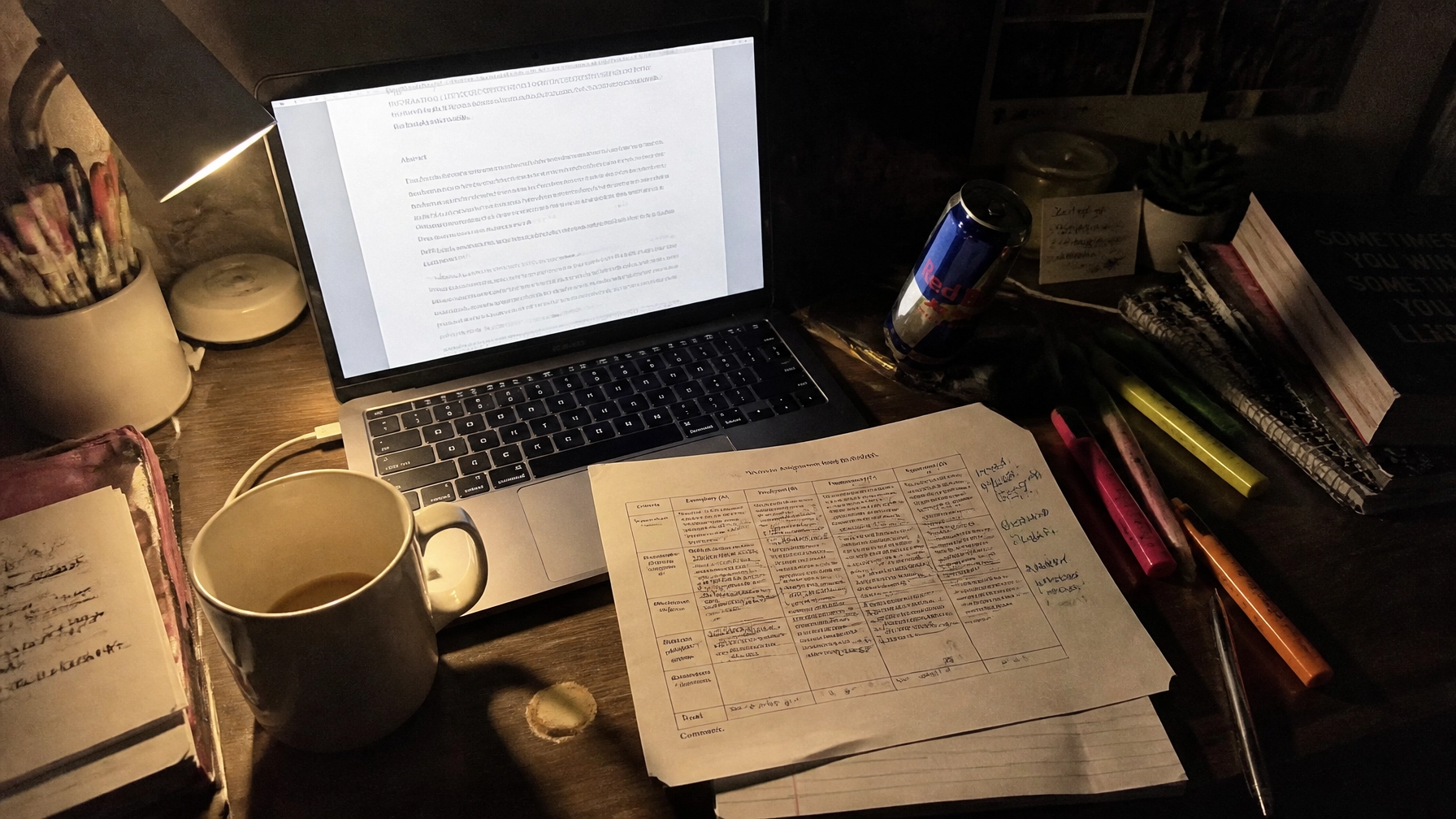
You’ve been there. It’s 3 AM, your third cup of lukewarm coffee is staring back at you, and you’re looking at a grading rubric that might as well be written in ancient hieroglyphics. You see the words "Critical Thinking" and "Logical Organization" under the 20-point section, and you realize you have no idea what your professor actually wants.
Does "Critical Thinking" mean just having an opinion? Does "Organization" just mean using a couple of transition words like "however" and "therefore"?
Spoiler: Usually, it’s a bit more than that.
Most students lose points not because they don't know the material, but because they don't know how to "check the boxes" that professors use to grade. If you’re tired of getting a "B" on a paper you worked on for ten hours, it’s time to stop guessing and start writing for the rubric.
Quick Writing Tips to Save Your Grade
Before we dive into the deep end, here are three things you can do right now to boost your score:
- The "So What?" Test: After every paragraph, ask yourself, "So what?" If your paragraph doesn't answer why this information matters to your main argument, delete it or fix it.
- Reverse Outlining: Once you finish your first draft, write down the main point of every paragraph in a separate list. If the list looks like a jumbled mess of unrelated thoughts, your organization is off.
- Stop Using "I Think": Professors already know it’s your paper. Instead of saying "I think the data shows," just say "The data shows." It sounds more authoritative and "critical."
Decoding "Critical Thinking" (The 40% Heavy Hitter)

When a professor looks at the "Critical Thinking" category, they aren't looking for how many facts you can list. They are looking for what you do with those facts.
In most rubrics, the "Exemplary" or "Advanced" column asks for things like "demonstrates a deep understanding of complexity" or "evaluates context and assumptions."
What does that actually look like in a paper?
It’s Not Just a Summary
The biggest mistake students make is summarizing. If you’re writing about a historical event or a business case study, don’t just tell the reader what happened. They already know. Critical thinking happens when you explain why it happened and what the long-term implications are.
Think of it like this: Summary is "The sky is blue." Critical thinking is "The sky appears blue because of Rayleigh scattering, which suggests that our atmosphere plays a vital role in filtering light: a fact that is often overlooked when discussing climate change."
See the difference? One is a fact; the other is a connection.
The "Counterargument" Cheat Code
One of the easiest ways to prove you are "critically thinking" is to bring up the other side. Professors love when you acknowledge that your argument isn't the only one.
If you are arguing that remote work is the future of business, spend a paragraph talking about the downsides: like "Zoom fatigue" or the loss of office culture. Then, explain why your original point is still stronger. This shows you’ve looked at the "complexity" the rubric keeps mentioning.
Evidence vs. Analysis
Using a quote from a peer-reviewed journal is great, but that’s only half the battle. If you just drop a quote and move on, you’re missing the analysis part. You need to "sandwich" your evidence:
- Top Bun: Introduce the point.
- The Meat: The quote or data.
- Bottom Bun: Explain how that quote proves your thesis.
If you're struggling to find that "bottom bun" explanation, you might need a bit of a consultation or brainstorming session to get your thoughts organized.
Organization: The "Roadmap" Your Professor Needs

Have you ever read something and had to restart the paragraph three times because you got lost? That’s poor organization.
When a rubric mentions "Organization" or "Structure," they are checking if your paper has a logical flow. If your paper feels like a collection of random "fun facts" about a topic, you’re going to get dinged.
The Thesis is Your North Star
Your thesis statement shouldn't just be at the end of the first paragraph; it should be the "vibe" of the entire paper. Every single topic sentence in your body paragraphs should link back to it.
If your thesis says "Social media is harmful to teens because of sleep deprivation and body image issues," your first paragraph better be about sleep and your second better be about body image. If you suddenly start talking about the history of MySpace, you’ve lost the plot.
Transitions That Actually Work
Most of us were taught to use "First," "Second," and "Finally." Those are fine, but they’re a little basic. If you want to hit that "Exemplary" column, you need transitions that connect the ideas, not just the order.
Try phrases like:
- "Building on this idea…"
- "While the previous point focused on X, the following data suggests Y…"
- "This conflict leads directly to…"
These transitions act like a "roadmap" for your professor. It makes the paper easy to read, which usually leads to a much better grade. If your ideas are feeling a bit jumbled, looking into professional editing services can help smooth out those rough edges.
The Conclusion: More Than a Recap
Stop starting your last paragraph with "In conclusion." It’s a bit of a cliché. Instead, use the conclusion to talk about the "big picture." If everything you’ve said is true, what does it mean for the future? Why should the reader care?
Think of the conclusion as your final mic drop. You’ve presented the evidence, you’ve analyzed the data, now tell them why it matters in the real world.
Why Rubrics Feel Like a Trap

Let’s be real: rubrics can feel like they were designed to make you fail. They use vague words like "substantive" and "appropriate" that mean different things to different professors.
This is where the "grind" gets exhausting. You spend hours researching, but you still feel like you're missing some secret ingredient. The truth is, academic writing is a specific skill. It’s not just about being "smart": it’s about knowing the rules of the game.
At Submit Your Assignments, we’ve spent years decoding these rubrics. We know what a "Level 4" critical thinking section looks like because we’ve helped thousands of students move from "Developing" to "Exemplary."
Whether you need a model paper to see how an expert structures an argument or you need a tutor to help you outline your research, we’ve got your back. We’re here to help you get that "No Homework and Chill" vibe back into your life.
How to Use Our Help for Your Rubric
- Upload Your Rubric: When you work with our writers, send the rubric along with your prompt. We’ll make sure every "Critical Thinking" box is checked.
- Review the Flow: Our editors look specifically for organizational gaps that might confuse a reader.
- Learn the Style: Use our reference materials to see how a professional handles complex analysis. It’s like having a "cheat sheet" for your specific class.
Fun Facts & Quick Wins
Just to keep things light, here are a few random things we’ve noticed over the years:
- The "Page 3" Slump: Most students' organization falls apart on page 3. That’s usually where the "brain fog" sets in. Check your transitions extra carefully there.
- Word Count vs. Quality: Adding "filler" words to meet a length requirement is the fastest way to kill your "Organization" score. Be punchy, not wordy.
- Font Choice: While it’s not usually on the rubric, a clean, standard font (like Times New Roman or Arial) makes your paper look more professional, which can subconsciously bias a grader in your favor.
- Houston Pride: Since we’re based in the HTX area, we know the "grind" of the local universities. Whether you're a Cougar or an Owl, we know the academic standards you're facing.
Stop letting a vague rubric keep you up at night. You have a life to live, and staring at a blinking cursor isn't part of it. Trust our writers to help you navigate the complexity and deliver a paper that checks every single box.
For immediate assistance, iMessage us at info@submityourassignments.org or WhatsApp us at https://wa.me/13466176123. Call Only: 346-603-6340
Submit Your Assignments provides custom reference materials and tutoring services for research and educational purposes only. We encourage all students to follow their institution's academic integrity policies.