You know the feeling. You’re sitting in a lecture hall, the hum of the air conditioning the only sound in the room, when your professor drops the "A-word."
"I’ve run all your essays through the latest AI detection software," they say, peering over their glasses like a hawk spotting a field mouse. "And I have some… concerns."
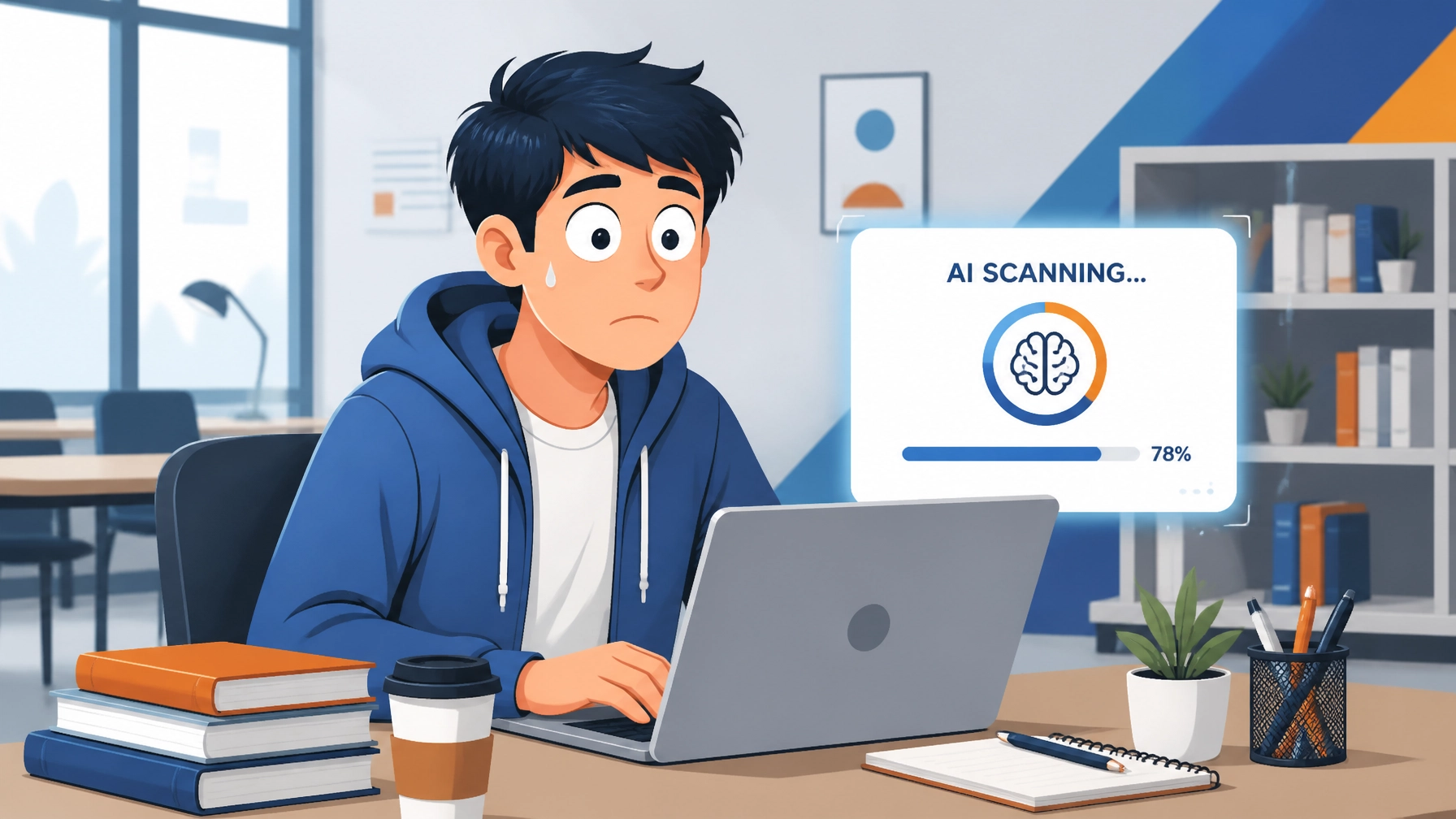
Suddenly, your heart performs a Olympic-level backflip. Your palms start to sweat. You find yourself adopting a "poker face" so rigid it would make a professional gambler jealous. The irony? You didn't even use AI. You spent twelve hours fueled by lukewarm coffee and sheer desperation to finish that paper. But in the world of modern academia, being innocent doesn't always mean you feel innocent.
Why does the mere mention of an algorithm make us feel like we’re hiding a robot in our backpack?
The Anatomy of the 'False Positive' Panic
If you’ve ever felt that cold spike of adrenaline when a professor mentions Turnitin or GPT-Zero, listen up: you aren’t crazy. Recent studies have shown that AI detectors are notoriously finicky, with false positive rates ranging anywhere from 15% to a staggering 50%.

The reality is that these tools often flag perfectly human writing, especially if you’re a non-native English speaker or someone who naturally writes with a very structured, clear logical flow (you know, the way you were taught to write). It’s detrimental to your mental health to live in fear of a "guilty" verdict for a crime you didn't commit.
When an algorithm decides your tone is "too consistent" or your vocabulary is "too academic," it creates a trust gap. You start to wonder: Should I intentionally add a typo? Should I make my sentences more chaotic just to prove I'm human?
Stop worrying. You shouldn't have to downgrade your intelligence just to satisfy a bot.
Quick Tips to 'Bot-Proof' Your Writing Style
Before we dive into the art of the poker face, let’s talk strategy. If you want to ensure your work screams "human," try these quick adjustments to your workflow:
- Vary Your Sentence Length: AI loves a predictable rhythm. Throw in a short, punchy sentence. Then follow it with a longer, more complex one.
- Use Personal Anecdotes: A bot can't tell the story about that time you got lost in the library stacks or how a specific lecture changed your perspective. Personal flair is AI-proof.
- Keep Your 'Receipts': Save your early drafts, your messy outlines, and your consultation notes. If you have a trail of breadcrumbs, no one can claim the loaf of bread just appeared out of thin air.
- Read It Out Loud: If it sounds like a human talking, it usually reads like a human writing.
Mastering the Poker Face (When the Bot Flags You)
So, the worst has happened. You’ve been flagged. The professor wants to "chat." Here is your survival guide to maintaining that poker face and proving your integrity.
1. Stay Calm (The "I Have Receipts" Energy)
The moment you get defensive, it looks suspicious. Instead, adopt a tone of helpful confusion. "Oh, that's interesting! I wonder what triggered that? I actually have my original outline and research materials right here if you'd like to see how the paper evolved."
2. Walk Them Through Your Process
Professors love process. If you can explain why you chose a specific argument or how you found a particular source, the AI accusation usually evaporates. They want to see the "human" behind the text.
3. Use the "Consultation" Defense
There is a big difference between "using AI" and "using resources." If you used a model paper or an educational reference to help structure your thoughts, be transparent about your research process. Showing that you sought out professional tutoring or editing services demonstrates a commitment to quality, not a shortcut.

How We Help You Stay "Human-Verified"
At Submit Your Assignments, we’ve seen the "AI Panic" firsthand. That’s why our approach is built on transparency and human expertise. We don't just hand over a document; we provide a foundation.
Our writers are seasoned pros who understand the nuances of academic tone. When you work with us, the process typically looks like this:
- The Brainstorming Phase: We look at your prompt and help you find a unique angle that a bot would never think of.
- The Outline: We provide structured reference materials that show a logical progression of thought.
- The Editing: We refine the language to ensure it meets high academic standards while maintaining a natural, human voice.
This workflow ensures that the materials you receive are not only high-quality but also serve as a legitimate educational tool. You can use our custom writing services to see exactly how a top-tier paper should be structured, giving you the peace of mind to focus on your actual learning.
Living Your Life (Beyond the Screen)
The ultimate goal of getting academic help isn't just to "get by": it's to get your life back.
Imagine a weekend where you aren't checking your email every five minutes to see if a plagiarism report came back. Imagine the freedom of knowing your research is solid, your citations are perfect, and your logic is sound because you had a professional "messenger" in your corner.

Whether you’re a busy nursing student at UTMB or a grad student juggling a full-time job, you deserve to "No Homework and Chill" occasionally. We provide the safety net so you can stop practicing your poker face and start enjoying your degree.
Why Trust the "Bird"?
We "charge like a bird" (affordable and student-friendly!), but we deliver like a hawk. With an average rating of 94% and a 4.5 on Trustpilot, our track record speaks for itself. We prioritize quality custom writing because we know your academic reputation is on the line.

As we said earlier, the burden of proof shouldn't always be on you. But when it is, it helps to have the best reference materials in the business.
Stop worrying. Trust our writers. Live your life.
Random Student Survival Fun Facts:
- The Library Myth: Statistically, students who study in groups are 20% less likely to fall asleep on their keyboards (though the caffeine intake doubles).
- Houston Heat: If you're studying in the Houston area, "air conditioning" is technically a food group.
- The Midnight Oil: Most academic breakthroughs happen between 2:00 AM and 4:00 AM, right when you start seeing "the ghosts of deadlines past."
- The Pen is Mightier: People who use blue ink are often said to retain information better: maybe that's why our pen logo is so smart!
Submit Your Assignments provides custom reference materials and tutoring services for research and educational purposes only. We encourage all students to follow their institution's academic integrity policies.