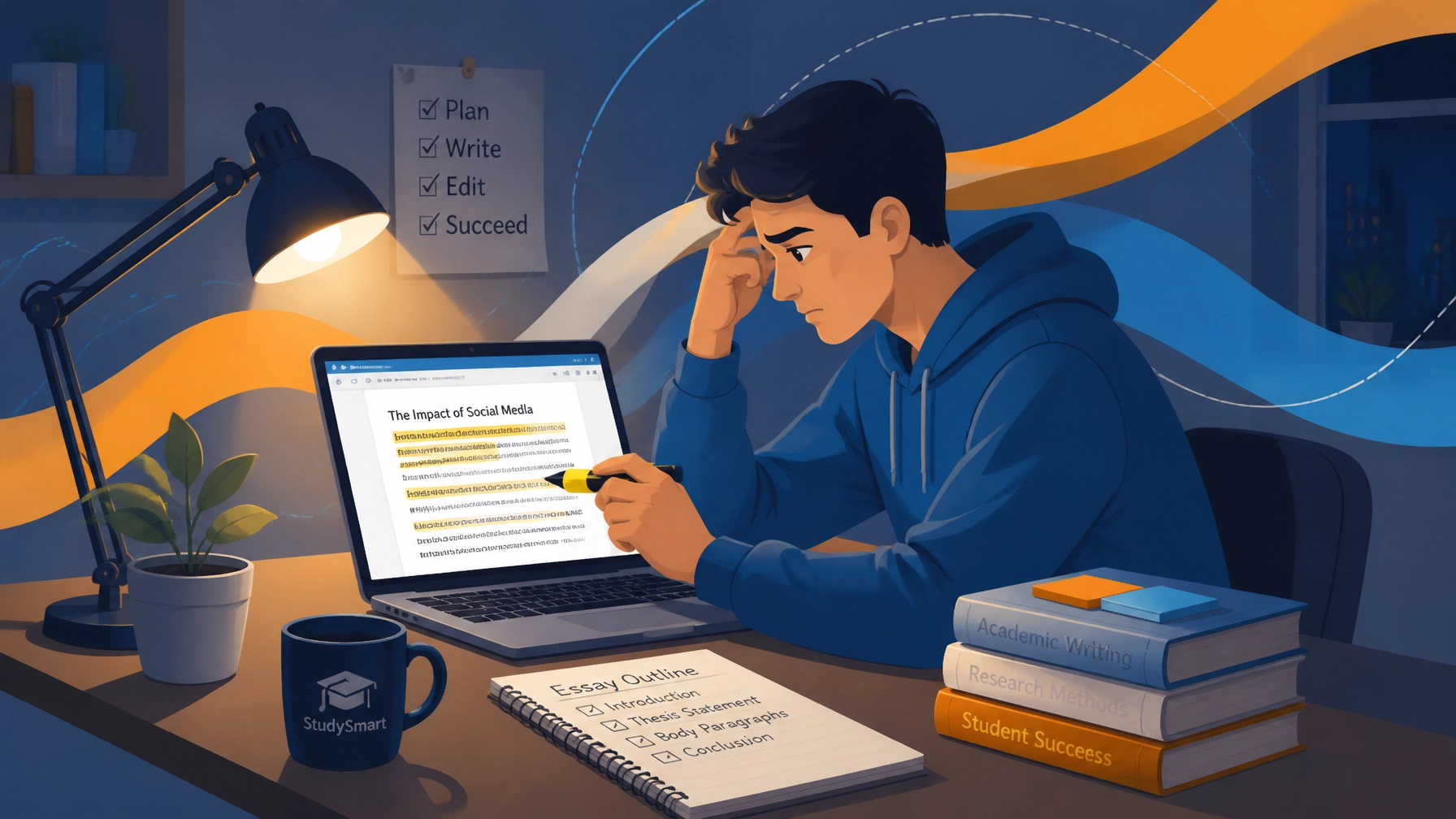
You’ve been there. It’s 2:00 AM, the deadline for your research paper at the University of Houston or Texas Southern University is looming, and you’re staring at a screen that feels like it’s staring back. You used an AI tool to help get your thoughts down, but now you’re stuck in "humanization" hell. You’ve changed a few words here and there, swapped "utilize" for "use," and sent it through a detector: only to see that dreaded "85% AI-generated" flag.
It’s frustrating, isn't it? You put in the work to edit, yet the "robot" remains. The truth is, rewriting AI text for college isn't just about changing words; it's about changing the very DNA of the writing. If you’re struggling to make your assignments feel authentic, you’re likely falling into a few common traps that professors (and their detection software) are trained to spot.
But don’t worry. We’re going to break down exactly where most students go wrong and how you can flip the script to ensure your work reflects your unique voice.
Quick Writing Tips to Humanize Your Draft Right Now
Before we dive into the deep end, here are three rapid-fire ways to breathe life into a stale AI draft:
- Read it aloud: If you run out of breath or feel like a robot reading it, the sentence is too long or too rhythmic. Break it up.
- Add a personal "so what?": Connect a generic point to something you discussed in your specific class at Rice University or San Jac.
- Delete the fluff: If a sentence starts with "It is important to note that," delete those first six words and start with the actual point.
Mistake 1: The "Synonym Swap" Trap
The most frequent mistake students make is thinking that a thesaurus is their best friend. You find a word like "complex" and change it to "intricate." You change "show" to "demonstrate." While this changes the vocabulary, it doesn't change the stylometry.
AI detectors aren't just looking for specific words; they are looking for the mathematical probability of word sequences. If you keep the same sentence structure but just swap out the nouns and verbs, the "fingerprint" remains. It’s like putting a new coat of paint on a stolen car: the VIN number is still the same.
The Fix: Instead of swapping words, rewrite the entire sentence from scratch. Ask yourself, "How would I explain this to a friend over coffee at the UHD student lounge?" Write that down instead.
Mistake 2: The "Moreover" Overload
Have you ever noticed how AI loves certain transition words? If your paper is littered with "Moreover," "Furthermore," "In addition," and "In conclusion," you’re waving a giant red flag. These words are the "filler" of the digital world. They provide a logical bridge, but they lack the personality and nuance of human transition.
The Fix: Use more natural, conversational bridges. Instead of "Moreover," try "But here’s where it gets interesting," or "This doesn't just apply to X; it also impacts Y." Varying your transitions makes the flow feel less like a programmed sequence and more like a developing argument.
Mistake 3: Flat-Lining the Rhythm (Lack of "Burstiness")
Human writing is messy. We write short, punchy sentences for emphasis. Then we follow them up with longer, more descriptive thoughts that meander through an idea before bringing it home. AI, on the other hand, tends to produce sentences of roughly the same length and complexity. This creates a "monotone" rhythm that detectors call low "burstiness."

The Fix: Intentionally break the rhythm. Use a three-word sentence. Then use a thirty-word sentence. This variation is a hallmark of human thought and makes your writing significantly more engaging to read.
Mistake 4: Ignoring Hallucinations and Fake Citations
This is a "detrimental" mistake that can lead to more than just a low grade: it can lead to academic integrity issues. AI often "hallucinates" facts, statistics, and even entire peer-reviewed sources. If you rewrite a sentence that contains a fake fact, you’re still turning in a fake fact.
The Fix: Never trust the "knowledge" of the AI without verification. Treat the AI draft as a rough outline, not a source of truth. Double-check every date, name, and citation against real databases. If you're overwhelmed, looking into professional consultation and reference materials can help you find legitimate sources that actually exist.
Mistake 5: The Logic Leap
AI is great at sounding confident, even when it’s making no sense. Sometimes, two paragraphs will follow each other logically in terms of grammar, but the actual argument takes a massive leap that hasn't been earned. When you’re focused on rewriting AI text for college, you might miss that the underlying logic is flawed.

The Fix: Perform a "logic audit." Read the first sentence of a paragraph and then the last. Does the path between them actually make sense? If you can’t explain the connection, your professor won’t be able to either.
Mistake 6: Forgetting Your "Why"
Every professor at Lone Star College or TSU wants to see your synthesis of the material. AI provides a generic "middle-of-the-road" perspective. It doesn't know what happened in your Tuesday morning lecture or the specific case study your instructor is obsessed with. When you stay generic, you stay detectable.
The Fix: Inject niche context. Mention specific authors from your syllabus. Reference a specific Houston-based example if it’s relevant. This "on-the-ground" detail is something AI simply cannot replicate effectively without heavy prompting.
Mistake 7: The "One-and-Done" Delusion
Many students think that one quick pass of rewriting is enough to "humanize" a paper. Unfortunately, the AI "flavor" is often deeply baked into the structure. A single pass often leaves behind the "predictability" that modern detectors are designed to catch.
The Fix: Treat rewriting as a multi-stage process.
- First Pass: Restructure the order of ideas.
- Second Pass: Rewrite for voice and rhythm.
- Third Pass: Fact-check and edit for clarity.
How We Handle the "Heavy Lifting"
At Submit Your Assignments, we’ve seen how stressful the new landscape of academic writing can be. You aren't just competing against a deadline; you’re competing against algorithms. That’s why our approach is built on human expertise, not automated shortcuts.
When you work with us, our workflow looks like this:
- Brainstorming & Outlining: We help you map out an original argument that actually addresses your prompt's nuances.
- Custom Reference Materials: We provide high-quality model papers that serve as a blueprint for your own research.
- Professional Editing: Our editors look for those "robotic" patterns and help you smooth them out into a professional, human-sounding voice.
We don't just "fix" text; we provide a supportive environment where you can learn to be a better writer while taking the pressure off your shoulders. Trusting our team of experienced writers ensures you have the peace of mind to focus on living your life.
Why Students Choose the "Ally" Approach:
- Reliable and Professional: We maintain a 94% average rating for a reason.
- Student-Friendly Pricing: We "charge like a bird" to keep things affordable.
- High-Certainty Results: Our goal is to provide work that makes you feel confident when you hit "Submit."

Houston Writing Fun Facts:
- U of H is home to one of the most respected creative writing programs in the country!
- The Rice University Fondren Library is a favorite spot for late-night research marathons.
- Texas Southern University has a rich history of producing some of the city's most influential legal minds.
Stop Worrying and Start Succeeding
Don't let the fear of AI detection keep you up at night. Whether you need help outlining a complex nursing care plan or need a professional eye to edit your latest research paper, we are here to help.
Listen up: Your academic journey is yours to lead, but you don't have to walk it alone. Submit Your Assignments is your messenger for success, helping you bridge the gap between "stuck" and "finished."
Ready to get started? Check out our services today!
Submit Your Assignments provides custom reference materials and tutoring services for research and educational purposes only. We encourage all students to follow their institution's academic integrity policies.