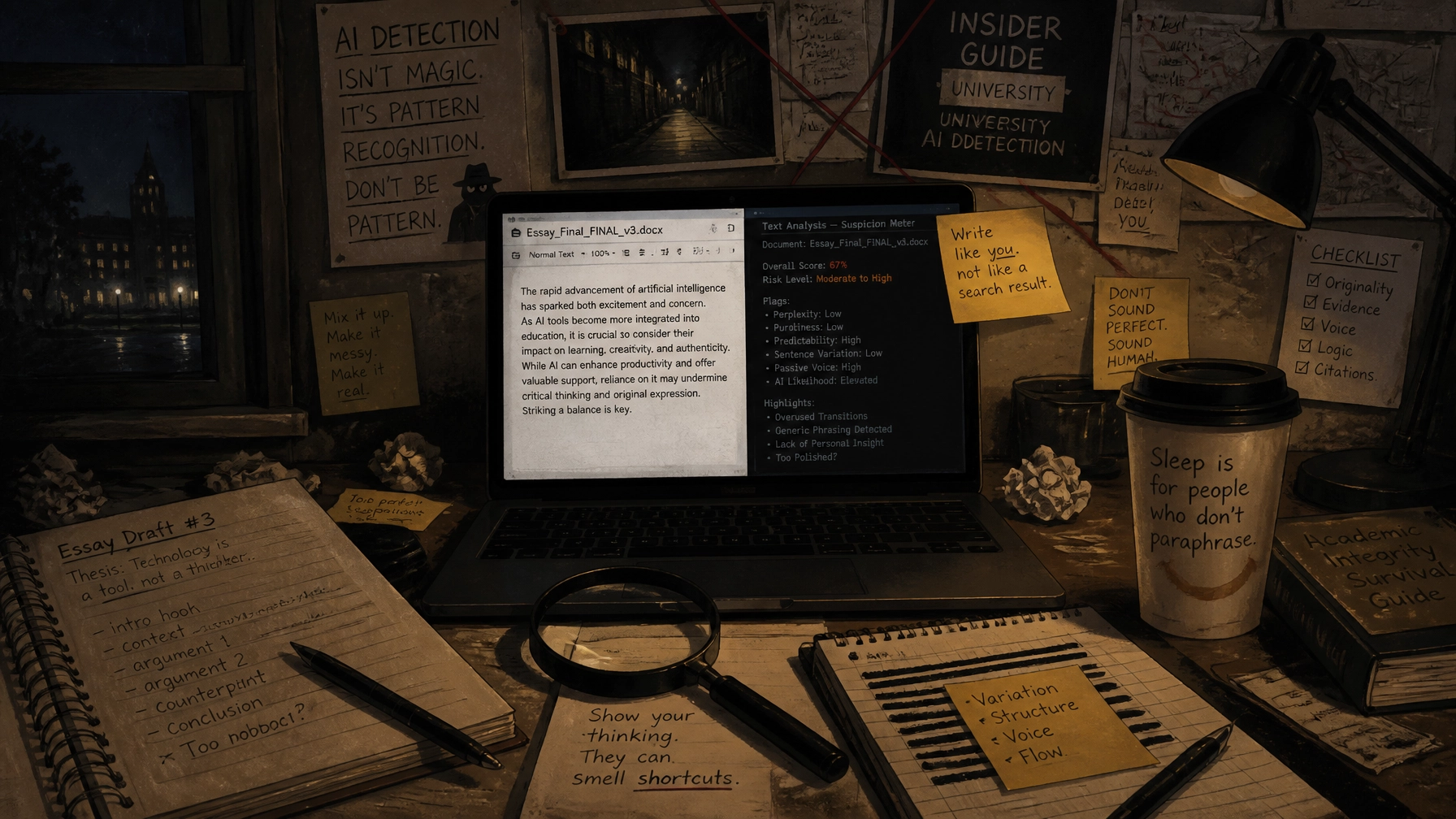
You know that moment. It’s 2:00 AM, your paper is due in a few hours, and the blinking cursor starts feeling a little judgmental. Maybe you used AI to get unstuck. Maybe you only “cleaned up a few lines.” Maybe now you’re staring at the submit button like it’s a trap.
Will your professor know?
Short answer: maybe faster than you think.
Here’s the behind-the-scenes version schools do not put on the homepage. Professors are not sitting around waiting for a dramatic red alert to flash across the screen. They are working inside a very normal, very nosy little system of checks: LMS integrations, plagiarism tools with AI flags, side-by-side comparisons with your past work, and old-fashioned suspicion when your paper suddenly sounds like it got a corporate rebrand overnight.
So yes, there is software. But there is also surveillance in the plainest university sense of the word. Your submission gets scanned. Patterns get flagged. In some classes, your writing style is basically on file. And once something looks off, a professor can start pulling at threads fast.
So let’s get into it. Not the brochure version. The actual reality, the common tells, and what’s happening behind the screen when your assignment lands in the system.
The Heavy Hitters: Turnitin and GPTZero
Most schools do not leave this to vibes alone. They wire detection software straight into systems like Canvas or Blackboard and let the quiet little surveillance machine do its thing.
Turnitin’s AI Indicator
You already know Turnitin as the plagiarism cop. Now it also flags writing that looks machine-produced.
- Why schools use it: It gives professors a neat, standardized way to say, “Hmm. Let’s look at this one again.”
- What it does: Turnitin scans for patterns commonly found in AI-written prose and highlights passages that look too smooth, too even, or too polished for the average stressed-out student draft.
- What professors know: It is not perfect. False positives happen, especially with short text. But on full essays, it gives faculty a starting point. And sometimes that is all they need.
GPTZero and the "This Looks Off" Score
Then there are standalone tools like GPTZero. These are less about plagiarism and more about pattern-matching. Basically, they are asking whether your writing sounds like a real student on a deadline or like something assembled in five seconds by a machine that has never suffered through a discussion board post.
The Pattern Problem: Why AI Writing Feels Weird
Here’s the behind-the-scenes part. Detectors are not reading your ideas with deep literary appreciation. They are scanning for patterns.

Human writing usually has:
- uneven sentence lengths
- odd little phrasing choices
- moments of personality
- occasional rough edges
AI writing usually has:
- suspiciously even rhythm
- very safe word choice
- polished but generic transitions
- that clean, beige, corporate-intern energy
That’s why so many AI-written papers feel “off” even before a tool flags them. They are often technically tidy and emotionally vacant.
Quick Writing Tip: Read your draft out loud. If every sentence sounds like it came from the same factory conveyor belt, break it up. Add a sharper line. Cut the fluff. Say the thing like a person.
The Vibe Check
Now for the part students underestimate: professors often just feel when something is not yours.
Yes, really.
Maybe your weekly posts sound natural, messy, and specific, and then suddenly your essay arrives sounding like a committee of overpaid consultants wrote it in a windowless room. That switch is loud. Professors notice it.
They notice when:
- your voice changes overnight
- your paper sounds weirdly formal for the assignment
- your phrasing gets stiff and generic
- your examples feel broad instead of lived-in
- your argument says words without actually saying anything
This is the vibe check. Not scientific in the neat little chart sense. But absolutely real.
And honestly? It catches a lot.
The "Professor’s Intuition": Human Red Flags
Software helps, but your professor has the real insider advantage: they know what students usually sound like. They know your class level. They know the assignment. And in a lot of cases, they have weeks of your writing sitting right there in the LMS.
That is the part students forget.
Discussion posts. Quiz responses. Reflection boards. In-class writing. Email tone. Short homework uploads. Universities collect a surprising amount of your “normal” voice without calling it that. So when a paper walks in overdressed, it stands out.
Even without a detector, several red flags can wreck your credibility:
- The Sudden Style Shift: If your discussion board posts sound normal and your final paper suddenly sounds like a Victorian press release, that contrast is not subtle.
- Made-Up Citations: This is one of the biggest giveaways. AI sometimes invents sources that look legitimate until somebody actually searches for them. One missing DOI later, and now everybody is having a bad day.
- Generic Filler Lines: Phrases like "It is important to note" and other empty transitions are classic tells. They sound polished until you realize they are saying almost nothing.
The ESL Dilemma: An Unfair Reality
There’s another uncomfortable truth here: AI detectors can be wildly unfair to ESL students. Research keeps showing that polished, grammatical, more formal English from non-native speakers gets flagged more often than it should.
That is not a minor glitch. That is a real problem.
Why does it happen? Because structured, careful writing can resemble the neat patterns detectors associate with AI. So if English is not your first language, you can end up looking “too clean” on paper even when the work is fully yours.
Keep your drafts. Save your outline. Hang on to your notes and source trail. If a professor ever questions your work, that paper trail matters.
Messy process. Beautiful evidence.
How to Stay Safe
The smart move is not trying to beat the detector. The smart move is giving professors less to be suspicious about in the first place.
That means:
- keep your drafts
- save your outline
- keep research notes and source links
- revise the wording until it sounds like your actual voice
- check every citation like your grade depends on it, because, well, it might
And if you are overwhelmed, get support early. Not in a panic at 2:11 AM. Early.
At Submit Your Assignments, we keep that support practical and low-drama. You can use our help for model papers, editing and humanization, brainstorming, outlining, and reference materials that help you understand what strong work actually looks like.
Why Students Trust Our Process:
- 94% Average Rating: Students stick with us because the process is clear and reliable.
- Human-First Writing Support: You get custom materials prepared by experienced writers.
- Student-Friendly Pricing: We charge like a bird because budgets are painfully real.
- More Freedom: You get breathing room while still learning how to tackle the assignment.

Fun Facts & Local Notes
- Did you know? Turnitin started back in 1998, way before the current AI panic cycle.
- Houston Highlight: A strong coffee and a brutally honest self-edit can fix more than you think.
- A lot of AI detection starts with software, but plenty of suspicion still starts with plain old professor side-eye.
If you want subtle, practical academic backup, trust our writers to help you get organized, revise smarter, and submit with more peace of mind.
Get a Quote and Start Your Order Today!
Submit Your Assignments provides custom reference materials and tutoring services for research and educational purposes only. We encourage all students to follow their institution's academic integrity policies.