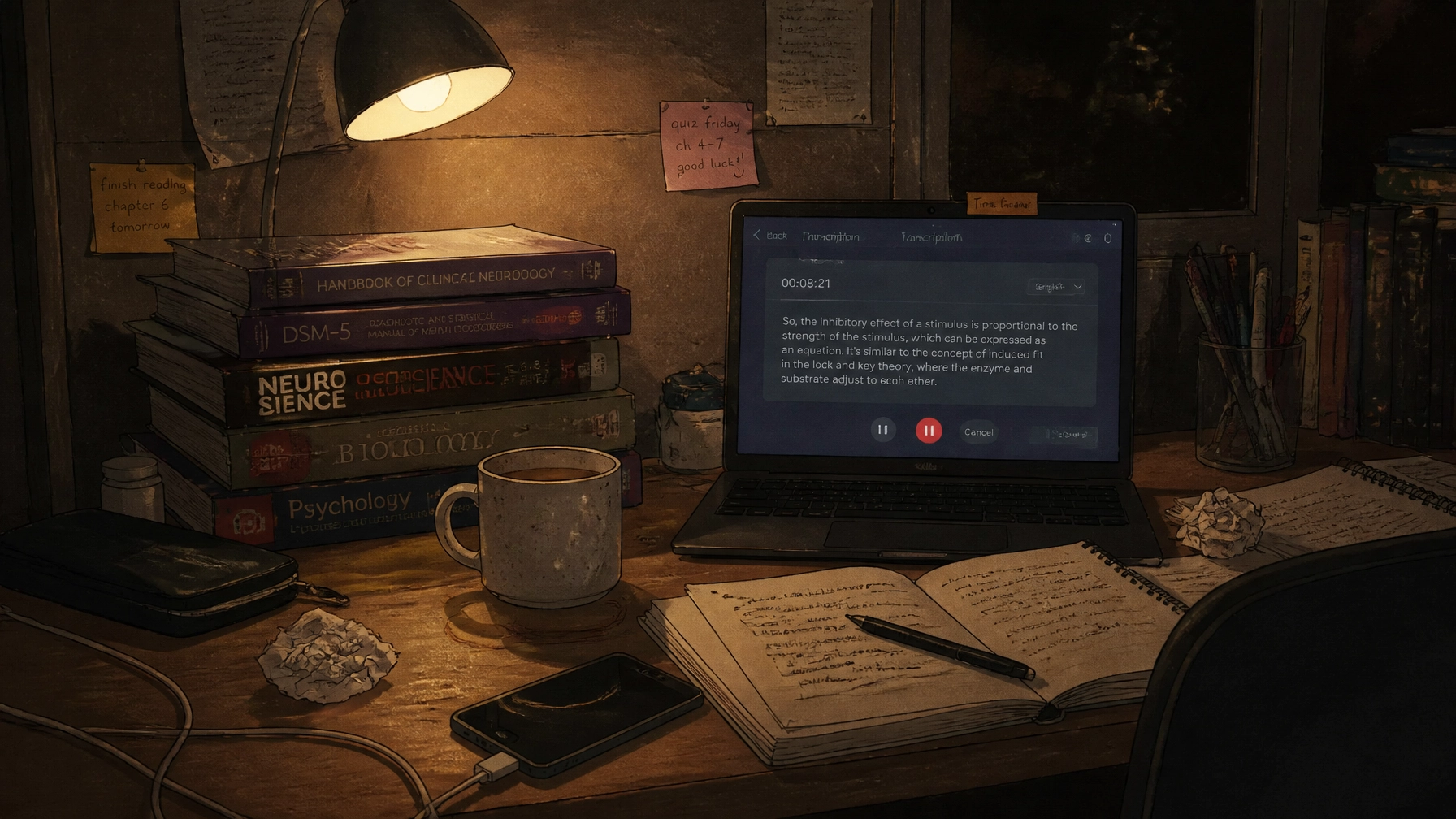
You’re sitting in a three-hour lecture, your hand is cramping, and the professor is talking like they’re trying to win a speed-reading competition. You look down at your notebook and realize your handwriting has devolved into ancient hieroglyphics that even you can't read. Sound familiar?
We’ve all been there. The "grind" of taking handwritten notes feels productive, but let’s be real: half the time you're just a human typewriter. You aren't actually learning the material; you’re just desperately trying to catch every word before the slide changes. It’s exhausting. It’s slow. And honestly, it’s a bit of a vibe killer when you could be actually engaging with the class.
What if you could stop the frantic scribbling and actually start getting it? What if you had more time to actually live your life instead of spending your Friday night deciphering messy ink stains?
Here are 7 study hacks that will save your sanity and your GPA.
1. Let Your Phone Do the Heavy Lifting
Why are you still trying to out-type a PhD? Just record the lecture. But don't just let that audio file sit in your "Voice Memos" app to die. That’s a trap. Use an audio transcription tool to turn that recording into a clean, searchable text document.
This is a total game-changer because you can actually listen to the professor. You can watch their hand gestures, see what they emphasize, and maybe even participate in the discussion. Later, you just search the transcript for "Midterm Exam" and boom, everything you need is right there.

2. The "Lazy" Flashcard Method
Making flashcards is the worst part of studying. You spend three hours making them and then you're too tired to actually use them. Stop that.
Copy and paste your reading material into an AI Note and Flashcard Generator. It’ll pull out the key terms and definitions for you. Now, instead of wasting time on the "making" part, you can spend all your energy on the "remembering" part. That’s where the actual grades come from anyway.
3. High-Speed Active Recall with AI Quizzes
Reading your notes over and over is basically just a way to lie to yourself. You think you know the material because it looks familiar, but the moment the exam starts, your brain goes blank.
Quick Writing Tip: Always test yourself before you think you’re ready. Use a tool to generate a quiz from your lecture notes. It forces your brain to dig for the info. If you can’t answer it now, you definitely won't answer it during the final.
4. The Digital "Blurting" Method
If you haven't tried blurting yet, you're missing out. Usually, it involves writing everything you know on a whiteboard and then checking what you missed. It’s great, but it’s messy.
Try the digital version: Record yourself talking about a topic for five minutes. Just "blurt" everything you remember. Then, transcribe that audio. Compare your "blurt" transcript to the actual lecture transcript. Whatever is missing is exactly what you need to study. It’s fast, it’s effective, and you don’t need a whiteboard.

5. Reverse-Engineer Your Essay Rubric
Ever get a paper back and realize you missed a whole section because you didn't read the rubric properly? Yeah, it hurts.
Before you submit anything, use an AI Essay Review tool. You can literally upload your rubric and your essay, and it will tell you if you actually followed the instructions. It checks for logic, flow, and even "professor suspicion indicators" (aka, does it sound like a robot wrote this?). It’s like having a tutor look over your shoulder without the awkward small talk.
6. The "Feynman Technique" on Autopilot
The best way to learn something is to explain it to a five-year-old. Since you probably don't have a five-year-old handy, just explain it to your phone.
Talk through a difficult concept like you’re teaching a friend. If you stumble or can't explain a certain part, you've found a gap in your knowledge. The best part? If you use a transcription service, you’ve just created a custom study guide in your own words.
7. Stop Caring About "Perfect" Notes
Perfect notes don't win awards. Grades do. And sanity does. If a lecture is moving too fast, stop writing. Just focus on the "vibes" of the main points and let the technology capture the details.
Pro-tip: Spend the first 10 minutes after class looking at your transcribed notes. Highlight the three most important things while they’re fresh. That’s it. You’re done for the day. Go get a taco.

Why We’re Doing This
Look, being a student in 2026 is hard enough. You’re juggling classes, probably a side hustle or a part-time job, and trying to have a social life that isn't just sending memes in the group chat. We get it.
At Submit Your Assignments, we don't think you should have to choose between a good grade and a good night's sleep. That’s why we built a whole hub of free tools for you to use. We want to help you work smarter, not harder.
Whether you need to generate flashcards, transcribe a messy audio file, or get a professional human writer to help you structure a massive research paper, we’ve got your back. We "charge like a bird", small and light, because we know what it’s like to live on a student budget.
How it works:
- Head to the Student Hub.
- Pick your tool: Notes, Quizzes, Transcription, or Essay Review.
- Upload or Paste: It takes about 30 seconds.
- Profit: (And by profit, we mean go outside and see the sun).
Stop worrying about whether your handwriting is legible. Trust our tools to handle the busy work so you can focus on actually being a human. You deserve the freedom to enjoy your college years, not just survive them.

Quick Fun Facts for the Bored Student:
- Did you know that the average student spends over 15 hours a week just taking and organizing notes?
- Research shows that you forget about 70% of what you hear in a lecture within 24 hours if you don't interact with it.
- The "all-nighter" is actually counterproductive, your brain literally stops forming long-term memories after about 18 hours of being awake.
- Coffee is great, but water actually helps your brain process information faster. (But yeah, we're still drinking the coffee).
Listen up: you don't have to do this the hard way. Check out our custom assignment services or play around with our free student tools. Your future self will thank you.
Check out more from our blog:
- How to Structure a Research Paper Without Losing Your Mind
- The Ultimate Guide to Avoiding AI Detectors
Submit Your Assignments provides custom reference materials and tutoring services for research and educational purposes only. We encourage all students to follow their institution's academic integrity policies.