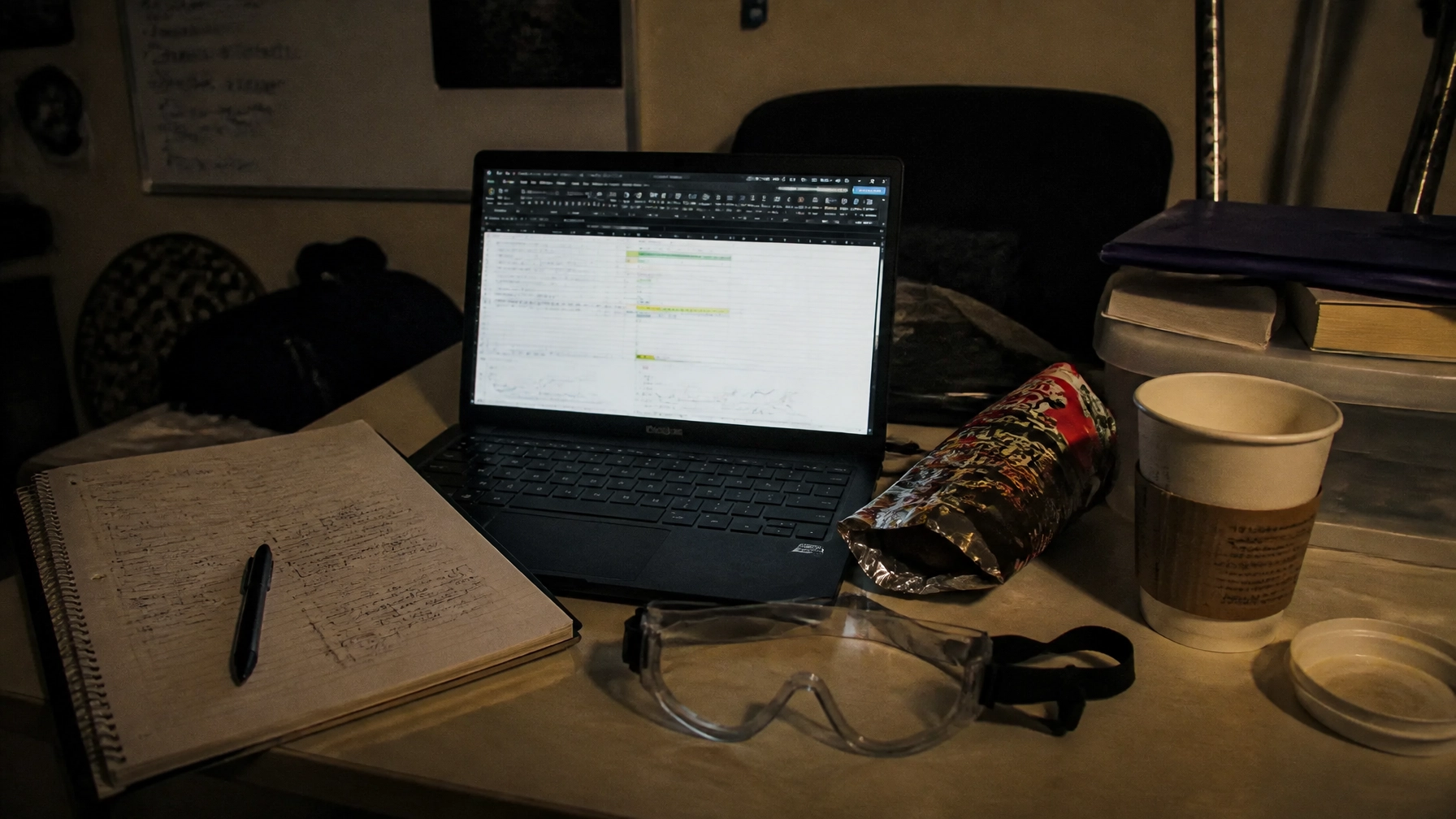
You’ve just spent three hours in a freezing lab, smelling like sulfur or vinegar, staring at a beaker that refused to change color. Now, you’re sitting at your desk with a pile of messy notes, a spreadsheet full of raw numbers, and a deadline that’s creeping up way too fast.
The lab report. It’s the bane of every STEM student’s existence. Whether you’re at Houston Community College or a major university, the struggle is the same: how do you turn all that "science stuff" into a formal document that won't make your professor reach for their red pen?
Don’t panic. Writing a high-quality lab report is actually just like following a recipe, once you know the ingredients and the order, the rest is just the grind. Here is the ultimate breakdown of how to crush your next lab report without losing your mind.
The Anatomy of a Perfect Lab Report
Professors are picky. They have a mental checklist they follow while grading, and if you miss a section, you’re basically handing them points. Most STEM reports follow a standard structure. Here is how to handle each one.
1. The Abstract (Write This Last!)
Think of the Abstract as the "TL;DR" of your lab report. It’s a short paragraph (usually 150-250 words) that summarizes everything.
- The Hook: What was the goal?
- The How: Briefly, how did you do it?
- The What: What were your main results? (Yes, include the actual numbers!)
- The So What: What’s the final conclusion?
Pro Tip: Seriously, write this last. You can’t summarize a paper that isn't finished yet.
2. Introduction: Why Should We Care?
This is where you set the scene. You need to explain the theory behind the experiment. If you’re testing gravity, don't just say "we dropped stuff." Explain Newton’s Laws.
- Define key terms.
- State your Hypothesis clearly. (e.g., "If we increase the temperature, then the reaction rate will double.")
- Keep it focused. Professors hate the "theory dump" where you copy half the textbook. Only include what actually matters for your experiment.

3. Materials and Methods: The Recipe
Imagine another student has to repeat your experiment using only your report.
- Use Past Tense: You already did the work, so it's "The solution was heated," not "Heat the solution."
- Be Precise: Instead of saying "a bit of water," say "15.0 mL of distilled water."
- Avoid "Then… Then… Next": Group your steps logically. It’s a report, not a cooking show.
4. Results: Just the Facts
This is where most students trip up. The Results section is for data only. No opinions. No "I think the experiment failed because…"
- Tables & Figures: Use them! A wall of text full of numbers is a professor's nightmare.
- Captions: Every table and graph needs a title (e.g., Table 1: Mass of Precipitate vs. Concentration).
- Units: If you forget to label your units (g, mL, m/s²), you're asking for a lower grade.

5. Discussion: The "Meat" of the Report
This is the most important section. This is where you explain why things happened.
- Did your results support your hypothesis?
- Compare your results to the "accepted" value. If you found the speed of light was 5 mph, you need to explain why that's wrong.
- Error Analysis: Don't just say "human error." That’s lazy. Was it a calibration issue? A parallax error? A change in room temperature? Be specific.
6. Conclusion
Wrap it up in one short paragraph. Restate your main finding and whether your hypothesis was right. No new info allowed here!
Formatting Requirements: APA vs. MLA
In the world of STEM, formatting is everything. Most science classes will use APA 7th Edition or CSE, while some might stick to MLA.
- APA: Focuses on the date of research. Very common in Psychology and Social Sciences.
- MLA: More common in general education or English-based science courses.
- The Golden Rule: Always check your syllabus. If your professor wants a specific font or margin size, give it to them. It's the easiest way to keep your "A."
Mistakes Professors Absolutely Hate
Before you hit submit, check for these "vibe killers" that drive instructors crazy:
- The "Figure Out" Trap: Avoid colloquial language. Don't say "We figured out the mass." Use "We determined the mass" or "The mass was calculated."
- Raw Data Dumps: Never just paste a giant Excel sheet into your report. Process that data into a clean table.
- Mixing Up "Data" and "Datum": Fun fact, "data" is plural. "The data are consistent," not "The data is consistent."
- Floating Figures: Don't just drop a graph into the middle of a page without mentioning it in the text. You should always say, "As shown in Figure 2…"
Quick STEM Writing Tips
- Proofread aloud: Technical terms are hard to spell, and spell-check won't catch it if you wrote "ether" instead of "either."
- Significant Figures: If your instrument only measures to two decimal places, your final answer shouldn't have eight.
- Be Concise: Science writing isn't about flowery adjectives. It's about being clear and fast.
Need a Hand With the Grind?
Let’s be real: sometimes the lab work is fun, but the writing is a total drag. If you’re juggling three other classes, a job, and trying to have a life, sitting down to write a 10-page STEM research paper can feel impossible.
That’s where we come in. At Submit Your Assignments, we specialize in helping students navigate the heavy lifting of academic writing. Whether you need a custom reference paper to help you structure your own report, or you need a professional editor to check your citations, we’ve got your back.
We "charge like a bird" (meaning we keep things light and affordable for students), so you can get the help you need without breaking the bank. Don't let one bad lab report tank your GPA.
Stop worrying about the formatting and the "theory dumps." Focus on the learning, and let us help you with the polishing.
Check out our free student tools or request a quote for Houston Community College writing help today.

Fun Facts for the Lab
- The "Euchre" Effect: Scientists often find their best breakthroughs when they're not looking for them (think Penicillin).
- Texas Pride: Houston is home to some of the most advanced medical and energy research labs in the world, you’re in the right place to be a STEM student!
- Coffee is King: Approximately 80% of STEM students admit to relying on caffeine to get through lab write-ups. (Okay, we made that number up, but it feels true, right?)
Wait! Before you go: If you're using AI to help brainstorm your lab report, make sure you know how to humanize that draft so your professor doesn't flag it. Check out our guide on Turnitin secrets to stay ahead of the game.
Submit Your Assignments provides custom reference materials and tutoring services for research and educational purposes only. We encourage all students to follow their institution's academic integrity policies.