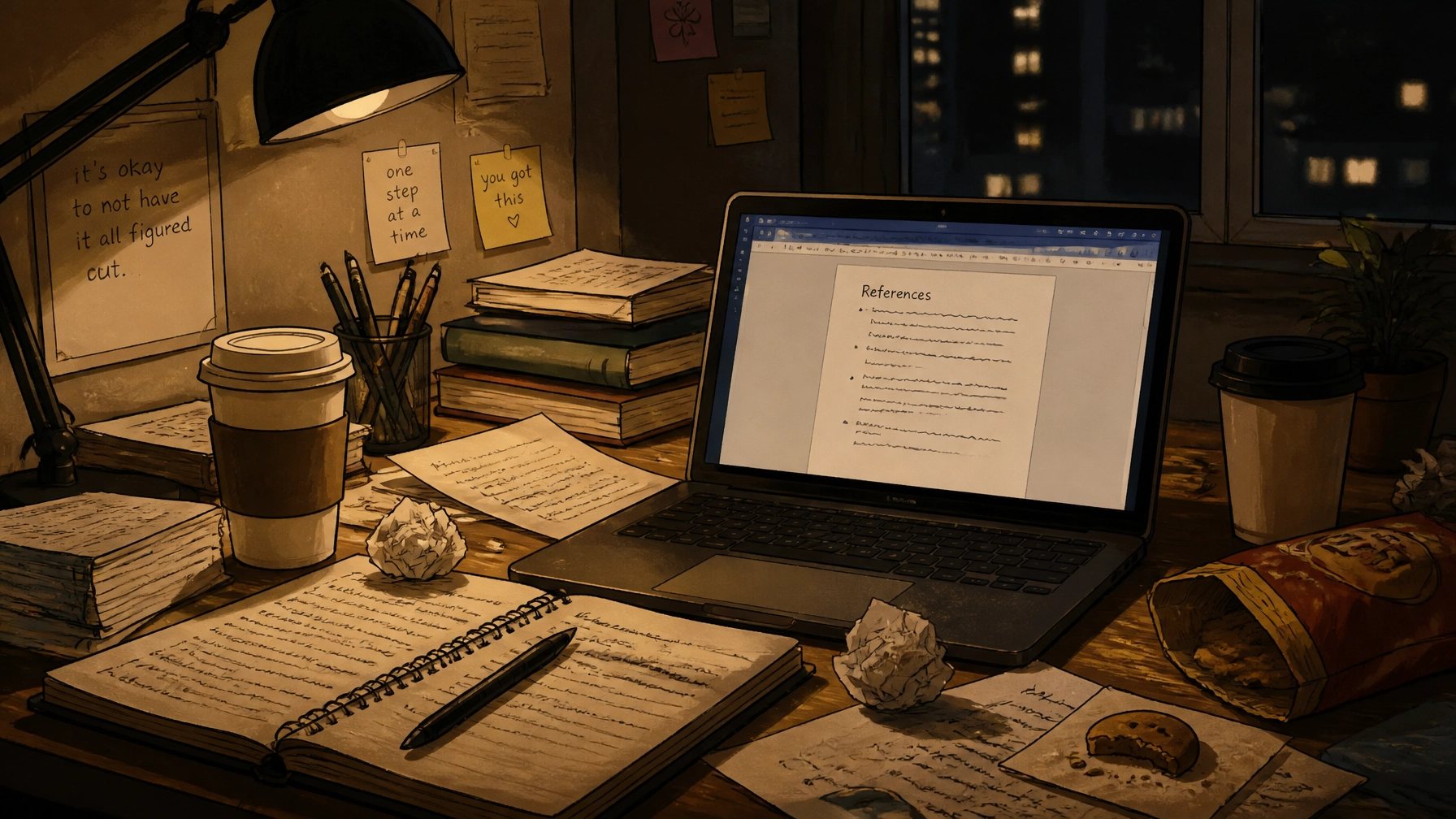
It’s 2:00 AM. You’ve finally finished the last paragraph of your 10-page research paper. Your eyes are blurry, your third cold brew has officially betrayed you, and all you want to do is hit "Submit" and vanish into a 12-hour nap. But then you remember: the Reference list.
You look at your pile of open tabs: three journal articles, a random PDF from a government site, and a YouTube video you’re pretty sure is academic enough: and you feel the soul-crushing weight of APA 7th edition formatting.
Why does a hanging indent feel like a personal attack? Why does the period go there but not there?
Take a deep breath. We’ve all been in that citation-induced spiral. Whether you’re working on a first college research paper or a complex engineering report for Texas A&M Galveston, mastering the "References" page doesn't have to be your villain origin story.
The Quick APA Cheat Sheet
Before we dive into the nitty-gritty, here are some quick vibes to keep your formatting on track. If you do nothing else, do these:
- Alphabetize everything: Use the first author’s last name. No author? Use the title.
- Double space only: Don’t add extra gaps between sources to make the list look longer. Your professor knows.
- Hanging indents are king: The first line of each source is flush left; every line after that is bumped in 0.5 inches.
- Sentence case for titles: In APA, we don’t capitalize every word in a title. Just the first word, the first word after a colon, and proper nouns.

Step 1: Setting Up the Page (The "Clean Aesthetic" Look)
Your reference page isn't just a list; it’s a vibe. It needs to look professional, even if your actual desk looks like a hurricane hit a Starbucks.
First, start a brand-new page. Don't just hit "Enter" until you reach the bottom of your conclusion: use a page break (Ctrl + Enter is your best friend). At the very top, center the word References in bold. No italics, no underlining, no giant fonts. Just plain, bold text.
The Hanging Indent Hack
This is where most students lose their minds. You try to use the "Tab" key, and suddenly your whole bibliography is a zig-zag mess. Stop.
Here is how you do it in Word or Google Docs:
- Highlight your entire list of sources.
- Go to the "Paragraph" settings (the little arrow in the corner of the Paragraph box).
- Look for "Special" and select Hanging.
- Make sure it’s set to 0.5".
And just like that, you look like a citation pro. No more manual tabbing required.

Step 2: Breaking Down the Sources
Different sources have different "personalities" in APA. Here’s how to handle the ones you’ll actually use.
The Journal Article (The Academic Staple)
If you’re using Galveston College research paper support resources, you’re likely pulling from databases like JSTOR or EBSCO.
The Pattern:
Author, A. A., & Author, B. B. (Year). Title of the article in sentence case. Journal Title in Title Case, Volume(Issue), Page–Page. https://doi.org/xxxx
Example:
Fisher, S. M. (2023). Coastal erosion and its impact on Gulf Coast communities. Journal of Marine Science, 12(4), 88–102. https://doi.org/10.1037/mar0000123
The Book (The Classic)
Simple and clean. Just remember: no publisher location anymore! APA 7th edition cut that out to save us all some time.
The Pattern:
Author, A. A. (Year). Title of book in sentence case (Edition if needed). Publisher.
Example:
Miller, R. J. (2021). Engineering the future: Maritime structures and design. Anchor Press.
The Webpage (The "Wild West")
Webpages are tricky because they often lack dates or authors. If there's no date, use (n.d.). If the author is a company (like NASA or the WHO), use the company name as the author.
The Pattern:
Author, A. A. (Year, Month Day). Title of page in sentence case. Site Name. URL
Example:
National Oceanic and Atmospheric Administration. (2024, February 14). Understanding tide patterns in Galveston Bay. NOAA. https://www.noaa.gov/galveston-tides
Why Formatting Matters for TAMUG and Galveston Students
If you’re a student at Texas A&M Galveston, your engineering reports or marine biology papers aren’t just about the data. They’re about professional credibility. In the maritime and engineering industries, precision is everything. If you can’t get a period in the right place on a reference list, a hiring manager might wonder if you can get a decimal point in the right place on a structural blueprint.
The same goes for the Galveston College grind. Professors there use APA to prepare you for the "real world" of academic writing. It feels like busy work, but it’s actually about learning how to credit the giants whose shoulders you’re standing on.

Feel Like You’re Still Drowning?
Look, we get it. Sometimes the "grind" is too much. Between a part-time job, trying to have a social life, and surviving finals week, a 20-source reference list can be the straw that breaks the camel's back.
With that being said, you don’t have to do it alone. At Submit Your Assignments, we don’t just "write papers." We provide the scaffolding you need to succeed. Think of us as your academic pit crew. Whether you need a model paper to see how APA is actually done or help polishing an AI draft so it sounds like a human wrote it, we’ve got your back.
Our writers are experts in various styles: including the dreaded APA 7: so you can stop worrying about hanging indents and start living your life.
Why Students Trust SYA:
- 100% Human Written: We have an authenticity promise because we know your reputation is on the line.
- Fast Delivery: We "charge like a bird" (fast and light!) to make sure you never miss a deadline.
- Student-Friendly: We’ve been where you are. We know the stress, the all-nighters, and the pressure.
Final Pro-Tips for Your References
- Don't trust citation generators 100%: They often mess up the capitalization (Sentence Case vs Title Case). Always double-check.
- DOI over URL: If a journal article has a DOI (Digital Object Identifier), use that. It’s a permanent link, whereas URLs can break.
- Check your in-text citations: Every source in your reference list must appear in your paper, and every source in your paper must be in the list. It’s a 1-to-1 match.
Fun Facts About Galveston (Because you need a break)
- Did you know Galveston was the first city in Texas to have electric lights and telephones?
- The "Great Storm" of 1900 is still the deadliest natural disaster in U.S. history: which is why the Seawall exists!
- The Elissa (the tall ship at the Texas Seaport Museum) is one of the oldest sailing hulls still in operation.
Stop stressing over the small stuff. Let us help you handle the heavy lifting so you can focus on the big picture.
Trust our writers. Stop worrying. Submit your assignment.
Submit Your Assignments provides custom reference materials and tutoring services for research and educational purposes only. We encourage all students to follow their institution's academic integrity policies.