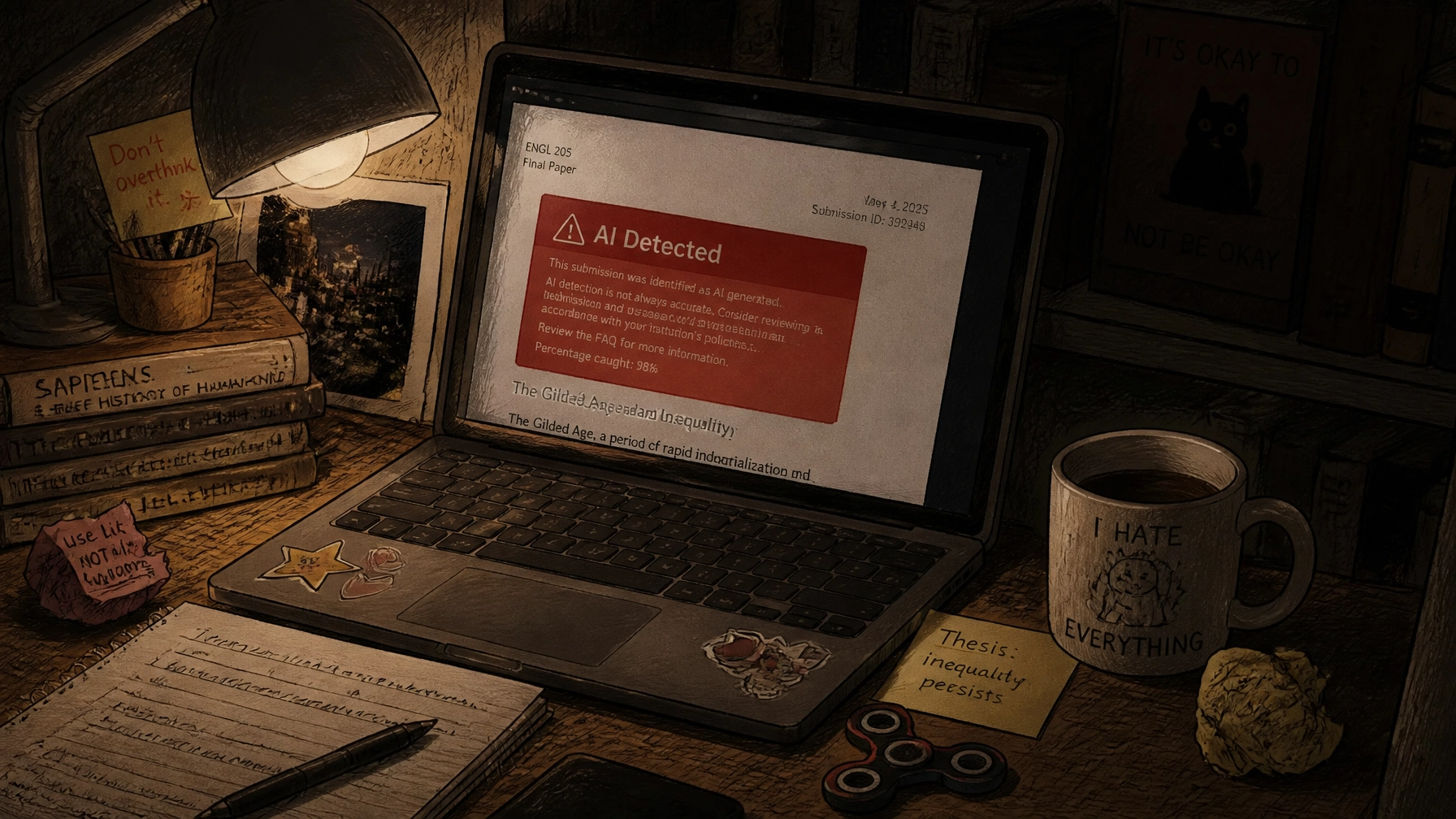
You just spent twelve hours in a hyper-fixation spiral, deep-diving into the nuances of 18th-century maritime law or the metabolic pathways of rare fungi. You finally hit "Submit," your brain is fried, and you’re ready to sleep for three days. Then, the notification pings.
Your professor flagged your paper for "High AI Probability."
Wait, what? You literally wrote every single word. You have the messy drafts, the thirty-seven open tabs, and the literal caffeine shakes to prove it. But according to some algorithm sitting in a server room, you write like a robot.
If you’re neurodivergent: whether you have ADHD, Autism, or any other flavor of "spicy brain": this isn't just a glitch. It’s a systemic problem. Dealing with AI detection when neurodivergent is the new final boss of academic life, and honestly, the vibes are rancid.
Why the Algorithm Hates Your Brain (Technically Speaking)
AI detectors like Turnitin or GPTZero don't actually "know" if a human wrote something. They are just math machines looking for patterns. They look for two main things: perplexity and burstiness.
- Perplexity: This is how "random" your word choices are. AI likes to pick the most statistically likely word.
- Burstiness: This is the variation in your sentence length. AI tends to write very uniform, rhythmic sentences.
And here is the kicker: many neurodivergent people naturally write with low perplexity and low burstiness. If you’re a literal thinker, you might use precise, direct language. If you like structure, your sentences might naturally follow a consistent, logical rhythm.
To a dumb algorithm, "precise and structured" equals "Robot." It’s basically punishing you for being clear and organized.

Quick Tips to "Humanize" Your Naturally Direct Writing
Before we get into the heavy stuff, let’s talk about how to protect your work right now. You shouldn't have to "perform neurotypical" just to pass a class, but a few small tweaks can save you a massive headache with your professor.
- Vary your "Burstiness": Try to throw in a super short sentence right after a long one. Like this. It breaks the "robotic" rhythm that detectors look for.
- Keep your "Reciepts": Always write in a program with a version history (like Google Docs). If a professor accuses you, show them the hour-by-hour grind of how that paper came to life.
- Add Personal Anecdotes: AI is terrible at telling real stories about that one time you forgot your keys in the fridge. Sprinkle in specific, lived-experience details that only a human would know.
- Use Rhetorical Questions: Why would a robot ask you a question it already knows the answer to? Exactly.
Prompts to Make AI Support Your Neurodivergent Voice
Look, we know AI is a literal lifesaver for getting past "Blank Page Syndrome." But if you use it for brainstorming or outlining, you need to make sure it’s actually mirroring you, not a generic Silicon Valley chatbot.
If you’re looking for prompts to make AI text pass as neurodivergent writing, stop trying to "trick" the system and start training the AI to match your specific style. Try this prompt next time you're using a tool for brainstorming:
"I am neurodivergent and my natural writing style is very direct, structured, and literal. I want you to analyze this sample of my actual writing [Paste Sample]. Now, help me brainstorm an outline for my essay on [Topic], but use my specific voice. Avoid flowery language, 'marketing' filler, and overly uniform sentences. Keep the directness but vary the sentence length to match how a human actually thinks."
By using AI as a mirror rather than a ghostwriter, you keep the "human" in the loop. But even then, those detectors are getting more aggressive every day.

Dealing with AI Detection When Neurodivergent: The Advocacy Part
It is deeply unfair that you have to defend your identity just because an algorithm has a narrow definition of "human." If you get flagged, don't panic. Take a deep breath and advocate for yourself.
Explain to your professor that AI detectors have a documented bias against neurodivergent and non-native English writers. Ask for a human review of your work. Most professors don't actually want to fail a student who did the work; they're just scared of the technology.
But let’s be real: sometimes you don't have the spoons for a fight. You’re already juggling a full course load, maybe a part-time job, and the general chaos of being a student in 2026. That’s where a human touch makes all the difference.
The SYA Difference: Why We Don’t Do "Robotic"
At Submit Your Assignments, we’ve seen students get burned by AI over and over again. It’s why we’ve stayed committed to a 100% human-led process. When you work with us for essay services or tutoring, you’re not getting a generated response. You’re getting a writer who understands nuance, tone, and the "burstiness" of real human thought.
We provide custom reference materials and editing that actually sound like you. Our team knows how to structure a paper so it’s academic gold without triggering those "bot" alarms. Think of us as your academic sous chefs: we help you prep the meal so you can focus on actually living your life.
And if you’re worried about whether the work is legit? Every project we handle is backed by a commitment to quality that no AI can touch. We even have a Human Authenticity Certificate to give you that extra peace of mind.

Stop Worrying and Start Thriving
You shouldn't have to choose between your mental health and a high GPA. If dealing with AI detection when neurodivergent is making you want to drop out, listen up: you’re not the problem. The system is.
Whether you need a full consultation on a complex research paper or just someone to help you edit your thoughts into a coherent flow, we’ve got your back. We "charge like a bird" (student-friendly prices, always) and treat you like a human, not a number.
A Few "Spicy Brain" Fun Facts:
- Did you know some of the most famous authors in history (like Agatha Christie) were likely neurodivergent? They didn't have AI detectors to worry about, and neither should you.
- Fidgeting actually helps some people focus because it increases dopamine levels: so keep that spinner spinning while you write!
- "Body doubling" (working alongside someone else) is one of the most effective ways for ADHDers to get through an essay. We’re basically your digital body double.
Ready to get that "No Homework and Chill" vibe back? Trust our writers to help you navigate the academic grind without the AI drama.

Submit Your Assignments provides custom reference materials and tutoring services for research and educational purposes only. We encourage all students to follow their institution's academic integrity policies.