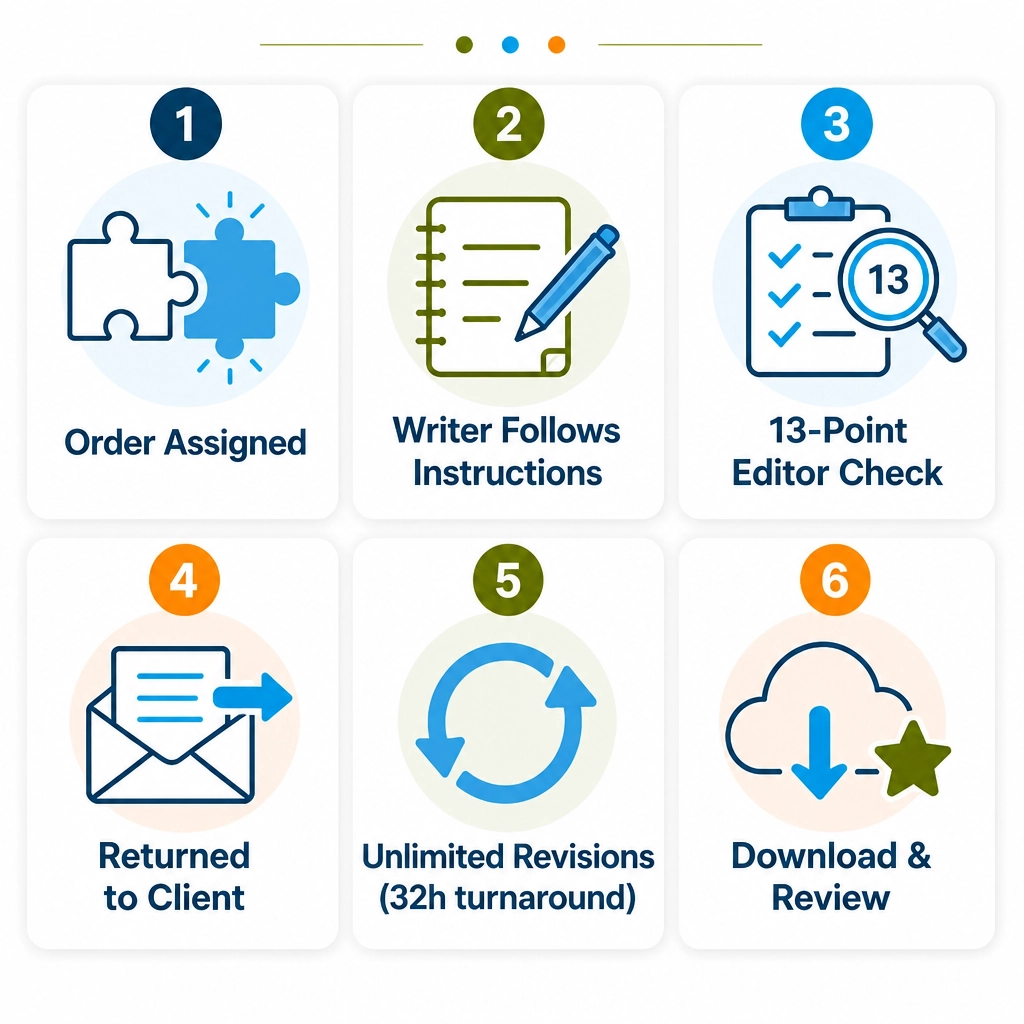
Tell us what you need to be written or edited by filling out a brief form. Start by registering or logging in via the order now form, or the register or login tabs.
Step 2
You can pay a deposit(half) or the full amount of the order for a writer to begin.
Step 3
We will find you a suitable writer within a few short hours. If you selected Preferred Writer, it’ll go to the writer of your choice if they are available.
Step 4
Get an email and/or SMS notification to download your paper when it’s ready for you.
Reviews, comments and love from our customers and community
You may have been the type of high school student that turned in all of your assignments on time, and even early on occasion. The benefit of this study style is that you take learning seriously and respect deadlines. You have good time management skills when it comes to getting work done. But you can still benefit from the help of Submit Your Assignments.
The college years are a new and challenging period of time for most students. Even those who excelled in high school might find that college is much more difficult. The classes are harder and you have to do much more work to stay on top of things. Also, there are many other activities you want to get involved with, so you don’t have the same amount of time to dedicate to your classwork and studying. You still care about school, but you spend more time making lists than crossing anything off of them.
Professional Essay Writers for Stressed Students
Scenario. You are a full-time student at a respectable university. You also have a full-time job, and while you manage to attend both on time, you are exhausted by the time you get home. In fact, you probably have something to eat and go straight to bed after a short movie. The next step in this scenario is you attend your morning English class and your professor assigns an 8-page research essay. You are required to site 2 pages of sources and conduct an in-depth analysis of a complicated social issue. As she gives this assignment, all you can think about is your 6-hour shift after your classes, and how you need to do the dishes and walk the dog before you go to bed. In fact, the rest of your week will look something like this. So when will you have the time to write your essay and ensure your grade?
Trustindex verifies that the original source of the review is Google.
They provide original and well organised content
Posted on Google
Leonard Bradley
347 days ago
Trustindex verifies that the original source of the review is Google.
Soo thankful for this company!
Posted on Google
Lynn Cox
1321 days ago
Trustindex verifies that the original source of the review is Google.
Great work I received an A on my paper
Posted on Google
Sadie Perry
3062 days ago
Trustindex verifies that the original source of the review is Google.
This company is truly a blessing. Working, going to school full time and also being a single parent can be overwhelming. This company help me out so much! I have use them several times and receive all A's coming back from my professors. I would definitely recommend this company for help with homework!
Posted on Google
Moises Villasenor
3790 days ago
Trustindex verifies that the original source of the review is Google.
Very professional and thorough with their work. Couldn't have asked for a better grade on my paper. Thanks for your help!
Posted on Google
Joel Casiano
3795 days ago
Trustindex verifies that the original source of the review is Google.
Highly recommend! All my assigments were given ahead of time to review and give feed back to the writer for anything that I had questions on. Grades on papers were good!! Will work with them again!
Posted on Google
Brighton Daniel
3888 days ago
Trustindex verifies that the original source of the review is Google.
The whole process was professional. I knew every step of the way how Far along the writers were with my paper. I recieved an A and passed my class. I am very happy with this service.
Posted on Google
Nathan Arriaga
3888 days ago
Trustindex verifies that the original source of the review is Google.
Submitted my assignment and got it returned in time for the due date, got an 89 on the first and 91 on the second. Great time saver!!!
Posted on Google
T. Hamilton
3941 days ago
Trustindex verifies that the original source of the review is Google.
outstanding help done by this business. one of the highest grades I've gotten so far. would recommend!!
Posted on Google
David O
3944 days ago
Trustindex verifies that the original source of the review is Google.
I was in a tough spot for a paper and was struggling to grasp the material and write the required paper. The team here was able get me where I needed to be before the assignment was due. I got a 98% on the paper, had I written it alone I would have come no where close. Highly recommend to try this service!
Verified by Trustindex
Trustindex verified badge is the Universal Symbol of Trust. Only the greatest companies can get the verified badge who has a review score above 4.5, based on customer reviews over the past 12 months. Read more
How Changeable is Our Privacy Policy?
We continuously strive for improvement and we update our website regularly to improve your experience of ordering papers from us. Therefore, we always develop our policies.
We keep all policy information updated, including our policy on Privacy. We recommend you to monitor our policy pages for the most current news.
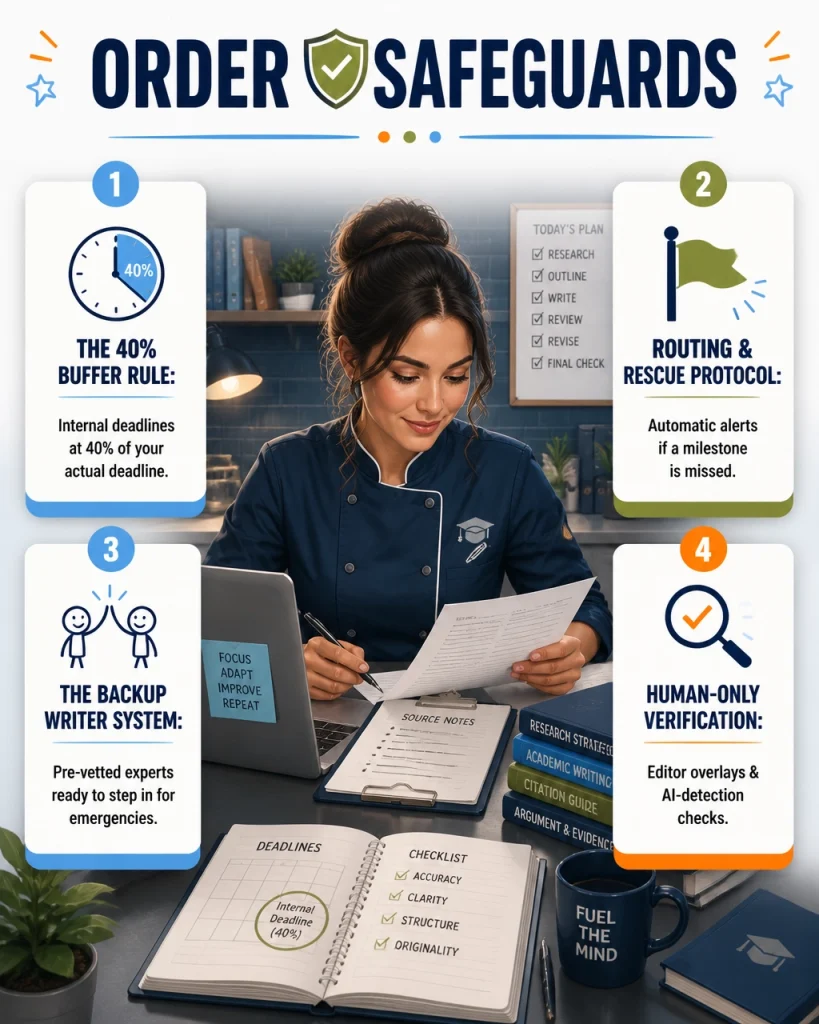
Every paper we produce is original. Furthermore, their authenticity is supervised by our plagiarism detection system. All papers will be correctly referenced using the citation style you specify. We carefully monitor papers for inaccurate information and incorrect citations.
We guarantee that all papers are authentically produced with no recopying or rephrasing to ensure fully non-plagiarized work.
Who We Employ
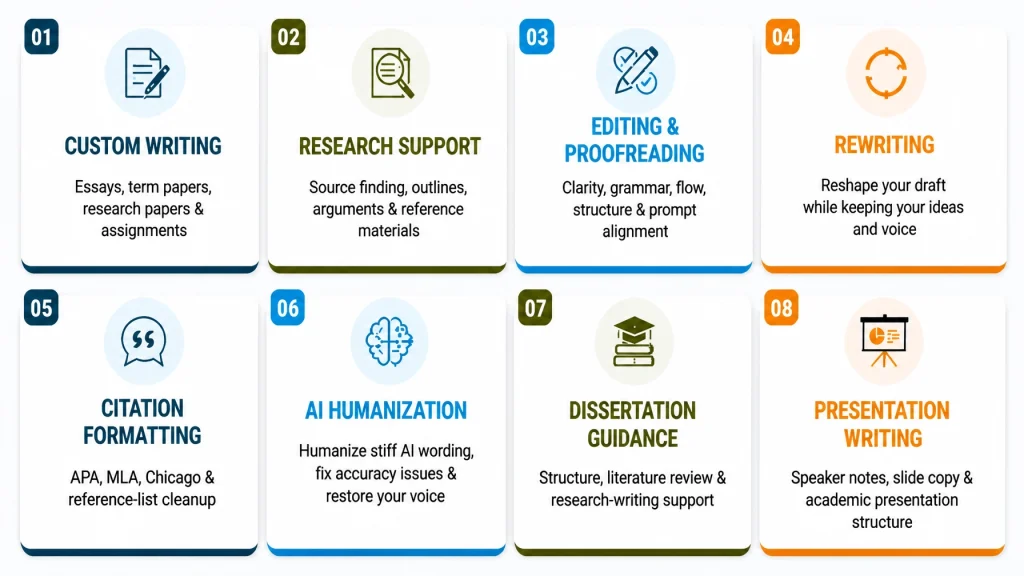
Our team is comprised of highly-educated individuals who have considerable experience in the academic writing field. We have put together the most talented professionals to provide our customers with great assistance. You will reap enormous benefits if you allow our experts to take on your essay, term paper, report, research paper, thesis or any other academic project.
Our Expert Writers
The writers we employ are true professionals who have commitment and passion for their art. Most of them are Bachelor’s and Master’s degree-holders in a variety of disciplines. We also employ doctorate degree-holders in certain disciplines. A dedicated writer assigned to your project will thoroughly research your subject and follow your instructions. All our team adheres to customers’ directions to ensure superb results
36702
# Pages written this year
19
Active Writers
99%
Positive Feedback
4
Editors Active
Reviews, comments and love from our customers and community
Client #1324
Verified order
Hello,I do appreciate all the work you put into this and appreciate financial accounting classes might not be what you regularly work on but wanted to go over the following:There were several inaccuracies in the original information that required me to go back through the assignment and manually verify and correct the work. The issues were not limited to wording or formatting; there were incorrect financial figures, calculations, interpretations, and citation inconsistencies throughout the assignment.The main corrections included:* **Question 4 – Balance Sheet:** Target’s total liabilities were stated as $43,324 million in the discussion, while the correct amount is **$43,325 million**. The discussion also needed to be revised so that the comparison between Dollar Tree and Target was based specifically on their total assets, liabilities, and shareholders’ equity rather than using a vague statement about overall business size.* **Question 5 – Income Statement:** Target’s net sales were initially stated as $104,780 million instead of the correct **$104,781 million**. Dollar Tree’s gross profit was also initially stated as approximately $7.05 billion, but the correct calculation is **$19,411.8 million ? $12,345 million = $7,066.8 million**, or approximately **$7.07 billion**. Some of the discussion also made an overly broad causal statement about why Target has higher sales than Dollar Tree, which needed to be revised to reflect the companies’ actual operating models.* **Question 6 – Financial Ratios:** The ratio calculations and supporting figures had to be manually rechecked, including average total assets, return on assets (ROA), profit margin, and asset turnover for both companies. The verified results were:* Dollar Tree: **ROA 7.99%, profit margin 6.61%, asset turnover 1.21 times**
* Target: **ROA 6.32%, profit margin 3.54%, asset turnover 1.79 times**The discussion also required correction because some explanations did not clearly distinguish between the ratios. In particular, **asset turnover measures how efficiently a company uses its assets to generate sales**, while ROA reflects the combined effect of profitability and asset utilization. Some wording in the discussion was unclear or misleading and needed to be revised. There was also a sentence placed in quotation marks even though it was not a direct quotation, so the quotation marks needed to be removed.* **Question 7 – Statement of Cash Flows:** Several operating cash flow figures in the discussion were incorrect. Dollar Tree’s operating cash flow is **$2,534 million**, not $1,251.5 million, and Target’s is **$6,562 million**, not $2,857 million. The investing and financing activity sections also required review because some figures were described or attributed incorrectly.The verified figures included **$728.5 million** of net investing cash outflow for Dollar Tree and **$3,649 million** for Target, as well as **$2,556.9 million** of net financing cash outflow for Dollar Tree and **$2,187 million** for Target. Capital expenditures were corrected to **$1,134 million for Dollar Tree** and **$3,727 million for Target**, while long-term debt payments were corrected to **$1,000 million for Dollar Tree** and **$1,643 million for Target**. The net change in cash was verified as a **$750.5 million decrease for Dollar Tree** and a **$726 million increase for Target**.* **Question 7 – Cash Flow Interpretation:** The discussion needed to be corrected to distinguish between operating, investing, and financing cash flows and to accurately explain why operating cash flow and capital expenditures are important. Some of the original wording was confusing and did not accurately communicate what the cash flow statement showed.* **Question 8 – SWOT Analysis:** Some of the Dollar Tree SWOT factors were duplicated or did not exactly match the information in the D&B Hoovers source. The comparison also contained overly casual wording such as saying the companies were “plagued” by competition. This was revised to accurately state that both companies face significant competition and that price, product, and distribution factors are identified as competitive considerations in their respective SWOT analyses.* **Question 9 – Corporate Governance and Ethics:** Some of the governance discussion used awkward or inaccurate wording, particularly the statement about the Board overseeing “management and shareholders.” This needed to be revised to distinguish the Board’s responsibility for overseeing management from shareholders’ ability to communicate with the Board.* **Citation consistency:** There were inconsistencies between the years used in the in-text citations and the years listed in the reference section. These needed to be manually reviewed and standardized.* **Academic source citation:** At least one academic source had a publication year that did not match between the in-text citation and the reference list. This required verification and correction.* **Reference/URL issues:** Several reference entries and URLs also needed to be checked for formatting and accuracy, including malformed DOI/URL formatting and inconsistencies in the SEC and D&B Hoovers references.* **Overall interpretation and wording:** Several portions of the assignment made conclusions that were broader than what the financial statements actually demonstrated. These had to be revised so that the discussion remained directly supported by the companies’ reported financial information.Overall, I had to manually go back through the assignment, recheck the source financial statements, recalculate the ratios and financial figures, compare the discussion against the tables, verify the cash flow information, and review the citations and references for consistency. Because there were errors in both the underlying financial information and the explanations of that information, it did not feel as though the original work had been thoroughly verified before being provided.
Client #1316
Verified order
Client #1324
Verified order
Client #1332
Verified order
Client #1228
Verified order
Client #1324
Verified order
The writer completed the work, and I appreciate the effort that was put into the assignment. However, I was disappointed with the handling of the revision process.The initial revisions I requested were necessary because the writer did not include the citations and reference page that I had specifically requested and paid for as part of the order. These are standard and important components of college-level academic writing, so I expected them to be included based on the instructions provided.For the final revision, I provided an additional rubric for the PowerPoint once I realized there was a separate rubric that I had not initially uploaded. I understood that this was an oversight on my part and apologized for it. However, the writer seemed unwilling to complete the requested revisions and their response came across as particularly hostile and condescending. Revisions are part of the paid service, so I was surprised by the resistance to making the requested changes.Overall, the work itself was completed, but the communication and willingness to accommodate revisions significantly affected my experience. I would have preferred a more professional and collaborative approach to addressing the revisions and additional requirements.
Client #763
Verified order
Client #1337
Verified order
Client #1332
Verified order
Client #1234
Verified order
Client #1324
Verified order
Client #1316
Verified order
Client #1316
Verified order
Client #1324
Verified order
Client #1324
Verified order
Fantastic job! So thankful for your help and skill!
Client #1320
Verified order
I received both A’s on my assignments! Thanks so much & for the fall definitely will be using this website again ! & hopefully I get the same writer as well.













 BioMagica131 days ago
Trustindex verifies that the original source of the review is Google.
They provide original and well organised contentPosted on Google Leonard Bradley347 days ago
 Lynn Cox1321 days ago
 Sadie Perry3062 days ago
 Moises Villasenor3790 days ago
 Joel Casiano3795 days ago
 Brighton Daniel3888 days ago
 Nathan Arriaga3888 days ago
 T. Hamilton3941 days ago
 David O3944 days ago