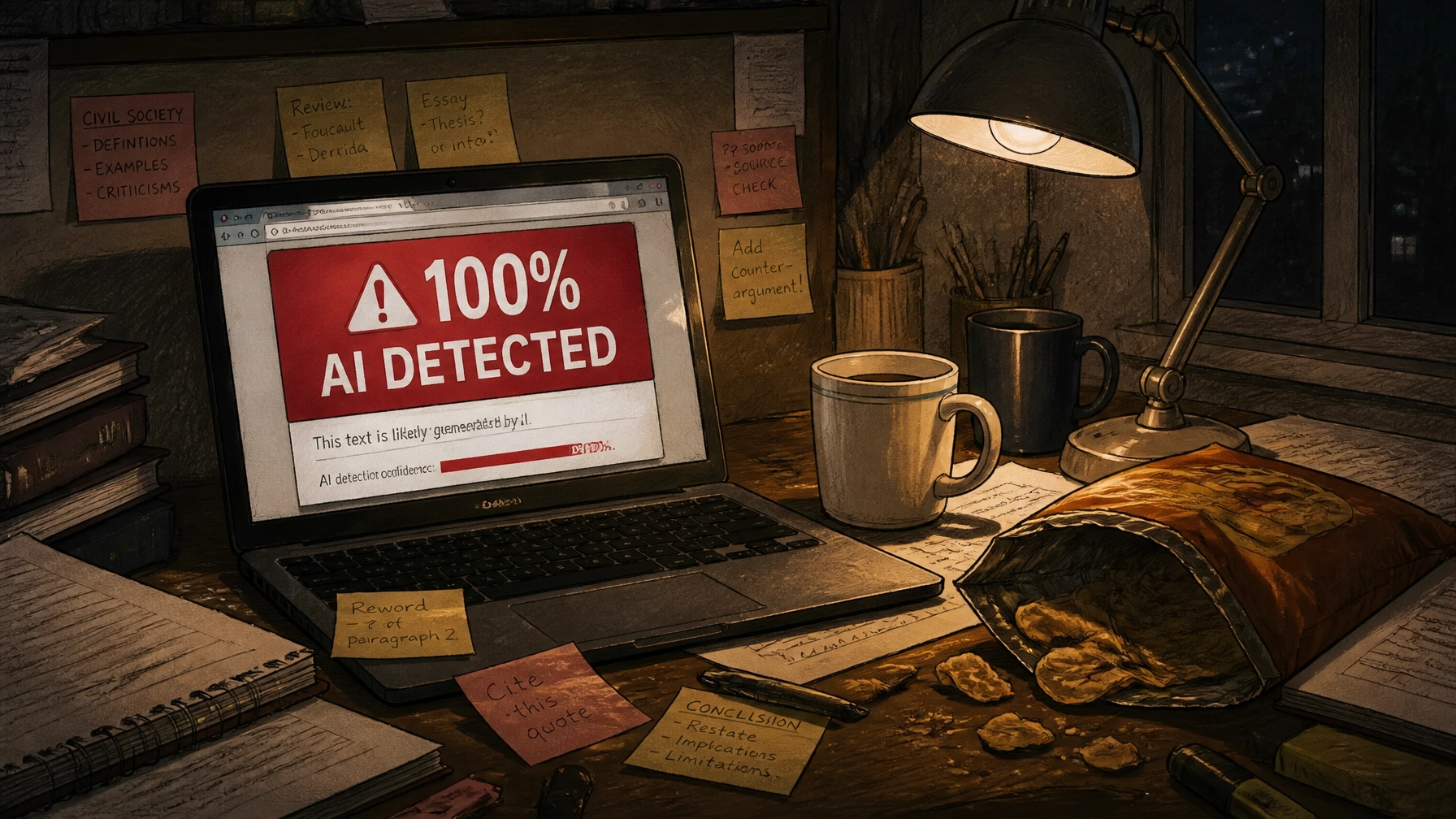
You’ve been there. It’s 3:00 AM, the third empty coffee cup is staring you down, and you just finished rewriting that one stubborn paragraph for the fiftieth time. You spent weeks on the research, months on the data, and an eternity just trying to make the introduction sound like you didn’t lose your mind during the process.
Then, you run it through a detector just for peace of mind.
Flash. "90% AI Confidence Detected."
Your heart does that weird sinky thing. You know you wrote it. You know every citation is real. So why is a piece of software telling your professor that a robot did the heavy lifting?
Welcome to the dissertation trap. It’s a place where "perfect" writing actually gets you in trouble, and where the very tools meant to help you "clean up" your work are the ones snitching on you. Honestly, it’s a mess. But there’s a reason for it, and it’s not just because the AI detectors are out to get you (though it feels like it).
Quick Tips: How to Humanize Your Writing Right Now
Before we get into the math and the "why," here are three quick ways to make your paper sound less like a machine and more like a person who actually cares about the topic:
- Break the Rhythm: AI loves medium-length sentences. It’s a total vibe killer. Throw in a short, punchy sentence. Then go long. Variety is the spice of human life.
- Use "Low-Frequency" Words: Robots stick to the most likely word choices. If you can use a specific, slightly weird (but accurate) term instead of the generic one, do it.
- Show the Struggle: Mention why a certain theory was difficult to apply or why you chose one method over another. AI doesn't have "opinions" or "struggles", you do.
The Math of Being Boring: Perplexity and Burstiness

Here’s the thing: AI detectors don't actually "know" anything. They don't read your work and think, "Hmm, this sounds like ChatGPT." Instead, they use math to measure two things: Perplexity and Burstiness.
Perplexity is just a fancy word for predictability. If you’re writing a sentence like, "The results of the study indicate that…" the detector already knows the next words are probably "…further research is needed." Because AI is trained on basically the entire internet, it always picks the most "likely" next word. If your writing is too smooth and too predictable, the detector thinks you’re a bot.
Burstiness is about your sentence structure. Think about how you talk to your friends. You might say something short. Then you might go on a long, rambling tangent about how the campus parking situation is a literal nightmare. Then you stop. That "bursty" energy is uniquely human. AI, on the other hand, tends to write sentences that are all roughly the same length and rhythm. It’s like listening to a metronome. It’s steady, it’s "perfect," and it’s a massive red flag.
When you’re writing a dissertation, you’re often trying to be as professional as possible. You’re mimicking the dry, academic tone of the papers you’ve been reading for years. But by being "perfectly academic," you’re accidentally lowering your perplexity and burstiness. You’re essentially training yourself to write like an AI.
Why "Vibes" Aren't Enough for a Dissertation

A dissertation isn't just a long essay. It’s supposed to be original research. That means you’re contributing something new to the world.
AI is great at summarizing things that already exist. It’s a master of the "vibe." You can ask it to explain a theory, and it’ll give you a decent, C+ level summary. But it can’t do the heavy lifting of a dissertation because it lacks nuance.
Nuance is that annoying little detail that makes your research matter. It’s the "but" or the "however" in your data. Maybe your survey results didn't match the existing literature. A robot might try to smooth that over to make the text sound "better." But a human researcher (that’s you) knows that the mismatch is actually the most interesting part of the paper.
When professors flag dissertations for AI, they aren't always looking at a detector score. They’re looking for a lack of depth. If your literature review sounds like a Wikipedia summary rather than a critical engagement with the experts, it feels "AI-like." If your discussion section doesn't connect your specific data to the real world, it’s going to raise eyebrows.
The Hallucination Nightmare

We’ve all heard the stories. A student uses AI to help with a bibliography, and the bot just… makes stuff up. It creates "perfect" citations for papers that don't exist, written by authors who never said those things.
In a dissertation, this is the kiss of death. Your committee is going to check your sources. They know the field. If you cite "Smith & Wesson (2022) on the impact of TikTok on neurobiology," and that paper doesn't exist, your credibility is gone.
AI "hallucinates" because it doesn't actually understand facts. It just understands patterns. It knows what a citation should look like, so it builds one out of thin air. This is why you can’t just "prompt" your way to a doctorate. You need real research, real sources, and a human eye to make sure everything actually exists in the physical world.
How the SYA Team Keeps it Real

At Submit Your Assignments, we get the grind. We know that sometimes you aren't trying to "cheat": you’re just stuck. You’ve been staring at the same 50 pages for so long that they don't even look like English anymore.
When you work with us for custom research and editing, you aren't getting a bot-generated template. You’re getting a real person who actually knows how to write. Our writers have Bachelors, Masters, and even Doctorates, so they understand the level of nuance required for a dissertation.
Our workflow is built on trust and actual human effort:
- Brainstorming & Outlining: We help you map out your ideas so you don't get lost in the "predictability" trap.
- Original Research: Our team digs into the real databases (not just what’s on the surface web) to find legitimate, high-quality sources.
- Human Editing: Our editors look for that "burstiness" we talked about. They make sure the voice sounds authentic, critical, and: most importantly: like a human wrote it.
We believe in the "No Homework & Chill" lifestyle. That doesn't mean skipping the work; it means working smarter so you can actually live your life. Whether you need an assignment breakdown or someone to help you refine your discussion board posts, we’ve got your back.
Stop Worrying, Start Living
The stress of an AI flag shouldn't be the thing that keeps you up at night. You’ve worked too hard on your degree to let a buggy algorithm ruin your peace of mind.
If you’re feeling the pressure of a deadline or just can’t seem to get that one chapter right, check out our services. We’re here to be the supportive, expert tutors you need to get over the finish line.
Wait, why should you trust us?
- 94% average customer rating (we don't miss).
- Google reviews are our main social proof because students actually tell the story there.
- We "charge like a bird" (student-friendly pricing, always).
- 24/7 support because we know your panic doesn't keep office hours.
A few fun facts about the SYA family:
- We've written over 22,000 pages this year alone.
- Our owner, Shannon, is a writing pro who actually cares about your success.
- We have a 5% cashback program in our "Wallet" because who doesn't like free money?
- We’re based in Texas, but our writers are everywhere you need them to be.
Trust our writers. Ensure your work is authentic. Get your freedom back.
For immediate assistance, use iMessage: nicoleshannon7@icloud.com or WhatsApp: wa.me/13466176123. Call Only: 346-603-6340
Submit Your Assignments provides custom reference materials and tutoring services for research and educational purposes only. We encourage all students to follow their institution's academic integrity policies.
Submit Your Assignments