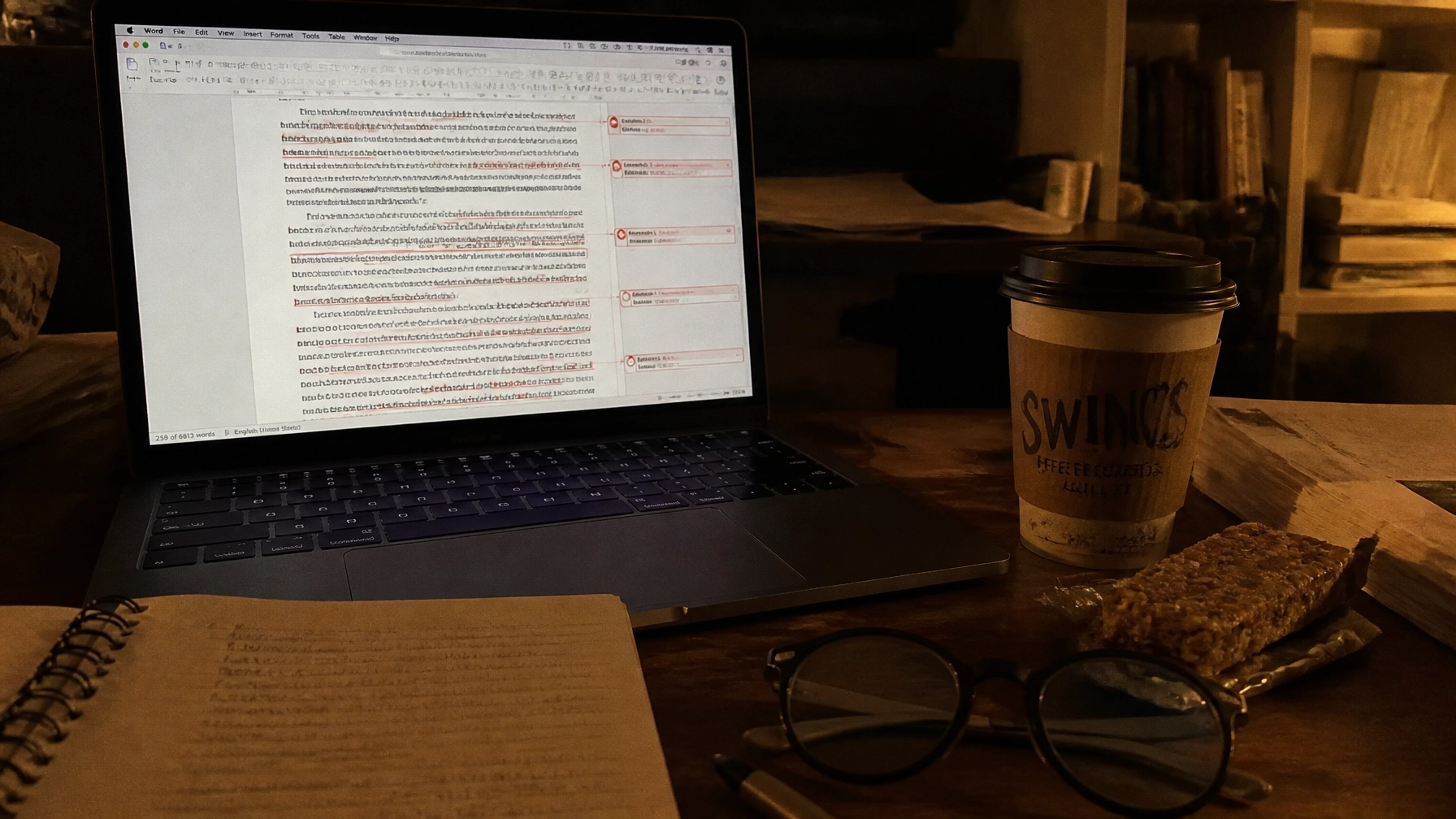
You know that feeling. It’s 11 PM on a Tuesday. You’ve just finished a ten-hour shift of actual corporate work, and now you have to sit down and write an MBA paper about… corporate work. Your brain is fried, so you start leaning on the same jargon you’ve been hearing in meetings all day. Words like "synergy," "leveraging stakeholders," and "optimized strategic roadmaps" start flying onto the page.
But here’s the cold, hard truth: your professor isn't your boss. They don’t want to be "aligned" with your "best-in-class solutions." They want to see that you actually understand the material.
When you hide your ideas behind a wall of corporate fluff, you’re basically telling your grader, "I don't really know what I’m talking about, so I’m going to sound as 'business-y' as possible." We see this all the time at Submit Your Assignments. Students come to us with drafts that look like a LinkedIn feed threw up on a Word doc.
Don't worry, though. We’re going to show you exactly how we take a wordy, jargon-heavy MBA mess and turn it into a sharp, clear argument that actually gets the grade it deserves.
Quick Tips to Kill the Fluff Right Now
Before we jump into the case study, try these three things on your current draft. They take about five minutes and will immediately make your writing sound 10x more professional (the real professional, not the "middle manager" professional).
- The "16-Year-Old" Rule: If you couldn’t explain your sentence to a smart 16-year-old, it’s too wordy. Strip it down until the core idea is visible.
- Active Voice Only: Instead of saying "The project was completed by the team," say "The team completed the project." It’s shorter, punchier, and sounds way more confident.
- Search and Destroy: Use the "Find" tool (Ctrl+F) to look for words like utilize, leverage, optimize, impactful, and synergy. If you find them, replace them with regular human words like use, help, improve, or work together.

The Case Study: From "Corporate Speak" to "Academic Clarity"
Let’s look at a real example of a paragraph from an MBA draft we recently helped a student with. This was for a leadership and organizational behavior course.
The "Before" (The Jargon Trap)
"In order to facilitate a culture of excellence, it was decided by leadership that a transformation initiative should be implemented to optimize operational synergies and drive impactful outcomes across key stakeholders. A cross-functional strategic roadmap was developed, enabling best-in-class efficiencies through the leveraging of digital assets. Alignment was ensured through a series of touchpoints, ultimately creating significant value for the organization's bottom line."
The Problem: Read that out loud. You probably ran out of breath halfway through, right? It’s filled with passive voice ("it was decided," "was developed," "was ensured"). It uses ten words when three would do. Most importantly, it doesn’t actually tell us what happened.
The "After" (The Submit Your Assignments Revision)
"To improve performance, the leadership team launched a six-month project to reduce duplication across departments. I developed a strategic plan that used new digital tools to automate reporting, which cut processing time by 15%. I met weekly with department heads to keep the project on track, eventually saving the company $500,000 in annual operating costs."
Why it works:
- It’s Active: We know exactly who did what. "The leadership team launched…" and "I developed…"
- It’s Specific: "Transformation initiative" became a "six-month project to reduce duplication."
- It Uses Data: We swapped "significant value" for "$500,000 in annual operating costs." Professors love numbers. It proves you aren't just making things up.
Why We Fall for the Wordiness Trap
We get it. You’re in an MBA program. You want to sound like an expert. You feel like if you use "big" words, you’ll look smarter. But in reality, true expertise is the ability to explain complex things simply.
When you’re stressed out and the grind is getting to you, your brain takes the path of least resistance. It’s easier to write "utilize" than to think of a better way to describe a specific process. It’s a defense mechanism. But that defense mechanism is killing your GPA.
And let’s be honest: most MBA students are juggling a million things. Between the 9-to-5, the family, and the never-ending stream of discussion board posts, you don't always have the mental energy to edit for "clarity." That’s usually when students reach out to us for some custom reference materials or a fresh set of eyes on their work.

How to Clean Your Own Draft (The Submit Your Assignments Method)
If you’ve got a draft that’s feeling a little "fluffy," here is our internal workflow for cleaning it up. This is exactly what our writers do when they’re helping students refine their work.
Step 1: The Passive Voice Hunt
Passive voice is the #1 enemy of a good MBA paper. It makes you sound like a bystander in your own career. Look for the words is, was, were, been, and be.
- Weak: "The decision was made to pivot the strategy."
- Strong: "The CEO pivoted the strategy."
Step 2: Kill the "Zombie Nouns"
A "zombie noun" is a verb that’s been turned into a clunky noun.
- Instead of "The implementation of the plan…" use "Implementing the plan…"
- Instead of "The provision of feedback…" use "Providing feedback…"
- Instead of "The optimization of the system…" use "Optimizing the system…"
These small changes make your sentences move faster and keep your reader (the professor) engaged.
Step 3: Be Direct
Stop "clearing your throat" before you say something. Delete phrases like "It is important to note that," "In my personal opinion," or "Due to the fact that." Just state your point. Trust us, the professor knows it’s your opinion: you’re the one writing the paper!
The Lifestyle Benefit: Less Fluff = More Freedom
Why does this matter beyond the grade? Because writing clearly actually saves you time. When you stop trying to sound like a corporate robot, you write faster. You communicate better. And most importantly, you get your assignments done so you can actually live your life.
Whether you're struggling with a thesis or just a weekly reflection paper, the goal is to get the ideas out of your head and onto the page as cleanly as possible. No one wants to spend their Saturday night untangling a 40-word sentence.
If you find yourself stuck in the jargon loop, remember that you don't have to do it alone. We’re here to help you brainstorm, outline, and edit those monster drafts into something you’re actually proud of. Our pricing is built for the student budget because we know you’re already paying enough for that degree.

A Few "Fun" Facts About Corporate Fluff
- Fact 1: The word "leverage" was originally only a noun. It didn't become a verb until people started wanting to sound fancy in boardrooms.
- Fact 2: Studies show that readers find people who use simpler language to be more intelligent than those who use complex jargon.
- Fact 3: "Synergy" was one of the most hated words in the business world for five years straight, yet it still haunts our drafts like a ghost.
- Fact 4: Most MBA professors spend less than 10 minutes reading a standard essay. If they can't understand your point in the first 30 seconds, you're in trouble.
Stop worrying about sounding "MBA-ish." Start worrying about being clear. Your grades (and your sanity) will thank you.
Listen up: you've worked too hard on your career and your education to let a few "leveraged synergies" hold you back. Trust our writers to help you find the clarity you need. Peace of mind is just a click away.
Let's Get You That A!
Stop stressing. Start moving smarter. If you need help with brainstorming, outlining, editing, or strong model papers, we're here for you.
- Text Academic Success Advisor: 832-926-5551
- WhatsApp: https://wa.me/13466176123
- Call Only: 346-603-6340
- Email: info@submityourassignments.org
Submit Your Assignments provides custom reference materials and tutoring services for research and educational purposes only. We encourage all students to follow their institution's academic integrity policies.
Author: Shannon Nicole