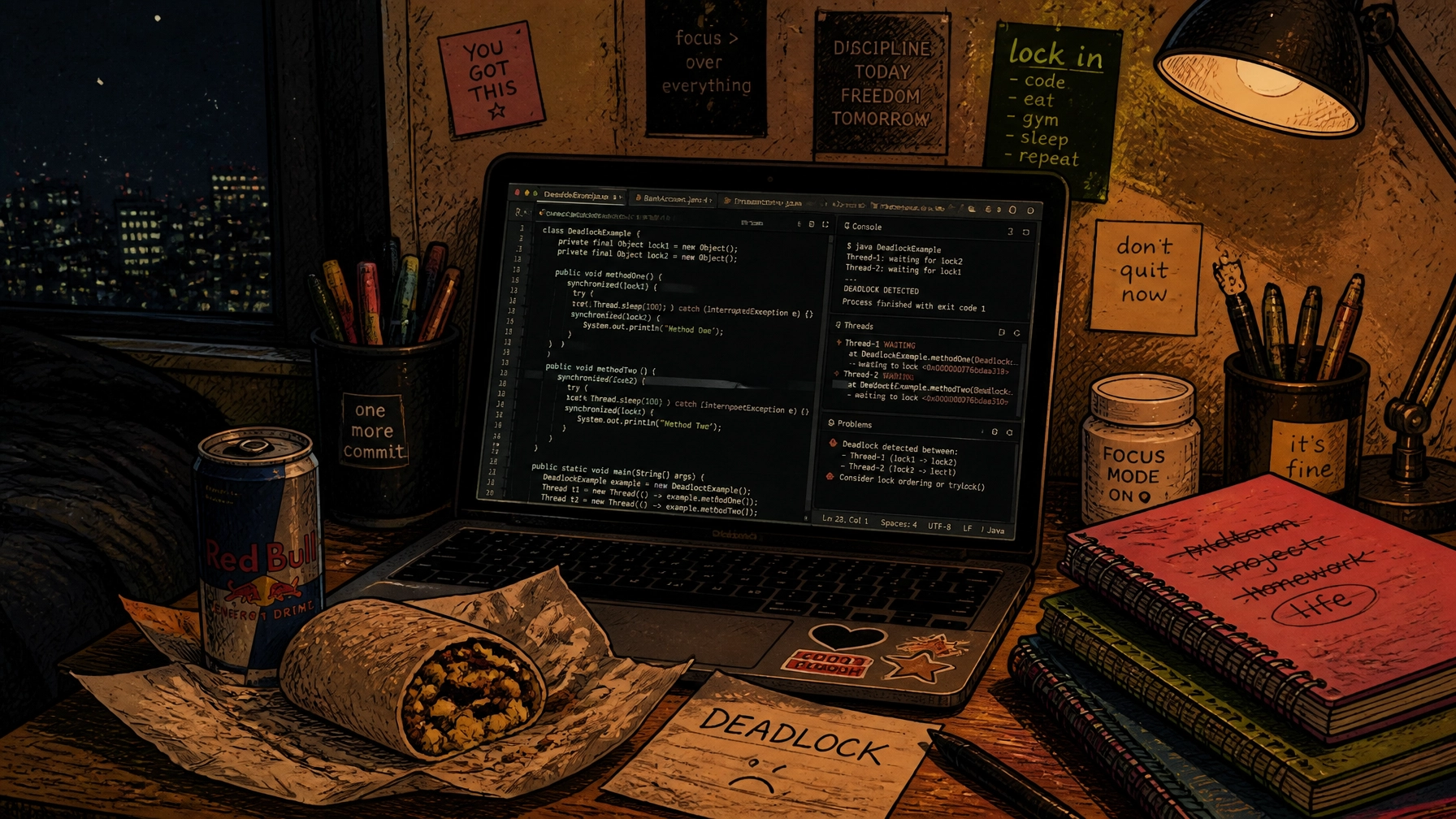
You know that feeling when you finally think you’ve mastered Java, and then Rice hits you with COMP 322? Suddenly, your code isn’t just running in a straight line anymore. It’s splitting, merging, syncing, and: more often than not: crashing because of a race condition you can’t see. Whether you’re staring at a "deadlock" error at 3 AM or trying to figure out how to explain your parallel logic in a technical report, the struggle is real.
If you're feeling like your brain is currently running on too many threads with zero synchronization, you aren't alone. Transitioning from the linear world of COMP 215 to the parallel universe of HJ-lib and memory management is one of the biggest hurdles in the CS curriculum. But here’s the good news: you don't have to debug your life in isolation.
Table of Contents
- Why COMP 322 is a Different Beast
- The Writing Side of Coding: Technical Reports
- Quick Writing Tips for Parallel Success
- Mastering the HJ-lib Learning Curve
- How SYA Supports Your Academic Grind
- Finding Freedom Beyond the Hedges
Why COMP 322 is a Different Beast
At most schools, parallel programming is an elective you take when you're feeling brave. At Rice, COMP 322 (Principles of Parallel Programming) is a rite of passage. It’s the moment you stop worrying about what the code does and start obsessing over when it does it.
You’re dealing with concepts like Amdahl’s Law, work vs. span, and the "Finish-Accumulator" pattern. It’s not just about getting the logic right; it’s about making sure your program scales properly across multiple cores. When you’re deep in the weeds of an assignment involving async and finish blocks, it’s easy to lose sight of the big picture.

With that being said, the hardest part for many students isn't actually the code: it's the documentation. Many COMP 322 assignments require you to write detailed technical reports explaining why you chose a specific parallel pattern. If you can't articulate your logic, those performance gains won't save your grade.
The Writing Side of Coding: Technical Reports
Let's talk about the part of CS that nobody warns you about: the writing. In COMP 322, you aren't just submitting a .java file. You're often tasked with creating documentation that explains your approach to data parallelism or how you avoided data races in your divide-and-conquer algorithm.
Writing a technical report is a completely different skill set than writing a method. You have to:
- Explain complex synchronization patterns in simple English.
- Justify your use of
phasersover simplefinishblocks. - Analyze your performance metrics (work, critical path, and speedup) without sounding like a robot.
If you find yourself staring at a blank document after twelve hours of coding, that’s where specialized Rice University essay help comes in. Sometimes you need a second pair of eyes to help structure your technical arguments so they actually make sense to your TA.
Quick Writing Tips for Parallel Success
Before you dive into your next technical report or reflection paper, keep these quick tips in mind to save yourself some stress:
- Define Your Performance Metrics Early: Don't wait until the end of the report to talk about Amdahl's Law. Establish your "work" and "span" metrics early so your analysis has a solid foundation.
- Use Diagrams: A hand-drawn diagram of your task graph can be worth a thousand words. If you can visualize the
asyncdependencies, you can write about them more clearly. - Be Honest About the Bottlenecks: Professors love it when you identify why your code isn't scaling. Is it a synchronization overhead? A memory locality issue? Identifying the problem is worth more than pretending your code is perfect.
- Focus on the "Why": Don't just list what your code does. Explain the design choices. Why was a
futurebetter than anasyncin this specific case?

Mastering the HJ-lib Learning Curve
The Habanero-Java library (HJ-lib) is a powerful tool, but it feels like a foreign language at first. You’re moving away from standard Java threads and into a world of high-level abstractions.
As we said earlier, the learning curve is steep because HJ-lib forces you to think about "determinism." You’re constantly checking for data races: those sneaky bugs that only happen when two threads try to touch the same memory at once. It’s a grind, and it’s okay to admit that the "Habanero" part of the name refers to how much your brain is burning by Friday afternoon.
How SYA Supports Your Academic Grind
If you're feeling overwhelmed by the technical documentation or the conceptual essays required for your CS classes, Submit Your Assignments is here to act as your academic support crew. We don't just provide generic writing; we offer targeted Rice COMP 322 help that understands the specific demands of a high-tier engineering program.
Our writers can help you with:
- Technical Report Editing: We can polish your documentation to ensure your parallel logic is crystal clear.
- Model Papers: If you're struggling to understand how to structure a research paper on parallel algorithms, we can provide a high-quality model to guide your way.
- Brainstorming & Outlining: Stuck on how to explain the difference between undirected and directed synchronization? We can help you outline your thoughts.
We believe in "charging like a bird": keeping things affordable because we know the student budget is tight. With a 94% average rating, we’ve helped plenty of students navigate the toughest courses in Houston without losing their minds.

Finding Freedom Beyond the Hedges
At the end of the day, your time at university should be about more than just fighting with a debugger. You deserve the freedom to actually enjoy the local culture, grab some late-night food in the Museum District, or just sleep for more than four hours.
Don't let one difficult technical report or a complex parallel programming assignment keep you from living your life. Trust our writers to help you bridge the gap between "stressed out" and "successfully finished."
Ready to get some backup?
- Check out our Houston writing services to see how we can help.
- Need to see what else we offer? Head over to our homepage for a full breakdown.
- Curious about our quality? Read more about our professional essay writers.
- Don't fall for the cheap stuff; learn why the $5 essay is a trap.
Fun Facts About the Hustle:
- Most "all-nighters" at the Fondren Library are powered by coffee and sheer willpower.
- The "Rice Hedges" are legendary, but they don't help you write technical reports.
- Parallel programming is actually used to simulate everything from weather patterns to movie CGI.
- A "deadlock" in code is basically the digital version of a four-way stop in Houston traffic where nobody knows who goes first.
Stop worrying about the deadlines. Trust our writers, and take back your peace of mind.
All university names, logos, and trademarks mentioned in this post are the property of their respective owners. Use of these names does not imply any affiliation with or endorsement by the institutions.
Submit Your Assignments provides custom reference materials and tutoring services for research and educational purposes only. We encourage all students to follow their institution's academic integrity policies.