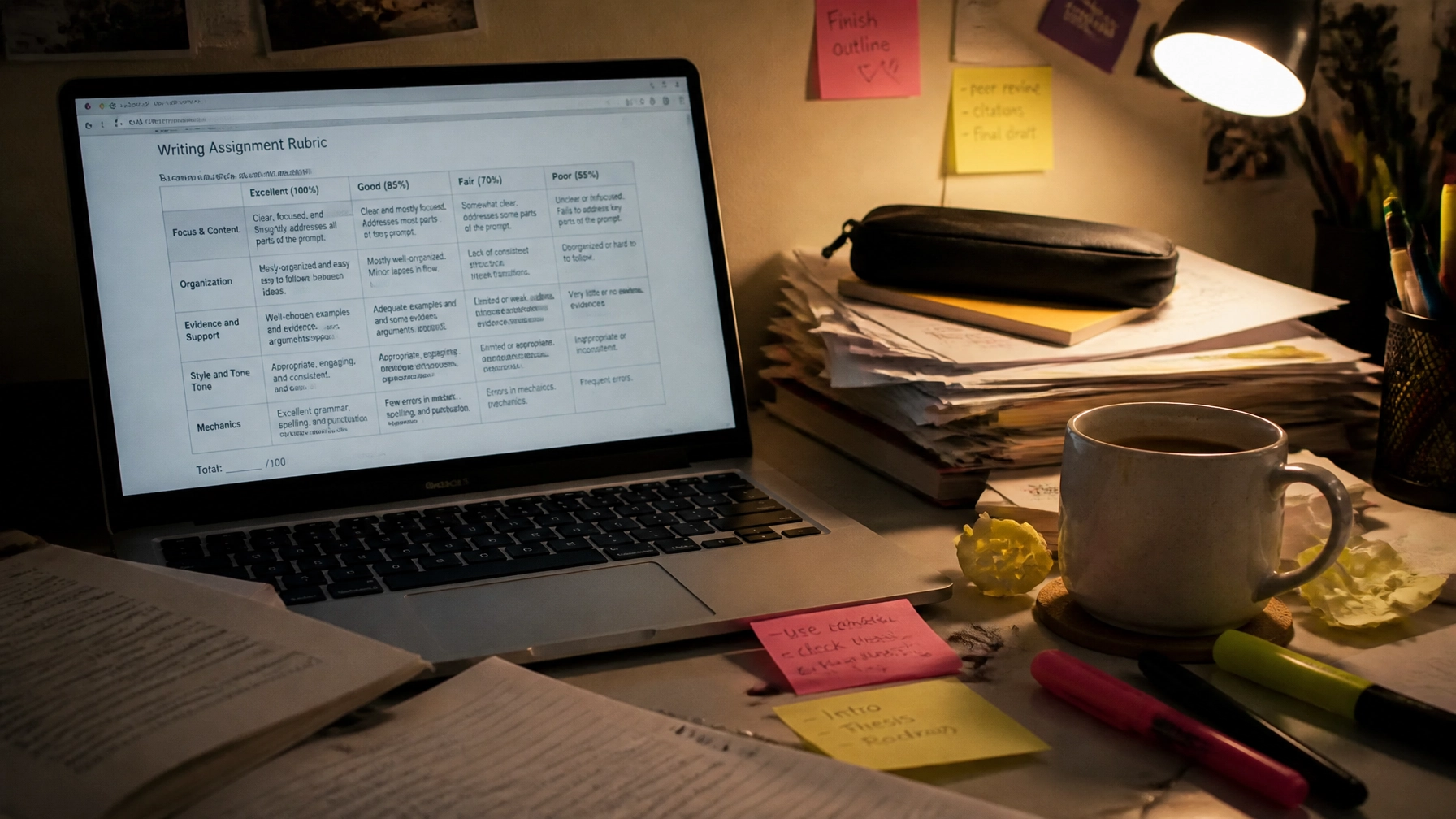
It’s 11:42 PM on a Tuesday. You’ve finally finished the third cup of coffee, the one that tastes more like burnt beans and desperation than actual caffeine, and you open the assignment portal. There it is: The Rubric.
Four pages of tiny font, grids, and academic jargon that feels more like a legal contract than a guide to writing a paper. You see words like "Synthesizes," "Critical Evaluation," and the dreaded "Substantive Analysis." Your brain is already fried, and honestly, you just want to know how many paragraphs you need so you can go to sleep.
But here’s the thing: that rubric is actually your best friend. It’s the literal map to your professor’s brain. If you know how to read it, you aren't just guessing what they want; you’re checking boxes for an A.
Stop staring at the screen in a panic. Let's break down how to stop playing "Rubric Roulette" and actually win.
Quick Wins for the Rubric Grind
Before we get into the heavy stuff, here are a few "cheat codes" to use the next time you're staring down a complex assignment sheet:
- Read the "A" Column First: Forget the "C" or "B" columns. Go straight to the "Exemplary" or "Advanced" section. That’s your target. Anything less is just a list of ways to lose points.
- Highlight the "Action Verbs": Are they asking you to list, describe, or evaluate? These words aren't interchangeable. If you "describe" when they asked you to "evaluate," you’re leaving points on the table.
- Check the Weighting: If "Organization" is worth 10% but "Content Analysis" is worth 60%, don't spend three hours obsessing over your font choice while your main argument is still thin.
- Count the "Must-Haves": Most rubrics have a "Formatting" or "Mechanics" section. This is basically free money. Use a spellchecker, fix your APA citations, and boom, you just secured 10-20% of your grade without even trying.

The Great Divide: Analysis vs. Description
This is where most students lose the "vibes" of their paper. You spend hours researching, you find great quotes, and you write a solid summary of what happened. Then the paper comes back with a "C" and a comment like: "Too descriptive. Needs more analysis."
What does that even mean? Is your professor just being a hater?
Not exactly. In the world of academic rubrics, "Description" and "Analysis" are two completely different beasts.
Description is the "What"
Description is safe. It’s when you tell the professor what the book said, what the experiment showed, or what the history textbook says about the Civil War. It’s a summary. It proves you read the material.
Example of Description: "The author states that social media causes anxiety because people compare their lives to others."
Cool. The professor knows that. They probably assigned the book. They don't need you to tell them what’s in it, they want to know what you think about it.
Analysis is the "So What?"
Analysis is where the real points live. This is where you explain how and why something matters. You aren't just repeating the info; you're breaking it down and building something new with it.
Example of Analysis: "By highlighting the link between social media and anxiety, the author implies that digital platforms have shifted from tools of connection to tools of performance. This suggests that the psychological cost of 'staying connected' might actually be the erosion of authentic self-image."
See the difference? One is just a report. The other is a thought. Analysis requires you to take a risk and make an argument.

How to "Hack" Your Way to Better Analysis
If you’re struggling to move past the summary stage, try using the "Because, So What, Compared to" method.
After every descriptive sentence you write, ask yourself:
- Because of what? (What’s the cause behind this fact?)
- So what? (Why should the reader care about this?)
- Compared to what? (How does this idea stack up against another one?)
If you can answer those, you’re officially analyzing. You’re no longer just a student repeating facts; you’re a researcher providing insight. And that, my friend, is what the "A" column in your rubric is looking for.
Reading Between the Lines: The Secret Rubric Language
Sometimes, professors use code words. If you see these in your rubric, here is what they actually mean:
- "Synthesizes Sources": Don't just give me a list of what five different authors said. Show me how Author A and Author B agree, or how Author C totally disagrees with both of them. It's a conversation, not a monologue.
- "Demonstrates Critical Thinking": This is professor-speak for "Don't just agree with everything you read." Find a flaw in the argument. Suggest a different perspective. Show that you have an original thought.
- "Logical Flow": This isn't just about grammar. It means your paragraphs should actually talk to each other. Don't jump from Topic A to Topic Q without a transition.
Why Rubrics Feel Like a Trap
Let’s be real: sometimes rubrics are just poorly written. You might have a professor who uses a generic rubric for every single assignment, even if half the criteria don't apply. Or maybe the rubric says "APA Style," but the prompt says "MLA."
This is where the panic sets in. You’re trying to do the right thing, but the instructions are a mess.
When you're in the middle of a late-night grind, the last thing you need is a riddle. You need clarity. You need someone to look at that rubric and say, "Okay, here is exactly what they are looking for."

How We Bridge the Gap at SYA
At Submit Your Assignments, we don't just "write papers." We're essentially professional rubric-readers. When you send us an assignment, the first thing our writers do isn't writing: it's analyzing that rubric.
We look at the "Exemplary" column and build the paper from there. Our goal is to provide you with a model paper that shows you exactly how to hit those "Analysis" points.
Our process is built on trust and authenticity. We know how stressful it is to worry about AI flags or generic content. That's why we focus on custom, human-led research that mirrors the way a real student would think and write: just with a little more "Analysis" sprinkled on top for those extra points.
We even provide a human authenticity certificate because we want you to have peace of mind. You aren't just getting a document; you're getting a roadmap for your own academic success.

Stop Worrying and Start Winning
You don't have to stay up until 4 AM trying to figure out if your "Discussion Board" post sounds "authentic" enough. You don't have to play the Rubric Roulette alone.
Whether you need help brainstorming an outline or you want a full reference paper to show you how to structure that MBA dissertation, we've got your back.
A Few Fun Facts About Academic Life (Because you need a break):
- Did you know the average student spends about 15% of their study time just trying to understand what the assignment is asking for?
- Research shows that students who use rubrics as a checklist while writing score significantly higher than those who only look at it before they start.
- The term "Rubric" actually comes from the Latin word for "red," because early academic instructions were often written in red ink. (Fitting, since that's usually the color of the marks we're trying to avoid!)
Listen up: you’ve got this. The rubric is just a puzzle, and now you have the pieces. Stop stressing over the tiny details and focus on the big picture. And if you ever feel like the puzzle is missing a few parts, you know where to find us.
Trust our writers to help you navigate the chaos. Let’s get that "A" column checked off.
For immediate assistance, iMessage us at info@submityourassignments.org or WhatsApp us at https://wa.me/13466176123. Call Only: 346-603-6340
Submit Your Assignments provides custom reference materials and tutoring services for research and educational purposes only. We encourage all students to follow their institution's academic integrity policies.