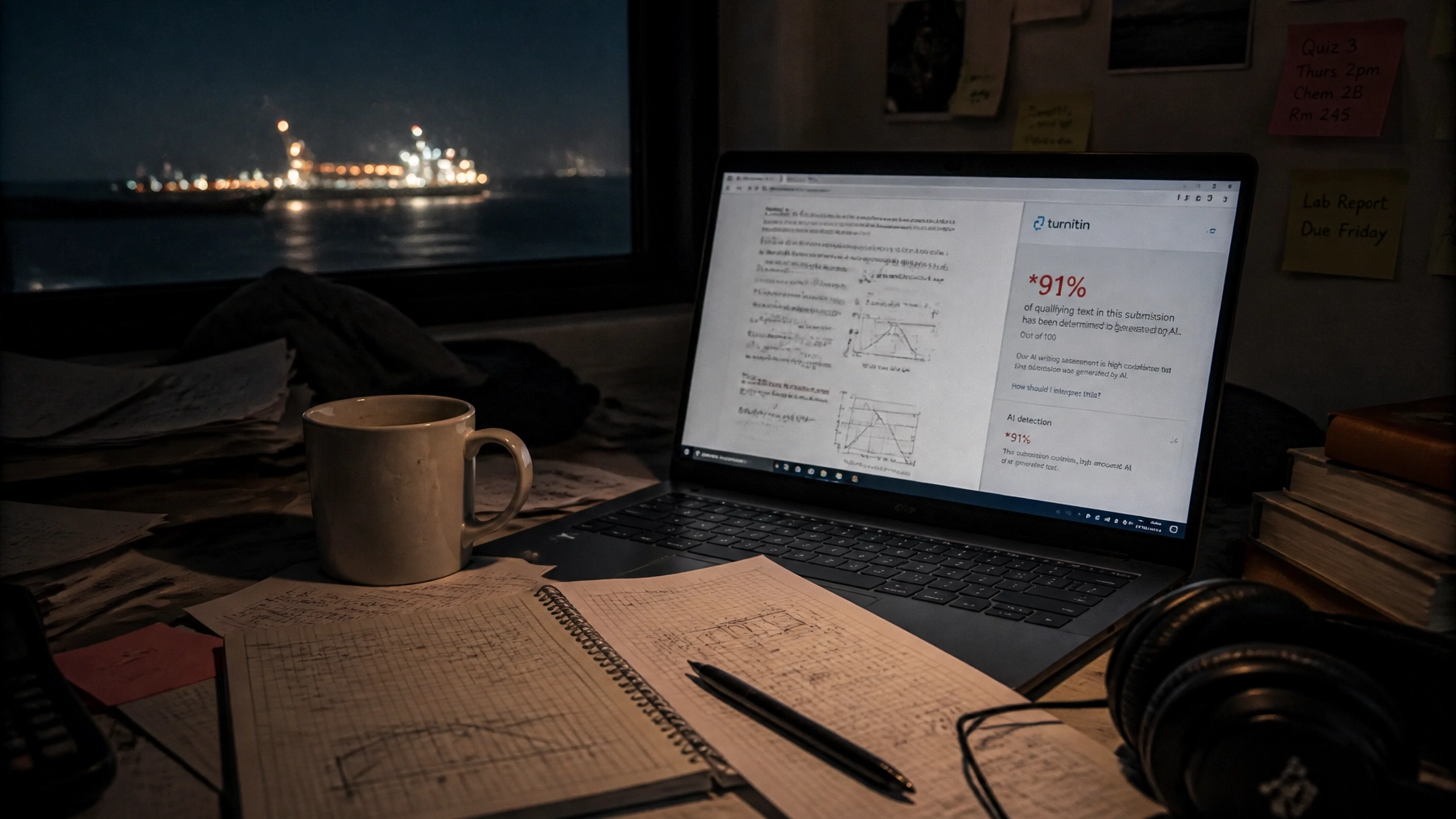
It’s 3:14 AM. You’ve been staring at your laptop screen in your Galveston apartment for six hours, trying to finish that thermo-fluids lab report. You finally hit "submit," and then you see it. The Turnitin icon turns a shade of orange or red that makes your stomach drop.
45% AI Detection.
But here’s the kicker: You didn’t even use ChatGPT. You wrote every single word.
If you’re a student at TAMU Galveston engineering or Galveston College, this isn’t just a bad dream: it’s the new reality. AI detectors are getting aggressive, and for technical majors, the "false positive" rate is a nightmare. In a world where a single flag can lead to an "F*" on your transcript, how do you protect your grade without losing your mind?
Quick Writing Tips to Lower Your AI Score
Before we dive into the deep end of academic integrity, try these quick fixes to make your technical writing sound more "human" to a machine:
- Vary your sentence length. AI loves writing sentences that are all the same size. Throw in a short, punchy sentence. Then follow it with a longer, more complex one.
- Stop using "connector" words exclusively. If every paragraph starts with "Additionally," "Furthermore," or "In conclusion," the detector is going to flag you.
- Add your own observations. Instead of just stating a data point, explain why it surprised you during the lab.
- Use active voice. AI leans heavily on passive voice (e.g., "The data was collected by the team"). Switch to active (e.g., "We collected the data").
The Engineering Trap: Why TAMU Galveston Reports Get Flagged
Engineering reports are a unique beast. They require a specific, rigid structure: Abstract, Introduction, Methodology, Results, Discussion. Because this format is so formulaic, AI detectors often mistake your technical precision for a bot’s output.
For TAMU Galveston engineering students, the stakes are incredibly high. The Aggie Honor Code isn’t just a suggestion; it’s the law. If your report on ship systems or marine engineering gets flagged, you aren’t just looking at a point deduction. You’re looking at a potential "F*": a grade that stays on your transcript to show future employers that you were "flagged for academic dishonesty."
And here’s the extra stress nobody talks about enough: for technical assignments, beating the detector is only half the battle. Your equations, terminology, method descriptions, and source use still have to be tight. If your work sounds human but the technical details are shaky, that can tank your grade just as fast. For TAMU Engineering and Galveston College students, technical accuracy matters every bit as much as dodging a messy AI flag.
The irony? The more professional and "engineering-like" you write, the more likely a detector is to think you're a robot. It’s a total "Catch-22."

The Galveston College Reality Check
If you’re over at Galveston College, you’re likely juggling a lot more than just school. Many students there are working jobs on the docks, at the hospital, or in the tourism industry while trying to finish a degree. When you’re exhausted and short on time, it’s tempting to use AI just to "clean up" your grammar.
But listen up: even "cleaning up" your work with heavy AI tools can trigger a plagiarism report. Professors at Galveston College are increasingly trained to look for "burstiness" and "perplexity": the two metrics detectors use to catch AI. If your writing is too smooth and too perfect, it raises a red flag.
With that being said, you don’t have to go it alone. You need a way to ensure your work is original, authentic, and reflects your brain, not a server in Silicon Valley.
How to "Humanize" Your Work (The Legit Way)
Authenticity isn't about being perfect; it's about being you. When we talk about "humanizing" an assignment, we aren't talking about using a software "spinner" (which usually makes your paper unreadable anyway). We’re talking about building a solid foundation from the start.
This is where Submit Your Assignments steps in. We don’t just "give you a paper." We provide custom reference materials and model papers that show you how to structure your own thoughts.
Our Authentic Workflow:
- Human Brains Only: Our writers are real people (many with advanced degrees) who understand the nuances of engineering and technical writing.
- Custom Research: We don't pull from a database of old papers. We find the peer-reviewed sources you need for that specific assignment.
- Reference Outlining: We can provide a comprehensive outline or a "model" report that you can use as a roadmap. This ensures your final submission is 100% your own work while being guided by professional standards.
- Humanizing With Risk Checks: When a draft feels too polished, too generic, or too machine-smooth, we review the wording for professor suspicion indicators like robotic phrasing, unnatural transitions, repeated sentence patterns, and vague claims that can scream "AI" even when the student did most of the work.
- Academic Plagiarism Scan Support: We also look for overlap risks, copy-paste trouble spots, and citation gaps that can trigger plagiarism concerns on top of AI concerns. That matters a lot when you’re trying to avoid the full AI detection trap.

Free Check, Real Protection: More Than an AI Detector Fix
Why "No Homework and Chill" is a Lifestyle, Not a Slogan
As we said earlier, life in Galveston is busy. Between the humidity, the commute, and the constant "grind," you deserve to actually enjoy your life. Imagine a weekend where you aren't stressing over a Turnitin report. Imagine going to the Seawall or catching a sunset at West Beach without a laptop in your lap.
That’s the freedom we provide. By using our custom writing services, you get the peace of mind that comes with professional support. Whether you need help with a research paper or you're stuck on a complex engineering prompt, we’re your academic wingman.
And if you already have a draft? Our Essay Check helps you catch problems before your professor does. And yes, this matters for students beyond Galveston too. If you’re at HCC or Rice University, where formatting rules, citation accuracy, and professor expectations can get very specific, a sloppy draft can raise questions fast. You need more than clean wording. You need a paper that looks legit, cites correctly, and doesn’t give off weird AI-detector vibes.
What Our Essay Check Looks For
- Source & Citation Validation: We check whether your sources are credible, relevant, and actually support your argument. We also look at whether your in-text citations and reference list line up, because broken citations are the kind of thing professors notice immediately.
- Academic Formatting Compliance: We review whether your draft follows the expected academic style and assignment setup, so your paper doesn’t lose points for messy formatting before the professor even gets to your ideas.
- Academic Plagiarism Scan: We check for copied wording, patchwork paraphrasing, and overlap risks that could create a plagiarism problem along with an AI problem.
- Professor Suspicion Review: This is a big one. We look for robotic phrasing, odd transitions, generic claims, and other patterns that can make your work feel AI-assisted even when you wrote it yourself.
- AI-risk review: We flag wording patterns that may trigger detector suspicion.
- Technical and evidence concerns: We catch spots where the content feels vague, unsupported, or weaker than it should be.
Why HCC and Rice Students Should Care
At HCC, instructors often want clear structure, proper citations, and clean formatting with zero nonsense. At Rice University, expectations can feel even stricter because professors are looking hard at argument quality, source handling, and whether the writing feels truly original. If your paper misses the formatting rules or your citations look off, that can create instant suspicion. Not great.
Submission Readiness Audit: The Last-Minute Save
This is the part students usually wish they had done sooner. Our Submission Readiness audit checks whether your draft actually looks ready to hand in, not just "done enough" at 2:47 AM. We review the overall structure, consistency, logic, and obvious red-flag issues that can make a professor pause.
For TAMU Engineering, Galveston College, HCC, and Rice students, that matters a lot. A clean-looking paper with weak citations, formatting mistakes, suspicious phrasing, or questionable claims is still risky. The goal is simple: help you submit something that feels solid from every angle.
Stop worrying about whether a machine is going to flag your hard work. Trust our writers to help you build the best possible version of your assignment.
Frequently Asked Questions (FAQ)
Can AI detectors actually tell if I used ChatGPT?
Not always accurately. They look for patterns, not facts. This is why human-written technical reports often get "false positives." Our service ensures you have a 100% human-written model to work from, and our Essay Check can also review AI-risk patterns, professor suspicion triggers, academic plagiarism scan issues, formatting problems, and citation trouble before you submit.
What is the "F" penalty at TAMU Galveston?*
It is a grade notation that indicates failure due to academic dishonesty. It can only be removed after completing a remediation program, and it can be a major hurdle for future job searches or grad school applications.
Is using a writing service "cheating"?
Not if you use it correctly! At SYA, we provide reference materials, brainstorming assistance, and model papers. Think of it like a tutor or a study guide tailored specifically to your exact assignment.

A Little Galveston Love (Fun Facts)
- The Mosquito Cafe: Our writers' favorite spot for a caffeine hit when tackling those long engineering reports.
- The 1900 Storm: Most students have to write about this at least once: we’ve got the research on lock.
- The Seawall: The best place to clear your head when the "writer's block" hits too hard.
Ready to stop the 3 AM panic? Check out our pricing and let's get that assignment started the right way.
Submit Your Assignments provides custom reference materials and tutoring services for research and educational purposes only. We encourage all students to follow their institution's academic integrity policies.