pexels photo 5537937

What Actually Is a Dissertation? The Straight Definition

If you have typed "what actually is a dissertation" into a search bar, you are probably tired of vague definitions that leave you more confused than when you started. You want a straight answer, free of academic jargon, that tells you exactly what this thing is, how long it takes, and whether you can handle it. This guide delivers that. By the time you finish reading, you will understand the US definition of a dissertation, how it differs from a thesis, what the process looks like from proposal to defense, and what to expect in terms of length, structure, and sheer effort. We wrote this for graduate students in the United States in 2026, and we promise to keep it real.

Table of Contents

The Simple Definition: What Actually Is a Dissertation?

A dissertation is a long-form, original research project required to earn a doctoral degree, most commonly a PhD, in the United States. When people ask what actually is a dissertation, they often imagine a very long paper. That is partly true, but it undersells the scope. A dissertation is not one paper. It is a comprehensive document, typically running between 100 and over 300 pages, that demonstrates your ability to conduct independent, rigorous research from start to finish.

The core purpose of a dissertation is to contribute new knowledge or a new perspective to your academic field. You are not just summarizing what other scholars have said. You are adding something original, whether that means new data, a new theoretical framework, or a fresh interpretation of existing material. This is what separates a dissertation from every other assignment you have ever completed.

A cozy, multi-level library environment featuring warmly lit bookshelves.
Photo by Helin Gezer on Pexels

Unlike a class paper, a dissertation must pass an oral defense in front of a faculty committee. You will stand in a room, present your work, and answer pointed questions from experts who have read every word. It is a high-stakes event, but it is also the final hurdle before you earn the title of doctor.

For clarity, in the United States, the word "dissertation" refers exclusively to doctoral-level research. A "thesis" refers to the research project completed for a master's degree. If you have heard the terms used differently elsewhere, you are not imagining things. We address that confusion next.

Dissertation vs. Thesis: What Is the Actual Difference?

The distinction between a dissertation and a thesis matters, especially for graduate students in the US who need to know which one they are signing up for. The most important difference is the level of study. A thesis is completed for a master's degree. A dissertation is completed for a doctorate. If you are pursuing a PhD, you will write a dissertation, period.

The originality requirement marks another sharp divide. A master's thesis may synthesize existing research, apply established theories to a new context, or demonstrate mastery of a subject. A dissertation must be original. It must add something new to the scholarly conversation, whether that is a novel experiment, a previously unexplored archive, or a theoretical contribution that shifts how researchers think about a problem.

Length and scope follow from these differences. A typical thesis runs 40 to 80 pages, or roughly 10,000 to 25,000 words. A dissertation ranges from 100 to over 300 pages, often landing between 40,000 and 90,000 words or more depending on the discipline. That is the difference between a substantial research paper and a book-length manuscript.
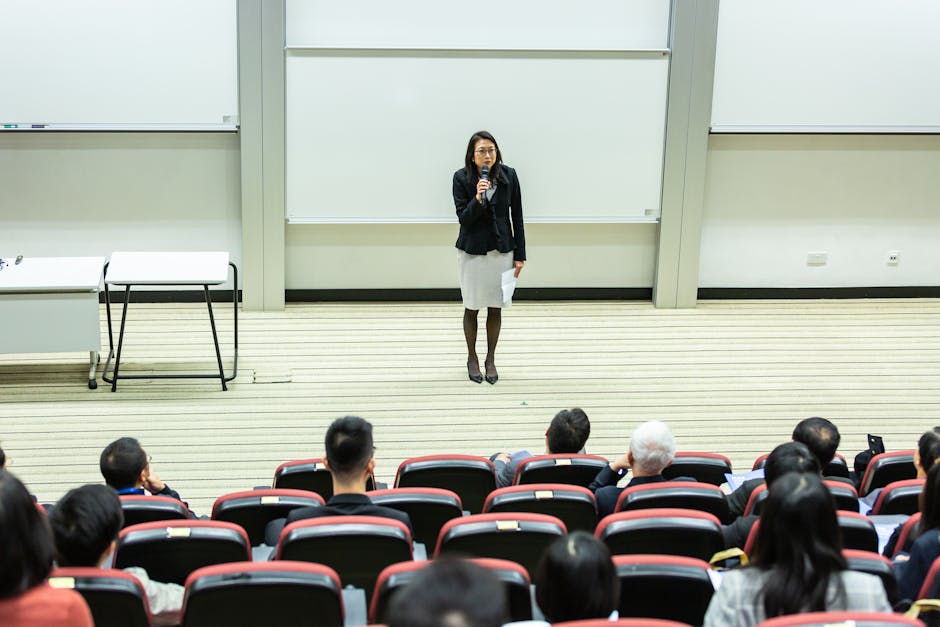
Female speaker presenting to an audience in a modern auditorium setting.
Photo by ICSA on Pexels

The defense requirement also differs. Some master's programs require a thesis defense, but it is not universal. For a dissertation, a formal, public oral defense before a committee of faculty members is a non-negotiable requirement at virtually every US doctoral institution. You will present your findings, justify your methods, and demonstrate that you own the research.

Time commitment is the final differentiator. A thesis may take one or two semesters of focused work. A dissertation often takes two to four years, including the proposal phase, research, writing, and multiple rounds of revision. This is not a project you knock out over winter break.

Why the Confusion Exists (US vs. UK Terminology)

If you have read conflicting definitions online, the source is likely international. In the United Kingdom and many Commonwealth countries, the terms are reversed. An undergraduate or master's student writes a "dissertation," while a doctoral student writes a "thesis." This article follows the US convention throughout because our audience is based in the United States. When you encounter advice from UK universities, simply swap the terms in your head.

The Core Components of a Dissertation (Chapter by Chapter)

Every dissertation follows a recognizable structure, though the exact chapter titles and organization may shift slightly by discipline. Understanding this architecture early will make the project feel less overwhelming.

Chapter 1, the Introduction, states your research problem, the purpose of the study, your research questions or hypotheses, and the significance of the work. This chapter answers the question, "Why should anyone care?"

Chapter 2, the Literature Review, synthesizes existing scholarship to identify the gap your research will fill. You are not listing summaries of articles. You are telling a story about what is known, what is contested, and where the conversation needs to go next. This chapter demonstrates your mastery of the field.

Chapter 3, the Methodology, explains exactly how you conducted the research. You describe whether your approach is qualitative, quantitative, or mixed methods, and you justify why that approach is valid for your research questions. Readers should be able to replicate your study based on this chapter alone.

Chapter 4, Results or Findings, presents the data you collected. In a quantitative study, this means tables, charts, and statistical outputs. In a qualitative study, this means themes, patterns, and representative quotes. You report what you found without interpreting it yet.

Chapter 5, the Discussion, interprets the results and explains their meaning. You connect your findings back to the literature review, acknowledge what surprised you, and wrestle with what the data actually means for your field.

Chapter 6, the Conclusion, summarizes the study, discusses its limitations honestly, and suggests directions for future research. Many dissertations also include implications for practice or policy here, especially in applied fields like education, public health, or social work.

Beyond the chapters, your dissertation includes front and back matter: an abstract, a table of contents, lists of figures and tables, a reference list or bibliography, and appendices for supplementary material like interview protocols or survey instruments.

Two Main Types of Dissertations: Empirical vs. Non-Empirical

Dissertations generally fall into one of two categories, and knowing which camp you belong to will shape your entire approach. An empirical dissertation involves collecting your own original data through experiments, surveys, interviews, or observations. This type is common in STEM fields, social sciences, and health disciplines. You generate new information that did not exist before your study.

A non-empirical dissertation is based on analyzing existing data, texts, archives, or theoretical frameworks. You are not running experiments or surveying participants. Instead, you are offering a new interpretation of historical documents, legal cases, philosophical arguments, or literary works. This type is common in humanities, philosophy, and some social sciences.

Your choice between these types depends on your discipline, your research question, and the resources available to you. Both types demand rigorous methodology and an original contribution. Neither is easier. They are simply different paths to the same destination.

The Dissertation Process: From Idea to Defense

The dissertation is not a single event. It is a multi-phase process that unfolds over years, and understanding the sequence will help you pace yourself.

Phase one is topic selection and proposal development. You identify a viable research question, one that is narrow enough to be answerable but significant enough to matter. You write a dissertation proposal, sometimes called a prospectus, and defend it before your committee. Approval at this stage is your green light.

Phase two involves a deep dive into the literature and finalizing your research design. If your study involves human subjects, you must obtain Institutional Review Board approval before you collect any data. IRB review ensures your research meets ethical standards for participant safety and informed consent.

Phase three is data collection and analysis. This phase often takes the longest. You might spend months in a lab, in the field, in archives, or conducting interviews. Once you have your data, you analyze it using the methods you described in your proposal.

Phase four is writing and revision. You draft each chapter, often out of order. Many students write the literature review first, then methodology, then results, and save the introduction for last. Expect multiple rounds of feedback from your advisor and committee members. Revision is not a sign of failure. It is the normal, expected process.

Phase five is the oral defense. You present your work to your committee, answer their questions, and demonstrate that you understand your research deeply. This is a formal, high-stakes event, but most students pass with revisions required. Outright failure is rare when you have prepared thoroughly.

Phase six is final submission and publication. You make the required revisions, format the document according to your university's guidelines, and submit it. Many US universities require submission to ProQuest for indexing, which makes your dissertation searchable in academic databases worldwide.

Common Challenges (and How to Overcome Them)

Writing a dissertation is as much a psychological challenge as an intellectual one. Imposter syndrome, the persistent feeling that you do not belong in your program and will soon be exposed as a fraud, affects the vast majority of doctoral students. Combat this by joining a writing group, scheduling regular check-ins with peers who understand what you are going through, and using campus mental health resources when you need them.

Writer's block and procrastination often stem from the sheer scale of the project. The cure is to break the work into tiny, daily goals. Commit to writing 300 words, not a whole chapter. Use the Pomodoro technique, working in focused 25-minute bursts with short breaks, to build momentum. Tools like Scrivener can help you manage a long document without getting lost in it.

Losing motivation over time is a real risk. The dissertation is a marathon, not a sprint. Set milestones and reward yourself when you hit them. Remind yourself why you started the program in the first place. That sense of purpose is fuel for the long haul.

If your advisor gives vague feedback, ask specific questions. Request written comments on drafts and schedule regular, structured meetings. You are entitled to clear guidance, and advocating for yourself is part of the doctoral training.

Essential Tools and Resources for Dissertation Writers

The right tools can save you hundreds of hours over the life of your dissertation. For reference management, Zotero, Mendeley, and EndNote allow you to organize citations and generate bibliographies automatically, eliminating the nightmare of manual formatting. For data analysis, SPSS and R handle quantitative work, while NVivo and ATLAS.ti support qualitative coding and thematic analysis. For writing and productivity, Scrivener excels at long-form drafting, Grammarly catches errors your tired eyes will miss, and time-tracking apps like Toggl or Forest help you stay accountable. Do not overlook your university's own resources. Campus writing centers, statistical consulting offices, and library research guides often provide free, one-on-one support that can make the difference between stalling and finishing.

Frequently Asked Questions About Dissertations

How long does it take to write a dissertation? Most students spend one to three years of full-time work, depending on the field and the complexity of the research. STEM dissertations tied to ongoing lab projects may move faster. Humanities dissertations requiring extensive archival work may take longer.

Can you fail a dissertation defense? Yes, but it is rare. Committees typically require revisions rather than issuing an outright fail. Preparation, including a mock defense with peers, dramatically reduces the risk.

Do all PhD programs require a dissertation? Most do, but some professional doctorates, such as the EdD or DNP, may require a capstone project or portfolio instead. Check your specific program's requirements.

What is the difference between a dissertation and a capstone project? A capstone is often more applied and less focused on generating original research. It typically solves a real-world problem rather than contributing new theory to a discipline.

How do I choose a dissertation topic? Start with what genuinely fascinates you, then narrow it by reading recent literature in your field and discussing ideas with your advisor. A topic you love will sustain you through the difficult months.

Conclusion: Your Dissertation Journey Starts Here

A dissertation is the single most challenging academic project you will ever undertake, but it is also the most rewarding. The key is to start with a clear understanding of what it actually is, then break the process into manageable steps. Whether you are just exploring doctoral programs or already enrolled and staring down the proposal, remember that thousands of students complete this journey every year. You can too. For more step-by-step guidance on writing your dissertation, explore the resources available at Submit Your Assignments, including our academic writing tips that apply to projects at every level.
F2J4kUjRnhO

The ChatGPT Trap: Why Checking Your Essay Online Can Get You Flagged

You just finished a 2,000-word research paper. Your eyes are bloodshot, your caffeine levels are dangerously high, and you’re feeling pretty good about the "grind" you just put in. But then, a tiny voice in your head whispers, “What if the professor thinks I used AI?”

So, you do what any modern student does: you paste your hard-earned work into ChatGPT or a free online "AI checker" just to be safe. You ask it for feedback or a quick proofread. Big mistake. Huge.

Suddenly, that original essay you wrote from scratch, the one you spent all night on, gets flagged for AI. How did that happen? You wrote every single word! Welcome to the ChatGPT trap, where trying to be careful actually puts a target on your back.

TL;DR: The Quick Breakdown

  • The Trap: Public AI tools like ChatGPT, Perplexity, and Claude store everything you type.
  • The Risk: Once you paste your work, those platforms can claim your student work by adding it to their training sets, and their "feedback" often rewrites your unique voice into a generic AI style.
  • The Solution: Use private, secure tools that don't train on your data.
  • How We Help: Submit Your Assignments provides human-led editing and custom reference materials that keep your work private and your academic integrity intact.

Table of Contents

  1. Why Your "Original" Work Gets Flagged
  2. The Style Shift: How AI Steals Your Voice
  3. Quick Tips to Stay AI-Detector Proof
  4. The SYA Difference: Private Tools for Smart Students
  5. Living Your Life While Staying Secure
  6. Fun Facts & Disclaimers

Why Your "Original" Work Gets Flagged

When you use a public AI tool, you aren't just getting "help." You’re feeding a machine. Platforms like ChatGPT, Perplexity, and Claude are data vacuums. Everything you paste into that chat box, your thesis, your outline, your weirdly specific arguments about 18th-century poetry, is saved on their servers.

Abstract digital art showing a vacuum-like force pulling handwritten papers into a dark cloud, hand-drawn aesthetic, textured brushes, non-clinical look.

By default, these tools use your input to train future versions of the model. That means public platforms like ChatGPT, Perplexity, and Claude can effectively "claim" your student work by adding it to their training sets. While a professor’s AI detector might not literally "see" into OpenAI’s database, the act of asking an AI to "check" your work often leads to it "claiming" the content in a different way. It starts suggesting changes that sound… well, like an AI.

And once you accept those "helpful" suggestions? Your human-written paper now has the statistical fingerprints of a robot. The sentence structure becomes too perfect, the transitions become too predictable, and the "vibes" go from authentic student to corporate chatbot.

The Style Shift: How AI Steals Your Voice

Public AI models love to use specific patterns. They love "delving" into things (which is a word no actual college student uses in real life). They love balanced, three-part sentences. When you ask ChatGPT to "fix the grammar" of your essay, it doesn't just fix commas. It flattens your personality.

But it’s even worse than that. Some free online checkers and public AI tools like ChatGPT, Perplexity, and Claude actually store your paper and can claim that student work for future training use. You’ve essentially handed over your intellectual property to a public database without even realizing it.

Quick Tips to Stay AI-Detector Proof

  • Keep Your Drafts: Always save your "shitty first drafts" and version history. If a professor ever questions you, showing the evolution of your paper is your best defense.
  • Avoid "Global" Edits: If you use AI for a quick synonym check, don't let it rewrite the whole paragraph. Keep your weird sentence structures: they're what make you human.
  • Use Offline Tools: Standard spell-checkers in Word or Google Docs are generally safer than pasting your entire soul into a public chat interface.
  • Trust Human Eyes: Nothing beats a real person looking at your work. Our essay writing service focuses on human-to-human collaboration.

The SYA Difference: Private Tools for Smart Students

At Submit Your Assignments, we know the "all-nighter" struggle is real. But we also know that privacy is the ultimate flex in the age of AI.

Unlike the big public bots, our internal AI tools are locked down tighter than a drum. When our team uses specialized tools to help with research paper writing or editing, that data stays within our secure system.

A stylized hand-drawn safe with warm orange and cool blue accents, representing secure and private student data.

We don't "train" public models on your work. We don't sell your data. And we definitely don't let a machine rewrite your voice until it sounds like a toaster wrote it. Our process is about support, not replacement. Whether you need a ghostwriter service to provide a model paper or a tutor to help you outline, you can trust that your work remains your work.

And if you want a safer option on your own time, Submit Your Assignments' free AI tools on the website are built with privacy in mind. They are designed not to store your drafts, not to "claim" your writing, and not to train on your student work. That means you can use them for brainstorming, outlining, and quick support without handing your paper over to a public training machine.

Living Your Life While Staying Secure

Look, the goal isn't just to get an "A." The goal is to have the freedom to actually live your life. You shouldn't have to spend your weekend worrying if a bot is going to "snitch" on your original writing because you dared to ask it for a grammar check.

As we said earlier, the "ChatGPT Trap" is real, but it’s avoidable. With that being said, if you’re feeling the pressure of a deadline or just can’t figure out how to structure that monster of a thesis, reach out to us. We offer professional ghostwriter services that act as a safety net.

Stop worrying about detection flags and start focusing on what matters: like actually getting some sleep or hanging out with friends. Trust our writers to provide the reference materials and editing you need without the risk of public AI "claiming" your hard work.

A student laughing and walking through a sunny park with friends, a backpack slung over one shoulder, unpolished and authentic student life aesthetic.

Fun Facts for the Road

  • The 94% Club: Our average customer rating is 94%. We're pretty proud of that.
  • Houston Strong: We’ve been helping students navigate the local academic culture for years.
  • Bird Rates: We "charge like a bird": affordable and light on your wallet.
  • Fast Turnaround: We’ve handled assignments with deadlines shorter than a Netflix movie.

Listen up: Your academic reputation is too valuable to gamble on free tools that see you as data rather than a person. Be smart, stay private, and let us help you handle the heavy lifting.


Academic Integrity & Disclaimers

Submit Your Assignments provides custom reference materials and tutoring services for research and educational purposes only. We encourage all students to follow their institution's academic integrity policies.

All university names, logos, and trademarks mentioned in this post are the property of their respective owners. Use of these names does not imply any affiliation with or endorsement by the institutions.

ajns0J4fwvZ

Your Privacy First: Why We Never Ask for Your ID or Personal Info

You’re staring at your screen at 2 AM, the blue light making your eyes feel like they’re filled with sand. You’ve finally found a service that can help you with that monster research paper due in three days. You click "order," feeling a wave of relief… until it happens.

A pop-up appears: "Please upload a photo of your government-issued ID and a selfie holding your student card to verify your identity."

Wait, what?

Your heart sinks. Why do they need your driver’s license? Why do they need to see your face? You just wanted help with a paper, not a background check for a top-secret government clearance. The vibes immediately go from "relief" to "creepy."

And you’re right to feel that way. At Submit Your Assignments, we think asking a student for their ID is a major red flag. We’re here to help you get your life back, not to collect your personal data like some digital hoarder.

Here is the truth: your privacy isn't just a "feature" for us. it’s the whole point.


Table of Contents

  1. The ID Verification Trap: Why Other Sites Do It
  2. Why We Never Ask for Your Personal Info
  3. The SYA PIN System: Anonymity by Design
  4. Quick Privacy Tips for the Savvy Student
  5. Living Your Life: The Real Benefit of Anonymity
  6. How the Process Works (Without the Drama)

The ID Verification Trap: Why Other Sites Do It

Let’s be real for a second. When a website asks for your ID, they usually claim it’s for "fraud prevention" or to "protect the cardholder." While that sounds professional, it’s often a lazy way for them to cover their own tracks.

But think about the risk you’re taking. When you upload a photo of your passport or driver's license to a random site, you have no idea where that data is actually going. Is it sitting on a server in a country with zero privacy laws? Is it being sold to "marketing partners"? If that site gets hacked: and let’s face it, even the big guys get hacked: your entire identity is out in the wild.

For a student, the stakes are even higher. You don't want your school, your professors, or future employers to have a paper trail linking your real identity to an academic support service. That's why our essay writing service was built from the ground up to keep you invisible.

Abstract digital art representing secure, anonymous communication through an envelope with a PIN seal

Why We Never Ask for Your Personal Info

We’ve been in this game long enough to know what actually matters to you: quality work and absolute silence. We don’t need to know your middle name, your home address, or what school you go to.

In fact, we prefer if you don't tell us.

When you work with us, we don't ask for:

  • Your Student ID card.
  • Your Driver’s License or Passport.
  • Your home address.
  • Your university's name (unless it's relevant to the prompt, and even then, we suggest keeping it vague).

We believe that your academic business is your business. By keeping things anonymous, we ensure that there’s never a direct link between "Student X" and "Order #54321." This gives you the peace of mind to focus on the million other things on your plate without looking over your shoulder.

The SYA PIN System: Anonymity by Design

So, if we don't use your name, how do we keep track of things? It’s pretty simple, actually. We use a secure, two-factor identification system that relies on numbers, not names.

Every account at Submit Your Assignments is assigned a unique Account PIN.

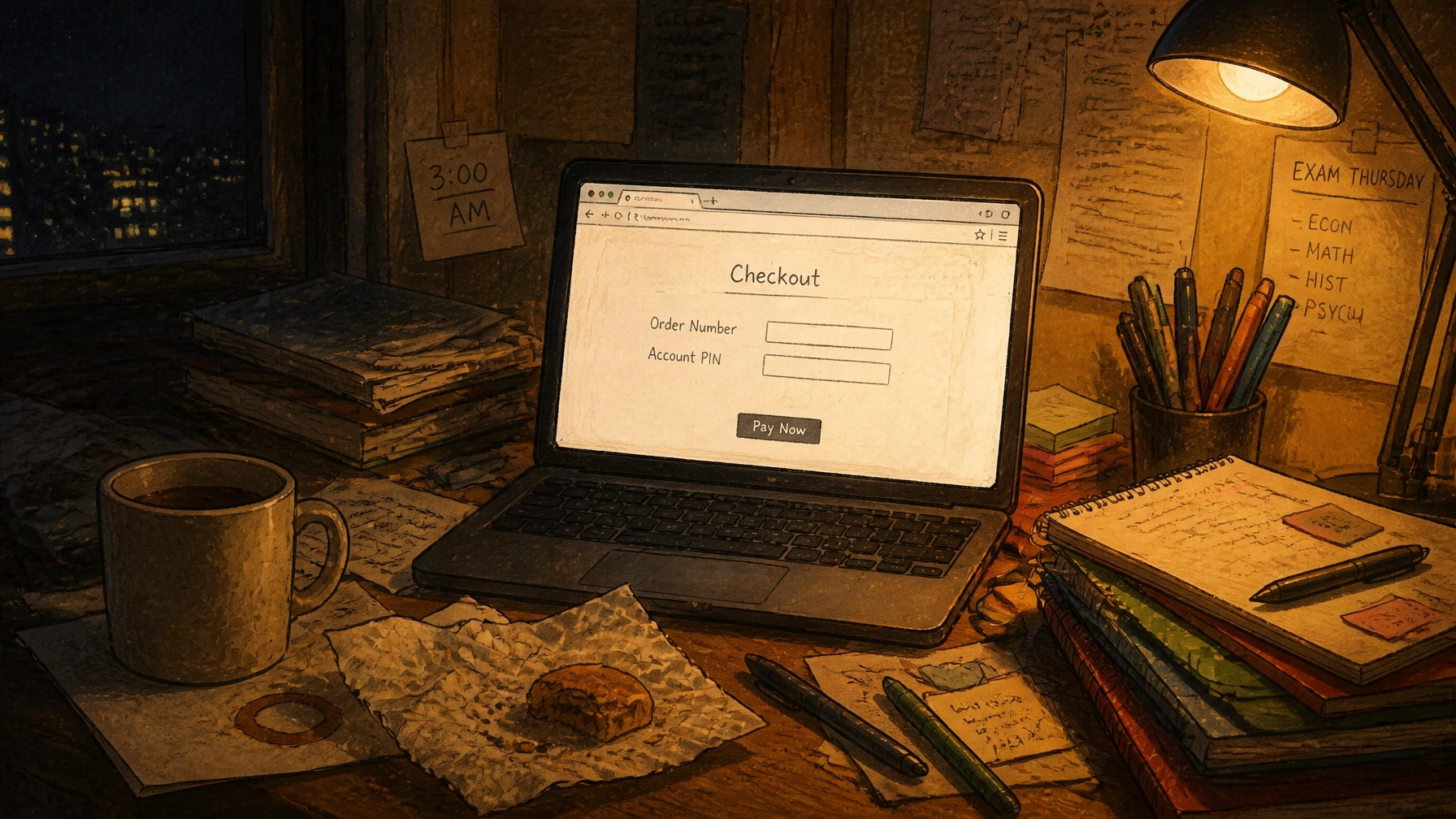
When you place an order, you get an Order Number. That’s it. If you need to talk to support, check on your status, or message your writer, all you need are those two things.

  • Order Number: Identifies the specific task.
  • Account PIN: Verifies that it’s actually you asking.

Think of it like a secret handshake. You don't need to show us your ID to get through the door; you just need the code. This system keeps your identity completely locked away. Our writers don't know who you are, and our system doesn't store the kind of sensitive data that hackers dream about.

A student's phone displaying a notification about an order being ready with a PIN code

Quick Privacy Tips for the Savvy Student

Even when you aren’t using our services, staying safe online is a full-time grind. Here are a few quick tips to keep your digital life under wraps:

  • Clean Your Metadata: Before you upload any draft to any site, check the "Properties" of the file. Often, Word or Google Docs will bake your full name into the document's metadata. Delete it!
  • Use a Burner Email: If you’re really worried, create a separate email address specifically for academic help or subscriptions.
  • Beware of "Free" Services: If a site offers "free" essays but asks for a phone number or social media login, run. You are the product.
  • Keep Your Prompt Vague: When sharing instructions, you don't need to include the header that says "Professor Smith’s History 101 at Texas Southern University." Just give us the prompt itself.

Living Your Life: The Real Benefit of Anonymity

Why do we go to these lengths? Because we want you to have the freedom to live your life.

Being a student in 2026 is exhausting. You’re likely juggling a part-time job, a social life, family obligations, and a course load that would make a CEO sweat. When you come to us for help, you're looking for a way to breathe.

If we made you jump through hoops with ID verification, we’d just be adding more stress to your life. Our goal is to be the "Academic Sous Chef" in your kitchen: doing the heavy prep work so you can plate the final dish and take the credit.

By staying anonymous, you get to enjoy:

  • Total Peace of Mind: No fear of data leaks or "being found out."
  • Stress-Free Help: No digging for your passport just to get an outline.
  • Professional Boundaries: Your personal life stays personal.

And that freedom is what allows you to actually enjoy your time. Whether it's heading out for a night in Midtown or finally catching up on sleep, you can do it knowing your privacy is guarded by our PIN system.

A hand-drawn sketch of a student relaxing in a park with a laptop, looking stress-free

How the Process Works (Without the Drama)

Ready to see how easy it is to get help without the "creepy" ID requests? Here is the step-by-step workflow at Submit Your Assignments:

  1. Submit Your Request: Head over to our order page and tell us what you need. Attach your prompt, your rubric, and any sources you want us to use.
  2. Get Your Order Number & PIN: As soon as you set up your account, you'll receive your unique credentials. Keep these safe! They are the only keys you need.
  3. Chat Anonymously: If you have questions for your writer, you can communicate through our secure dashboard. No real names required: just your Order ID.
  4. Download and Chill: Once the work is done, you'll get a notification. Use your PIN to log in, grab your files, and you're good to go.

It’s that straightforward. No selfies, no ID cards, and no unnecessary questions.

We know the grind is real, and we’re here to help you navigate it safely. If you’re feeling overwhelmed by your current workload, don't let the fear of privacy hold you back. Trust the team that puts your anonymity first.

Stop worrying about your data and start focusing on your freedom.

Fun Facts for the Privacy-Conscious

  • The First PIN: The Personal Identification Number was invented in 1966 by James Goodfellow.
  • Data Minimization: This is a real legal term that means companies should only collect the absolute minimum data they need to function. We're big fans of it.
  • Coffee & Coding: Most of our secure backend was built on a steady diet of local Houston coffee.
  • Anonymous Browsing: Using a VPN is another great way to keep your student life private while researching!

All university names, logos, and trademarks mentioned in this post are the property of their respective owners. Use of these names does not imply any affiliation with or endorsement by the institutions.

Submit Your Assignments provides custom reference materials and tutoring services for research and educational purposes only. We encourage all students to follow their institution's academic integrity policies.

pexels photo 37812837 1

How to Write My Thesis: A Complete Step-by-Step Guide for 2026

If you have been staring at a blank page wondering, "How do I write my thesis?" you are not alone. Thousands of students ask the same question every semester, and the anxiety it produces can feel paralyzing. The good news is that writing a thesis is not a mysterious talent reserved for a chosen few. It is a manageable project, a series of clear and repeatable steps that anyone can follow. This guide will walk you through the entire process, from choosing a topic you actually care about to defending your finished work with confidence. We will cover practical timelines, the core structure every thesis needs, formatting rules, and the mindset shifts that keep perfectionism from stalling your progress. Whether you are working on a bachelor's capstone or a master's dissertation, this roadmap is built for you.

Table of Contents

What Is a Thesis? (And What It Is Not)

Before diving into the how, we need to clear up a common source of confusion. A thesis, in the context of this guide, is a substantial academic paper that represents the culmination of your degree. It is not the same thing as a thesis statement, which is a single sentence inside an essay that states your argument. A thesis is a document, often 40 to 80 pages or more, that demonstrates your ability to conduct independent research, analyze evidence, and contribute a new perspective to your field.

A cozy, multi-level library environment featuring warmly lit bookshelves.
Photo by Helin Gezer on Pexels

It is equally important to understand what a thesis is not. It is not expected to be a groundbreaking, Nobel-worthy discovery. Your committee does not need you to reinvent your discipline. They want to see that you can frame a question, investigate it rigorously, and communicate your findings clearly. Think of your thesis as a capstone learning exercise, not a career-defining masterpiece. Most theses fall into one of three categories: empirical, where you collect and analyze original data; theoretical, where you build an argument from existing texts and ideas; or creative, common in the arts, where a written analysis accompanies a creative project. Regardless of type, the standard components remain the same: introduction, literature review, methodology, results, discussion, and conclusion.

Phase 1: Laying the Groundwork (Before You Write a Single Word)

How to Choose a Thesis Topic You Will Not Hate in 3 Months

Start with genuine curiosity. Think back through your coursework and identify the questions that made you want to dig deeper, the debates you kept thinking about after class ended. That lingering interest is your starting point. Next, narrow that broad interest into a specific, researchable question by applying the "so what?" test. If your topic is "social media and mental health," ask "so what?" until you arrive at something like "How does nightly Instagram use affect sleep quality and next-day anxiety in first-year college students?" That is a question you can actually investigate.

Feasibility matters just as much as interest. Do you have access to the data, archives, lab equipment, or participants you need? A brilliant topic you cannot execute is a dead end. Run your idea past your advisor early. A topic they find genuinely interesting will earn you better feedback and more engaged guidance. Avoid the classic trap of going too broad, like "the history of the internet," which would require an encyclopedia, and the opposite trap of going too narrow, like "a single deleted tweet from 2014," which leaves you with nothing to analyze.

Diverse colleagues discussing plans during a corporate meeting indoors.
Photo by RDNE Stock project on Pexels

Building Your Thesis Timeline: A Month-by-Month Plan

A realistic timeline is your best defense against last-minute panic. Most students need four to six months of consistent work. Here is a sample six-month plan you can adapt to your own deadlines. In month one, focus on topic selection, your first advisor meetings, and initial literature scoping to understand what already exists in your area. Month two is for writing your formal proposal and completing a deep, organized literature review. By month three, you should finalize your methodology and begin data collection if your thesis is empirical. Month four belongs to data analysis and drafting the results chapter. In month five, write your discussion and conclusion, then circle back to revise your introduction so it accurately reflects the paper you actually wrote. Month six is reserved for formatting, proofreading, and defense preparation. The most important pro tip: build a buffer week into every single month. Delays happen. Buffer weeks save you from cascading panic.

Working With Your Advisor Without Driving Each Other Crazy

Your advisor is your most valuable resource, but the relationship requires management. Schedule regular check-ins every two to three weeks and send a brief agenda 24 hours before each meeting. Come prepared with specific questions. Instead of asking "What do I do next?" ask "I am struggling to narrow my methodology section. Here are two approaches I am considering. Which one aligns better with my research question?" This shows respect for their time and keeps the conversation productive.

Learning to receive critical feedback is a skill in itself. Your advisor's job is to make your work stronger, not to attack you personally. When they mark up a chapter, take a breath before responding. There is a difference between feedback that challenges your core argument, where you might push back with evidence, and feedback about formatting or clarity, where you should simply comply. Keep a single running document where you record every piece of feedback you receive from all sources. This prevents anything from slipping through the cracks during revision.

Phase 2: The Core Structure of Your Thesis

The Introduction: Hook, Context, and Your Thesis Statement

Your introduction has a job to do, and it must do it efficiently. Open with a compelling hook: a surprising statistic, a provocative question, or a real-world problem that makes the reader understand why your work matters. Follow the hook with background context. Briefly explain what is already known and, crucially, what gap your work fills. Then state your thesis statement clearly. This is the central claim or argument your entire paper supports, and it should be specific and arguable rather than a bland statement of fact.

End the introduction with a roadmap sentence that tells the reader exactly what each chapter will cover. This signposting helps your committee navigate your work. One common mistake is writing the introduction first and never revisiting it. The best introductions are often written last, after you know precisely what your thesis argues and concludes. That way, the introduction accurately reflects the paper you actually wrote, not the paper you thought you would write.

The Literature Review: Positioning Your Work as the Missing Puzzle Piece

Think of your literature review as assembling a giant puzzle. The existing research represents 99 percent of the pieces already placed. Your thesis is the one missing piece that completes the picture. This metaphor, drawn from the research on effective thesis writing, keeps you focused on your real task: showing where your work fits and why that fit matters.

Organize your literature review thematically, not chronologically. Group sources by debate, methodology, or finding rather than marching through them by publication date. Your job is not to summarize every source. It is to critically evaluate them. What are the weaknesses, contradictions, or blind spots in the existing research? Where do scholars disagree, and why? End the literature review by clearly and explicitly stating the research gap your thesis will fill. This is the logical bridge to your methodology chapter. One practical note: start using a citation management tool like Zotero or EndNote from day one. Trying to format a bibliography manually at the end is a recipe for errors and frustration.

Methodology: How You Did What You Did

The methodology chapter is your opportunity to show your work. Describe your research design clearly: is it qualitative, quantitative, mixed-methods, or a theoretical analysis? Be specific. If you ran a survey, include your sample size, how you recruited participants, and the survey instrument you used. If you conducted interviews, explain your selection criteria and how you analyzed the transcripts.

Justify your choices. Why did you choose this method over alternatives? What are its limitations, and how did you account for them? For STEM theses, include equipment specifications, protocols, and data processing steps with enough detail that another researcher could replicate your work. For humanities theses, explain your interpretive framework or archival research process. A reader should finish this chapter understanding exactly what you did, why you did it that way, and what the boundaries of your approach are.

Results and Discussion: What You Found and What It Means

The results chapter and the discussion chapter serve different purposes, and keeping them separate is essential. In the results chapter, present your findings objectively. Use tables, charts, or direct quotes from participants. Do not interpret anything yet. Simply report what the data shows.

The discussion chapter is where interpretation happens. Now you explain what your results mean. How do they answer your research question? Do they support or contradict your original hypothesis? This is where you compare your findings to the literature you reviewed earlier. Are your results consistent with previous studies, or are they surprising? If they diverge, why might that be? Acknowledge your limitations honestly. Every study has them, and pretending yours does not will weaken your credibility. Small sample sizes, self-reported data, or time constraints are normal limitations to name. Finally, transition smoothly toward your conclusion by signaling the broader implications of your work.

Conclusion and Future Research

Your conclusion should be concise and confident. Summarize your key findings in three or four sentences. Do not introduce new information here. Restate the significance of your work: why should anyone care about what you found? Then suggest two or three concrete directions for future research that build directly on your study. This shows that you understand your work is part of an ongoing conversation, not the final word. End with a strong closing statement that circles back to the hook you used in your introduction, creating a sense of closure and coherence.

Phase 3: Practical Writing and Formatting

APA, MLA, or Chicago? A Quick Style Guide for Thesis Writers

Formatting requirements vary by discipline, and getting them right is non-negotiable. APA style, which uses author-date citations and double-spaced text with a running head, is the standard for social sciences including psychology, education, and nursing. MLA style, using author-page citations and a works cited page, dominates in literature, languages, and cultural studies. Chicago or Turabian style, which can use either footnotes or author-date citations, is common in history and the arts. Check your department's specific preference before you commit.

Use a citation manager to auto-generate your bibliography, but never trust it blindly. Always double-check every entry for errors in capitalization, punctuation, and author names. Follow your university's specific formatting template for margin sizes, font choice, and page numbering with religious attention to detail. These seemingly small elements signal professionalism to your committee.

Overcoming Writer's Block and Perfectionism

Perfectionism is the most common reason thesis writers get stuck. The solution is the "shitty first draft" method: write without editing for 25-minute sprints. Your goal is to get words on the page, not to produce polished prose. Editing comes later. Break your thesis into micro-tasks that feel achievable. "Write 200 words on the methodology limitations" is a task you can complete in one sitting. "Write the methodology chapter" is overwhelming and easy to avoid.

If you are stuck on one section, skip to another. Write the conclusion before the introduction if that feels easier. Change your environment. A library, coffee shop, or even a different room in your house can reset your focus. The mantra to repeat is simple: done is better than perfect. A finished thesis with minor flaws is a passing thesis. An unfinished perfect thesis in your head helps no one.

Phase 4: The Final Stretch: Revision, Defense, and Submission

How to Revise Like a Professional Editor

Revision happens in layers. Start with a structural edit. Read your thesis with one question in mind: does each chapter flow logically into the next, and does your overall argument hold up? Only after the structure is solid should you move to a line edit. Check for clarity, conciseness, and tone. Cut unnecessary words and tighten sentences. Reading your thesis aloud is one of the most effective ways to catch awkward phrasing and run-on sentences that your eyes skip over on the screen.

Get a fresh pair of eyes on your work. A peer reviewer or your university writing center can spot problems you are too close to see. Before you call it finished, run a final check for formatting consistency. Headings, citations, and page numbers should be uniform throughout.

How to Prepare for Your Thesis Defense

Know your thesis inside and out. You should be able to explain any decision you made, from your methodology choice to your interpretive framework. Anticipate the most common questions: Why did you choose this methodology? What are the limitations of your study? How does your work contribute to the field? Prepare a 10- to 15-minute presentation that summarizes your key points clearly and concisely.

Practice with friends or colleagues. Record yourself to catch nervous habits like speaking too fast or fidgeting. Most importantly, reframe the defense in your mind. It is a conversation, not an interrogation. Your committee wants you to succeed. They have invested time in your work, and the defense is their chance to discuss it with you as a junior colleague.

Frequently Asked Questions About Writing a Thesis

Can ChatGPT write my whole thesis? No. Using AI to generate entire chapters constitutes plagiarism and violates most university honor codes. You can use AI tools for brainstorming or light editing assistance, but the original content, analysis, and writing must be your own.

How long does it take to write a thesis? Most students need four to six months of consistent work. The idea of a "one-week thesis" is a myth for quality academic work, and attempting it almost always produces substandard results.

What if I hate my topic halfway through? Talk to your advisor immediately. You may be able to pivot your research question or adjust your focus without starting over entirely. This is more common than you think.

Do I need to collect original data? Not always. Many theses in the humanities and theoretical sciences rely on existing data, archival materials, or textual analysis. Check your department's requirements.

How do I find a thesis advisor? Look for professors whose research interests align with yours. Send a polite, professional email that briefly introduces your proposed topic and requests a short meeting to discuss the possibility.

Final Checklist Before You Submit

Thesis statement is clear and arguable. Literature review identifies a clear research gap. Methodology is replicable and justified. Results are presented objectively. Discussion connects findings back to the literature. Conclusion summarizes key points and suggests future research. All citations are formatted correctly in the required style. Page numbers, margins, and fonts match university guidelines. The entire document has been proofread for spelling and grammar errors. Your advisor has given final approval. When every box is checked, you are ready to submit with confidence.

I 7rX0BV ZR

The Best ChatGPT Prompts for Human-Sounding Essays (And Why They Still Need a Pulse)

You’ve been there. It’s 2 AM, the deadline is breathing down your neck, and you’ve finally massaged ChatGPT into spitting out something that looks like an essay. You run it through a detector just to be safe, and: boom. 98% AI detected.

Your heart sinks. You didn't even "cheat" in the traditional sense; you just used a tool to organize your thoughts. But now, you’re staring at a "robotic" piece of text that has all the personality of a toaster manual.

The internet is full of "magic prompts" that promise to bypass Turnitin or GPTZero, but most of them are outdated glitches. In 2026, the game has changed. If you want to humanize ai essay content, you can't just ask the bot to "write like a human." You have to hack the way it thinks.

But here’s the cold, hard truth: even the best prompts fail about 40% of the time. Why? Because AI lacks a "pulse."

In this guide, we’re going to look at the prompt strategies that actually work and why a human-in-the-loop is still your only real safety net.

Table of Contents

  1. The "Mirror Voice" Strategy: Training the Bot on You
  2. Prompts for Neurodivergent Writing Styles
  3. The Twist: Why Even Great Prompts Hit the Wall
  4. SYA’s "Human Pulse" Process: Beyond the Prompt
  5. Quick Fixes: Manual Humanizing Tips

The “Mirror Voice” Strategy: Training the Bot on You

Most students make the mistake of giving ChatGPT a prompt and hoping for the best. That’s like asking a stranger to give a speech at your wedding. If you want the best chatgpt prompts to make essays sound human, you have to start by showing the AI what your humanity looks like.

Instead of asking it to write, ask it to learn. Try this "Mirror Voice" sequence:

The Setup Prompt: "I am going to paste three samples of my previous writing. Do not summarize them. Instead, analyze my sentence structure, the way I use transitions, my level of formality, and how I use personal anecdotes. Create a 'Voice Profile' for me."

Once it gives you that profile, use it as a leash.

The Execution Prompt: "Now, using that Voice Profile, draft an essay on [Your Topic]. Avoid words like 'moreover,' 'furthermore,' or 'in conclusion.' Use 'bursty' sentence structures: mix long, complex thoughts with short, punchy sentences. Make it sound like a first draft, not a polished textbook."

By forcing the AI to look at your actual work, you're injecting a layer of authenticity that generic prompts can't touch.

A tired student lit by the blue light of a screen, looking focused but exhausted.

Prompts for Neurodivergent Writing Styles

Standard AI writing is terrifyingly linear. It follows a perfect A-B-C logic that most humans: especially those of us with ADHD or other neurodivergent traits: don't actually use.

If you’re looking for prompts to make AI text pass as neurodivergent writing, you need to tell the AI to break the "rules" of standard academic flow. Neurodivergent writing often features "info-dumps," sudden shifts in focus that eventually tie back together, and a hyper-focus on specific details.

Try this prompt to mess with the AI's "tidy" logic:

"Write this essay using a neurodivergent-leaning style. This means: avoid perfectly balanced paragraphs. Let some be long and info-dense, and others be a single sentence. Use parentheses for 'side-thoughts.' Focus on hyper-specific sensory details rather than broad generalizations. If you find a transition feels too 'smooth,' break it. I want the logic to feel earned, not manufactured."

This approach helps humanize chat gpt essay results because it mimics the "chaos" of a real human brain at work.


The Twist: Why Even Great Prompts Hit the Wall

Here is where the "hacker" vibe meets reality. You can have the most sophisticated prompt in the world, but AI detectors aren't just looking for words; they're looking for patterns.

AI is essentially a prediction engine. It chooses the "most likely" next word. Even when you tell it to be "random," it’s still being random within a mathematical framework. This is called "low perplexity."

The 40% Fail Rate: In our internal testing at Submit Your Assignments, we found that even with high-level humanizing prompts, detectors still flag about 4/10 essays.

Why?

  • The Uncanny Valley: The text feels "too perfect" in its imperfections.
  • Lack of Local Soul: An AI doesn't know what it’s like to grab a late-night honey butter chicken biscuit at Whataburger while stressing over a finals week in Houston. It can pretend, but it can't feel.
  • Update Lag: Detectors like Turnitin update their algorithms faster than the "prompt engineers" on TikTok can find new workarounds.

Abstract digital art of a heartbeat line turning into a handwritten script.

SYA’s “Human Pulse” Process: Beyond the Prompt

At Submit Your Assignments, we don't just "prompt" our way through your work. We believe in the "Human Pulse."

Our writers are real people: many of them former TAs and grads from schools like the University of Houston or TAMU. When you use our essay writing service, the process isn't a "glitch in the matrix." It’s a collaboration.

The Process:

  1. Brainstorming: We take your prompt and find the "angle" an AI would miss.
  2. Drafting: We write with actual intent, using current events and local context that AI wouldn't know.
  3. Editing: We run every piece through a rigorous check to ensure it doesn't just "pass" a detector, but actually sounds like a living, breathing student.

We don't "humanize" AI text; we provide human-original work that serves as a model for your own academic journey. You can check out our 94% average customer rating and see why students across Texas trust us to keep it real. If you want to see what our community thinks, take a look at our reviews and trust metrics.


Quick Fixes: Manual Humanizing Tips

If you’ve already got a draft and it’s sounding a bit robotic, stop looking for a "magic prompt." Take five minutes and do these manual fixes:

  • Kill the "Robot Connectors": Search for "Furthermore," "Moreover," and "Additionally." Replace them with "And," "But," or just start a new sentence.
  • Add a "Useless" Detail: AI hates irrelevance. Mention a specific (fictional or real) moment, like the sound of a radiator clicking or the smell of old library books.
  • Vary Your Sentence Lengths: If you have three sentences in a row that are the same length, your text will be flagged. Chop one in half. Make the other one a long, rambling thought.
  • Read it Out Loud: If you run out of breath reading a sentence, it’s too "AI." Break it up.

A student frustrated at a tablet in a lived-in Texas apartment.

Living Your Life While We Handle the Grind

Whether you're navigating the sprawling campus of HCC or trying to survive the engineering gauntlet at Rice, you shouldn't have to spend your entire weekend arguing with a chatbot.

The goal isn't just to get the grade; it's to have the freedom to actually live. Go to that game. Get some sleep. Let us handle the heavy lifting of research and outlining.

Stop worrying about whether your prompt is "human" enough. Trust the people who actually understand the Texas student experience.

Ready to get started? Order your custom reference model today and see what a real human pulse can do for your grades.


Helpful Links for Your Journey:

Fun Fact about Houston: Did you know that the "Underground Tunnel System" in downtown Houston spans over 6 miles and contains restaurants and shops? It’s the perfect place to hide from the Texas heat while you're catching up on reading!


All university names, logos, and trademarks mentioned in this post are the property of their respective owners. Use of these names does not imply any affiliation with or endorsement by the institutions.

Submit Your Assignments provides custom reference materials and tutoring services for research and educational purposes only. We encourage all students to follow their institution's academic integrity policies.

Keywords: best chatgpt prompts to make essays sound human, prompts to make AI text pass as neurodivergent writing, how to humanize chat gpt essay, humanize ai essay.

iHDgIebpvM5

Texas A&M Galveston Engineering: How to Ace Your Lab Reports Without the AI Headache

You’re sitting in your dorm on Pelican Island, staring at a spreadsheet that makes absolutely no sense. The bridge is probably stuck open again, your fluid mechanics data looks like a random number generator went rogue, and you have a 15-page lab report due in exactly eight hours.

We’ve all been there. Engineering at Texas A&M Galveston isn’t just a degree; it’s a marathon of technical writing and data interpretation that can leave even the most dedicated students feeling burnt out. Whether you’re navigating the intricacies of Ocean Engineering or trying to survive your first year of general ENGR courses, the lab report is the ultimate boss fight.

But here’s the thing: trying to "AI" your way out of it often leads to more headaches than it solves. If you’ve ever seen a chatbot hallucinate a Reynolds number or fail to understand how Galveston’s humidity affects your marine materials lab, you know exactly what we’re talking about.

Table of Contents

  1. The Engineering Lab Report Struggle
  2. Quick Tips for Better Lab Reports
  3. Why AI Struggles with Engineering Context
  4. The Human Solution: Why Expertise Matters
  5. Our Data-Driven Writing Process
  6. Local Vibes and Engineering Fun Facts

The Engineering Lab Report Struggle

Engineering reports are a different beast compared to your standard history essay. You aren’t just sharing an opinion; you’re explaining how the physical world works through the lens of data. At Texas A&M Galveston, the expectations are high. You’re part of the broader A&M College of Engineering system, meaning your technical writing needs to be precise, professional, and grounded in theory.

Common pain points we see students hitting every single week include:

  • The Data Gap: Having a bunch of numbers but no clue how to link them to the theoretical equations from your lecture.
  • Uncertainty Analysis: Calculating percent error is one thing, but explaining why it happened is where most points are lost.
  • Formatting Nightmares: Trying to get those IEEE or ASCE citations right while wrestling with LaTeX or Word’s finicky graph tools.
  • The Narrative Trap: Writing the procedure like a diary entry ("First, we turned on the pump…") instead of a technical document ("The pump was activated to initiate flow…").

It’s a grind, and when you’re already juggling a heavy course load and maybe a part-time job near the Strand, it’s easy to feel overwhelmed.

Abstract digital art of a marine vessel's hull integrated with mathematical equations and fluid dynamics symbols.

Quick Tips for Better Lab Reports

Before we dive into the deep end, here are a few fast ways to level up your writing right now:
* **Abstracts Come Last:** Never write your abstract first. It’s a summary of your *results* and *conclusions*, so you can’t write it until the report is actually done.
* **Watch Your Sig Figs:** Nothing frustrates an engineering TA more than inconsistent significant figures. Keep them tight and based on your instrument’s precision.
* **Label Everything:** If your graph doesn’t have units on the axes, it’s not a graph: it’s just a drawing.
* **Passive Voice is Your Friend:** Use “The data were analyzed” rather than “I analyzed the data.” It keeps the focus on the science, not the scientist.


Why AI Struggles with Engineering Context

It’s tempting to feed your lab manual into a chatbot and ask it to “write the discussion section.” But here’s the reality check: AI is a language model, not an engineer. When it comes to **Texas A&M Galveston engineering reports help**, the generic output from a standard AI tool often misses the mark for a few key reasons.

First, AI lacks the "Pelican Island context." It doesn't understand the specific equipment used in the TAMUG labs or the unique environmental factors of the Gulf Coast that might influence your experimental results. If you're working on a marine engineering project, the AI might give you equations for a freshwater environment when you're clearly dealing with high-salinity seawater.

Second, AI is notoriously bad at handling actual data sets. It might look like it’s doing the math, but it’s often just predicting the next likely word. That’s a recipe for a "Fail" when your TA notices the numbers in your discussion don't match your results table.

And let’s be real: professors are getting better at spotting the "AI smell." That overly polished, repetitive, and ultimately hollow tone is a red flag. If you want a paper that sounds like it was written by a future engineer, it needs a human touch.

A messy student desk at 2 AM with a glowing laptop and a 'Percent Error' calculation that is way off.

The Human Solution: Why Expertise Matters

This is where we come in. At [Submit Your Assignments](https://submityourassignments.org), we don’t just “generate” text. We pair you with writers who actually understand the engineering field. We believe that while technology is great for brainstorming, the heavy lifting of technical analysis should be left to people who know their way around a thermodynamics table.

As we said earlier, humans are the true heroes when it comes to high-stakes academic work. Our writers don't just look at your data; they interpret it. They can spot an outlier in your fluid dynamics lab and suggest a plausible engineering reason for why it happened: something a chatbot would likely ignore or "hallucinate" over.

Stop worrying about whether your AI-generated text is going to get flagged or if you’ve used the right technical jargon. Trust our writers to help you structure a report that reflects your hard work in the lab.


Our Data-Driven Writing Process

When you look for **engineering lab report help**, you deserve a process that’s as methodical as the experiment you just ran. Here’s how we handle your request:

  1. Context Gathering: You send us your lab manual, your raw data (messy Excel sheets and all), and any specific rubrics from your instructor.
  2. Expert Pairing: We assign your project to a writer with a background in engineering or a related technical field.
  3. Data Analysis: The writer reviews your results to ensure the logic holds up. They don't just write around the data; they write from the data.
  4. Technical Drafting: We build the report from the ground up: Title, Abstract, Introduction, Procedure, Results, Discussion, and Conclusion.
  5. Quality Check: Every report goes through a review process to ensure it meets academic standards and is free from the clinical, robotic tone of AI.

The result? A professional, data-backed reference model that you can use to ace your assignment and actually learn the material. It’s about more than just getting a grade; it’s about having the freedom to live your life without the constant stress of an impending deadline.

A student sitting in an Adirondack chair on a Galveston beach during sunset, looking relieved.

Local Vibes and Engineering Fun Facts

Since you’re already grinding away on Pelican Island, here are a few things to keep your spirits up:
* **The Bridge Life:** Did you know the Pelican Island Bridge was built in 1957? It’s basically a living case study in structural fatigue and marine corrosion: perfect for your next materials report.
* **Ship Channel Watching:** Galveston handles about 4 million tons of cargo a year. Every ship you see is a marvel of marine engineering.
* **HEB Fuel:** No engineering session is complete without a bag of HEB tortilla chips and maybe a Big Red. It’s the unofficial fuel of Texas students.
* **Island Time:** Once that report is submitted, head over to the East End Lagoon for a mental reset. You’ve earned it.

Stop letting lab reports dictate your entire weekend. If you need a hand with Texas A&M Galveston engineering reports, we’re here to help you get across the finish line with confidence.

Trust our writers to give you the edge you need. Head over to our order page and let’s get that lab report off your plate.


Keywords: Texas A&M Galveston engineering reports help, engineering lab report writer, Houston academic writing help.

*All university names, logos, and trademarks mentioned in this post are the property of their respective owners. Use of these names does not imply any affiliation with or endorsement by the institutions.*

Submit Your Assignments provides custom reference materials and tutoring services for research and educational purposes only. We encourage all students to follow their institution's academic integrity policies.

tCNEPP lIF 1

Rice vs. TSU: Cracking the Code on Your Houston University Personal Statement

So, you’re standing at the crossroads of 610 and 59, figuratively speaking. On one side, you’ve got the ivy-draped prestige of Rice University near the Village. On the other, the historic, high-energy pulse of Texas Southern University (TSU) right in the heart of the Third Ward. Both are Houston icons, but let’s be real: they want to hear two completely different stories in your personal statement.

If you’re staring at a blinking cursor and wondering why your draft sounds like a Wikipedia entry, you aren't alone. Writing about yourself is awkward. And trying to guess what a committee in a wood-paneled room wants to hear? That’s next-level stress.

Whether you’re aiming for that research-heavy Rice vibe or the community-driven excellence of TSU, we’re going to break down how to stop sounding like a robot and start sounding like a person.

Table of Contents

  1. The Vibe Check: Rice vs. TSU
  2. Rice University: Decoding "The Box" and Beyond
  3. TSU: Writing with Third Ward Heart
  4. How to Humanize Your Essay (And Why AI Usually Fails)
  5. The SYA Process: Real Writers, Real Results
  6. Quick Houston Admission Tips

The Vibe Check: Rice vs. TSU

Before you type a single word, you have to understand the “culture” of the reader. Houston is a melting pot, but the admissions offices at these two schools look for different “ingredients” in a student.

Rice University is all about intellectual curiosity. They want the thinkers, the weirdos, and the people who actually enjoy a 3 AM debate about quantum physics or urban planning. If you’re applying here, your essay needs to feel analytical but deeply personal.

Texas Southern University, on the other hand, is a cornerstone of the Third Ward. It’s an HBCU with a massive legacy of leadership and social justice. TSU wants to see your hustle. They want to know how you’re going to use your degree to impact your community. It’s less about "what you know" and more about "who you are becoming."

But regardless of where you apply, the biggest mistake students make is being too formal. But here’s the secret: professors and admissions officers are bored. They read thousands of essays that sound exactly the same. If you can make them smile or feel something, you’ve already won half the battle.

An abstract corkboard with polaroids and sketches representing the

Rice University: Decoding “The Box” and Beyond

If you’ve looked at the Rice supplement, you’ve seen it: The Box. It’s a literal empty space where you’re supposed to upload an image that represents you. It’s a total head-scratcher for most people.

But Rice isn't just looking for a cool photo; they’re looking for your personality. The same goes for their short essays. They ask "Why Rice?" and "Why this major?" but what they’re really asking is, "Will you actually contribute to our residential college system, or are you just here for the ranking?"

Rice Writing Tips:

  • Be Hyper-Specific: Don't just say you like their "diverse community." Talk about a specific club, a research project at the Texas Medical Center, or even the coffee at Rice Coffeehouse.
  • Show, Don't Tell: Instead of saying you’re "hardworking," describe that time you spent six weeks trying to fix a single line of code in your robotics project.
  • The Rice Village Connection: Mention how you plan to engage with Houston. Are you looking at internships in the Museum District? Say so.

TSU: Writing with Third Ward Heart

Applying to TSU is about more than just grades. It’s about joining a legacy. Whether you’re going for their world-class pharmacy program or the school of public affairs, your personal statement needs to bleed “Tigers” (wait, we’re keeping it casual: it needs to bleed blue and maroon pride).

TSU looks for resilience. Many students there are juggling jobs, family, and classes. If you’ve faced a challenge: maybe a rough semester or a personal hurdle: don't hide it. Use your essay to explain how that experience made you a better leader.

TSU Writing Tips:

  • Focus on Impact: How will a degree from TSU help you change your neighborhood or your field?
  • The Hustle Factor: If you’re a first-generation college student, talk about what that means to your family.
  • Authenticity is Key: TSU value's real voices. You don't need to use "SAT words" to sound smart. Just be you.

A candid shot of a student on a campus bench looking relieved after receiving an

How to Humanize Your Essay (And Why AI Usually Fails)

We’ve all seen what happens when you ask ChatGPT to “write a college essay.” It spits out something that sounds like a corporate HR manual. It uses words like “unleash,” “testament,” and “ever-evolving.”

Admissions officers see right through that. In fact, many are now using detectors specifically to flag robotic writing. But the real problem with AI isn't just detection: it’s the lack of "soul." AI can't remember the smell of rain on a Houston sidewalk or the specific nervousness you felt during your first internship interview in Downtown.

How to fix robotic writing:

  1. Read it out loud. If it sounds like something you’d never actually say, delete it.
  2. Add "Texture." Instead of "I learned a lot," try "I spent three hours hunched over a desk, surviving on cold coffee and sheer stubbornness."
  3. Break the Rules. It’s okay to start a sentence with "And" or "But." It makes your writing feel conversational and alive.

If you’re struggling to find that human touch, you might want to check out our guide on how to humanize AI content. We talk about how to take a rough draft and give it a "pulse."

The SYA Process: Real Writers, Real Results

At [Submit Your Assignments](https://submityourassignments.org), we don’t do generic. We’ve seen the “5-dollar essay traps” that leave students with flagged papers and zero help. That’s not our vibe.

When you work with us for a college essay consultation, you aren't getting a bot. You’re getting a human writer who understands the Houston academic scene. We help you brainstorm, outline, and refine your story until it sounds exactly like you: only better.

And we’re big on transparency. You shouldn't have to wonder what you're paying for. You can check out our transparent pricing guide to see how we "charge like a bird" while keeping the quality high.

A close-up shot of a student’s hands editing a paper on a laptop.

Quick Houston Admission Tips

* **Know the Deadlines:** Rice is strict. TSU can be more flexible, but the early bird gets the scholarships.
* **Visit the Campus:** Walk around Rice Village or grab some lunch near the TSU campus. It’ll give you “vibe” details you can put in your essay.
* **Get a Second Pair of Eyes:** Never submit a first draft. Ever.

Ready to stop stressing and start writing?
Stop worrying about whether your essay is "perfect." Focus on making it real. If you need a hand with the heavy lifting: from brainstorming "The Box" to perfecting your TSU statement of purpose: we're here to help.

Trust our writers to help you find your voice and get that peace of mind you deserve. You’ve got the grind; let us help with the polish.

Fun Houston Facts for Your All-Nighter:

  • Rice University was originally tuition-free until 1965.
  • TSU’s debate team is world-renowned and was famously coached by the late Barbara Jordan.
  • The best "study fuel" in the city? Most of our writers swear by a late-night run to Whataburger or a breakfast taco from a Third Ward truck.

A student walking through a sunny Houston neighborhood.

Keywords: Rice University essay help, TSU personal statement tips, Houston admission essay help, humanizing AI content for professors, Houston university admission help.


*All university names, logos, and trademarks mentioned in this post are the property of their respective owners. Use of these names does not imply any affiliation with or endorsement by the institutions.*

Submit Your Assignments provides custom reference materials and tutoring services for research and educational purposes only. We encourage all students to follow their institution's academic integrity policies.

5GmkKDs1K8F

How to Humanize Your Chat GPT Essay: The Secret to Professor-Proof Writing in 2026

You know that feeling. You’ve spent hours staring at a blinking cursor, the deadline for your 2,000-word research paper is staring you down, and you finally cave. You ask Chat GPT to "write an essay on the economic impact of urban sprawl." In three seconds, it spits out a perfectly structured, incredibly boring, and painfully robotic paper.

But then the panic hits.

You remember your professor at Rice University or TSU mentioning that new AI detector they’re using. You’ve heard the horror stories of students getting flagged for "AI-generated content" even when they only used it for an outline. Now you're stuck wondering: how do I make this sound like me? How do I humanize this AI text before I hit submit?

Let’s be real: those "AI humanizer" websites are usually a total bust. They just swap words with weird synonyms until your paper sounds like it was written by a Victorian ghost having a stroke. If you want to actually stay safe and keep your academic reputation intact, you need a different strategy.


Table of Contents

  1. The AI Detection Trap of 2026
  2. Quick Tips to Manually Humanize Your Text
  3. The SYA Difference: Real Humans, Real Results
  4. Our Process: Making Your Draft Professor-Proof
  5. The Lifestyle Win: Why We Do the Heavy Lifting
  6. Fun Facts for Houston Students

The AI Detection Trap of 2026

As we move further into 2026, the "arms race" between AI writers and AI detectors has reached a fever pitch. Universities like University of Houston and Houston Community College (HCC) have integrated advanced scanners that don't just look for keywords: they look for "perplexity" and "burstiness."

Basically, AI tends to write in a very predictable rhythm. It’s like a drum machine that never misses a beat. Human writing? It’s messy. It has weird pauses, personal stories, and sentences that vary wildly in length.

Abstract digital art showing a mechanical robot hand holding a paintbrush, painting a colorful, textured human portrait on a canvas. Lo-fi, grainy texture, hand-drawn feel.

Quick Tips to Manually Humanize Your Text

If you’re trying to fix a robotic draft on your own, stop relying on "spinners" and start focusing on these quick humanization wins:

  • Add Personal Anecdotes: AI doesn't know what it’s like to sit in traffic on I-45 for two hours. Throw in a specific, relatable detail about your life or your city.
  • Use "Hedging" Language: AI is very confident. Humans are usually more cautious. Instead of saying "The economy will fail," try "It appears likely that the economy may struggle under these conditions."
  • Vary Your Sentence Length: Follow a long, complex sentence with a short one. Like this. It breaks the "AI rhythm."
  • Cite Class-Specific Sources: AI often hallucinates sources. Go into your syllabus and manually add a quote from that one obscure reading your professor actually cares about.

But let’s face it: doing this for an entire 10-page paper while you’re also trying to maintain a social life and hold down a job is a massive grind.


The SYA Difference: Real Humans, Real Results

This is where Submit Your Assignments comes in. We don't use "humanizing tools." We use human beings.

We’ve seen the rise of AI tools, and while they can be a great starting point, they lack the "soul" required for high-level academic work. In a previous post, we talked about how AI can be your sidekick, but it should never be the pilot.

When you look for a human sounding essay service, you aren't just looking for someone to click a "rewrite" button. You’re looking for an editor who understands the local context of Houston academic writing help. Our writers aren't just random freelancers; they are experienced researchers who know the difference between a generic lab report and one that will pass at Rice University.

A close-up shot of a student’s hands editing a paper on a laptop, with a messy desk and a cup of coffee in the background.

With that being said, our goal isn't just to help you pass: it’s to help you learn. We provide model papers and custom reference materials that show you exactly how a "humanized" argument should look.

Our Process: Making Your Draft Professor-Proof

When you send us your draft (or just your prompt), we don't just "humanize" it; we rebuild it with authenticity. Here is how we ensure your work stays off the detector radar:

  1. The Human-in-the-Loop Review: One of our professional writers reads through your requirements. They don't just look at the word count; they look at the vibe of the assignment.
  2. Contextual Layering: We add specific references that AI would never know. This includes local Houston data, specific theories mentioned in your Texas-based curriculum, and nuanced arguments that require actual critical thinking.
  3. The Style Match: We adjust the tone to match yours. If you’re a freshman at HCC, your paper shouldn't sound like a PhD dissertation. It should sound like a smart, engaged freshman.
  4. Verification: Every piece of work we deliver goes through a rigorous quality check. We even provide a Human Authenticity Certificate to give you that much-needed peace of mind.

A generic Human Authenticity Certificate for Submit Your Assignments, certifying that the work is 100% human-written.


The Lifestyle Win: Why We Do the Heavy Lifting

Listen up: you only get to be a student once. Do you really want to spend your Friday nights stressing over "perplexity scores" and Turnitin reports?

Trusting our writers means you get your freedom back. Whether you want to head out to a game at Minute Maid Park or just finally catch up on sleep, our service gives you the space to live your life. As we said earlier, we "charge like a bird" (aka, student-friendly pricing) because we know what the grind is like.

Stop worrying about whether your AI draft is "human enough." Let a real human handle it for you. Check out our transparent pricing tool and see how easy it is to get professional, human-powered help today.


Fun Facts for Houston Students

  • Best Study Spot: If you’re tired of the library, the coffee shops in Montrose have the perfect "main character" energy for writing.
  • Brain Food: Houston has the best Vietnamese crawfish in the world. Change my mind.
  • The Grind: Did you know Houston is home to the largest medical center in the world? No wonder the nursing students here are so stressed! (We see you, and we’ve got your back).

Keywords: how to humanize chat gpt essay, human sounding essay service, Houston Community College writing help, Rice University essay help.


Academic Integrity Disclaimer:
Submit Your Assignments provides custom reference materials and tutoring services for research and educational purposes only. We encourage all students to follow their institution's academic integrity policies.

Trademark Disclaimer:
All university names, logos, and trademarks mentioned in this post are the property of their respective owners. Use of these names does not imply any affiliation with or endorsement by the institutions.

Is ‘Reddit Write My Paper’ a Trap? The Truth About Cheap Essay Writing on Reddit

You’ve been there. It’s 2:00 AM, your eyelids feel like lead, and that 10-page research paper is due in exactly nine hours. You haven't even started the bibliography. In a moment of sheer desperation, you open a new tab and type it in: "Reddit write my paper."

Suddenly, you’re in the Wild West. Your inbox starts blowing up with "bro, I got you" and "cheap essay writing reddit" offers from accounts created three days ago. It feels like a lifesaver, but is it? Or are you about to pay fifty bucks to get ghosted, or worse, get a paper that sounds like a glitchy AI wrote it in 2021?

Let’s get real about the "Reddit grind" and why chasing the absolute lowest price usually ends in a GPA-crushing disaster.

Table of Contents

  1. The Reddit 'Wild West': Why It's High Risk
  2. Scams, Ghosting, and The AI Trap
  3. The SYA Difference: Vetted Humans vs. Random DMs
  4. Understanding Your Order: The SYA Stages
  5. Privacy & The 'No-Ghosting' Guarantee
  6. Why You Won't Find Samples on Our Site
  7. Quick Tips for Stress-Free Assignments

The Reddit “Wild West”: Why It’s High Risk

Reddit is great for memes and niche hobbies, but trusting it with your academic career is a gamble. When you search for Reddit cheap essay writing, you’re walking into a marketplace with zero accountability.

Anyone can claim to be an expert. That "PhD student" offering to write your ethics paper for $10 might actually be a bot, or someone half a world away using a translator. There’s no vetting process, no quality control, and certainly no one to call when the paper they sent you is 40% plagiarized.

But hey, we get the appeal. You’re broke, you’re tired, and you need a win. But a "cheap" paper isn't cheap if you have to pay a professional to fix it later, or if you end up in the Dean's office explaining why your paper looks exactly like three others submitted that semester.

Scams, Ghosting, and The AI Trap

The most common story we hear from students who come to us after a Reddit fail? The "Ghost." You send the deposit, and suddenly, the user /u/EssayGod420 has deleted their account. Money gone. Deadline still looming.

And then there's the AI. Since ChatGPT went mainstream, the Reddit "writing" scene has been flooded with low-effort, AI-generated drafts. These papers often "hallucinate" facts and use weirdly formal, repetitive language that professors can spot from a mile away. If it sounds like a robot wrote it, that’s because it probably did.

At Submit Your Assignments, we don't play those games. We "charge like a bird", keeping things affordable for students, but we back it up with a 13-point quality shield that ensures every piece of work is human-crafted and researched from scratch.

Abstract 13-point quality shield digital art with textured orange and blue lines and hand-drawn checkmarks.

The SYA Difference: Vetted Humans vs. Random DMs

We don't just pick people off the street. Our writers go through a rigorous "audition" process. They have to showcase legit writing and editing skills before they ever touch a client's order.

We also have actual teeth in our contracts. If a writer is late? They get fined. We use strict order safeguards to make sure your work hits your inbox by the deadline you gave us, not five minutes before your class starts.

Understanding Your Order: The SYA Stages

We believe in transparency, not mystery. When you work with us, you aren't just shouting into the void. You can see exactly where your paper is in our system. Forget the "In Progress" vagueness; here are the actual stages your order goes through. And if you want the full breakdown without playing guessing games, check out our Orders & Account guide. It lays the whole thing out without the weird support-ticket vibes.

  • Pending: We’re waiting on payment, missing info, or haven't assigned it yet.
  • Assigned: Your dedicated writer (with a real ID!) is on the job.
  • Editing: A second pair of eyes is polishing the work to perfection.
  • Completed: The work is ready for your eyes.
  • Approved: You’ve looked it over and given us the thumbs up.
  • Revision: You need a few tweaks? We’re back at it.
  • Canceled: The order was stopped.
  • Review: We’re missing something crucial and can't move forward until you talk to us!

Important Ordering Information infographic showing the order stages and SYA guarantees on a blue and orange background.

Privacy & The “No-Ghosting” Guarantee

Listen, we get that the industry has a bit of a "hush-hush" vibe. There’s a lot of misinformation out there, which is why we take privacy seriously: for you and for our writers.

You won't see our writers' faces or full legal names on the site, and they won't see yours. We protect our team's identity to keep things professional and focused on the work. When you're assigned an expert, you'll see their First Name and their Writer ID.

And just because they're anonymous doesn't mean they're ghosts! We promise our writers are real humans who respond to your notes. If they vanished, they wouldn't get paid (and they'd lose their spot on the team). We treat your data with the same level of lockdown. Your secrets are safe with us, always.

Why You Won’t Find Samples on Our Site

Ever notice how some sites have "sample essays" that look suspiciously perfect? We don't do that. Why? Because we do actual assignments for real clients, and we never reuse or sell them.

Posting a "sample" of a real paper would be a betrayal of that client's privacy. We aren't an essay mill that sells the same "Analysis of Hamlet" to 500 different students. Every order is a one-off, custom creation.

If you really need to see what a writer can do before committing, reach out to us! We can send you vetted samples offline that showcase their skills without compromising anyone's academic integrity.

Close up of a hand-written note with a Writer ID next to a digital tablet with a paper outline, library background.

Quick Tips for Stress-Free Assignments

If you're still hovering over that "Post" button on Reddit, take a breath. Here are three things you can do right now to save your sanity:

  1. Check the Rubric: Most "writer's block" comes from not knowing what the prof actually wants. Highlight the action verbs (Compare, Contrast, Analyze).
  2. Outline First: Don't try to write a masterpiece in one go. Scribble three main points. That’s your skeleton.
  3. Trust the Pros: If the research paper grind is getting to be too much, don't risk it on an anonymous Reddit thread.

Stop worrying about whether /u/CheapEssayBot is going to scam you. Trust our writers to provide the reference materials and editing help you need to get the job done right.

Ready to get started? Check out our custom essay writing services or grab a discount code and let’s get that paper off your plate.

Fun Facts & Local Vibes

  • Our team loves a good Houston breakfast taco: it's the fuel for those late-night editing sessions.
  • The average student spends 15 hours a week just worrying about assignments. We’re here to give those hours back.
  • We've helped students with everything from freshman comp to complex engineering theses.
  • Our "charge like a bird" motto means we keep our overhead low so you don't go broke trying to pass.

*All university names, logos, and trademarks mentioned in this post are the property of their respective owners. Use of these names does not imply any affiliation with or endorsement by the institutions.*

Submit Your Assignments provides custom reference materials and tutoring services for research and educational purposes only. We encourage all students to follow their institution's academic integrity policies.

yXSYFJ I99

Is it Safe to Buy Essays on Reddit? A Guide for Rice, TSU, and UH Students

You’re sitting in your room, the AC is humming against the 98-degree Houston humidity, and you’ve been staring at the same three sentences for two hours. Whether you're navigating the intense workload at Rice University, balancing life and labs at TSU, or trekking across the massive UH campus, the pressure is real. You jump on Reddit to blow off some steam, and suddenly your feed is full of "need help with your essay?" ads and DMs.

It looks so easy, right? Just a few bucks via Venmo to some random user with a name like "EssayWizard420" and your problems disappear. But before you hit send on that payment, you need to know the reality. Is buying an essay on Reddit safe for Rice and TSU students?

The short answer: It’s a gamble where the house usually wins, and the "house" is often a scammer sitting thousands of miles away.

Table of Contents

  1. The Reddit Rabbit Hole: Why It’s Tempting
  2. The Risks You Didn't Sign Up For
  3. Local Stakes: Rice, TSU, and UH Policies
  4. Red Flags: How to Spot a Reddit Scammer
  5. A Safer Way to Get Academic Support
  6. Quick Writing Tips for Your Next Paper
  7. The Final Word

The Reddit Rabbit Hole: Why It’s Tempting

We get it. The "grind" is exhausting. When you’re pulling an all-nighter and the words just won't come, subreddits like r/homeworkhelp or r/essay_writing_service look like a lifeline. These communities are packed with people promising "original, AI-free, high-quality" work for "student-friendly" prices.

They use the right slang, they seem to understand your struggle, and they offer a level of anonymity that feels safe. But that anonymity is a double-edged sword. While it protects you from your professor seeing your face, it also protects the "writer" from ever being held accountable when things go south.

A smartphone displaying a suspicious Reddit DM offering writing services.

The Risks You Didn’t Sign Up For

When you step into the world of anonymous Reddit transactions, you aren't just paying for a paper. You're potentially buying a ticket to a nightmare.

1. The Classic Ghosting

This is the most common story we hear. You send a "deposit" via Cash App or Crypto, and… silence. The user deletes their account, or simply stops responding. Since these are unregulated peer-to-peer payments, your bank won't help you get that money back. You’re out $50, and you still have a blank Word doc staring at you.

2. The Blackmail Trap

This is the scary part. Some Reddit "writers" are actually scammers who look for students at prestigious schools like Rice or TSU. Once you send them your prompt and your university email, they have leverage. If you don't pay "extra" for revisions or a "secrecy fee," they threaten to forward your chat logs and the finished paper to your Dean of Students.

3. The AI Dump

With the rise of ChatGPT, Reddit has become a dumping ground for low-effort AI text. Many "writers" will just prompt an AI, copy-paste the result, and charge you for it. The problem? Universities in Houston have stepped up their detection game. If your paper gets flagged for AI at a school with a strict Honor Code, you’re the one facing the committee, not the random Redditor.

Local Stakes: Rice, TSU, and UH Policies

As we said earlier, Houston schools don't play around when it comes to academic integrity. Every institution has its own vibe, but the consequences for "contract cheating" (which is what buying a paper is called) are universally heavy.

  • Rice University: The Honor Code is the backbone of the Rice experience. Students are trusted to do their own work, and that trust is taken very seriously. If you're caught submitting work that isn't yours, the Honor Council can recommend anything from a failing grade to permanent expulsion. Is a Reddit paper worth losing your spot in the hedges?
  • Texas Southern University (TSU): TSU focuses heavily on professional preparation. Their student conduct code emphasizes honesty as a core value. A mark of academic dishonesty on your transcript can be a major roadblock when you’re applying for internships or grad school.
  • University of Houston (UH): With such a large student body, UH uses sophisticated automated tools to check for plagiarism and AI patterns. The Academic Honesty Policy at UH is clear: representing someone else's work as your own is a violation that stays on your record.

With that being said, the stress of a deadline shouldn't push you toward a risky Reddit deal. There are ways to get support without putting your entire future on the line.

A student looking frustrated at a laptop in a Houston coffee shop.

Red Flags: How to Spot a Reddit Scammer

If you’re still browsing those threads, keep your eyes peeled for these warning signs:

  • Too Good to Be True Prices: If someone offers a 10-page research paper for $30, they are either scamming you or using a bot. Quality research takes time.
  • Brand New Accounts: Check their karma. If the account was made three days ago and has zero posts but claims to have "5 years of experience," run.
  • Refusal to use Secure Platforms: If they insist on "Friends and Family" payments or Crypto and refuse to use a platform with buyer protection, they are avoiding accountability.
  • Aggressive Sales Tactics: "Pay now and get a 50% discount!" sounds more like a used car salesman than an academic tutor.

A Safer Way to Get Academic Support

You don't have to navigate the Houston academic grind alone. At Submit Your Assignments, we offer a transparent, professional alternative to the Reddit lottery. We aren't a group of anonymous "Wizards"; we are a professional essay writing service that focuses on providing model papers, research materials, and editing help.

Why trust us over a random DM?

  • Transparency: You know exactly who you’re working with.
  • Reliability: We’ve built a reputation with a 4.5 rating on Trustpilot because we actually deliver what we promise.
  • Supportive Learning: We frame our services as academic writing assistance. We provide the "blueprints" so you can understand how to structure your own work and succeed on your own merits.
  • Peace of Mind: No blackmail, no AI-slop, and no disappearing acts. Just professional support to help you live your life, whether that's grabbing pho at Mai's or hanging out at Hermann Park, without a deadline hanging over your head like a dark cloud.

Quick Writing Tips for Your Next Paper

Before you give up and head back to Reddit, try these quick steps to jumpstart your own brain:

  1. Voice-to-Text: If you’re stuck, stop typing. Open a voice memo on your phone and just "talk" about your topic. You’ll be surprised how much easier it is to speak your ideas than to write them.
  2. Reverse Outline: If your draft feels like a mess, list the main point of every paragraph you've written. If a paragraph doesn't have a clear point, delete it.
  3. The 20-Minute Sprint: Set a timer for 20 minutes. No phone, no tabs, just writing. You can do anything for 20 minutes.
  4. Ask for an Outline: Instead of looking for a full paper, look for an outline service. Having the skeleton of the paper makes the actual writing 10x easier.

A calm student sitting in Hermann Park looking at an outline.

The Final Word

Living in Houston is great, the food, the culture, the "H-Town" pride. But being a student here is tough. Don't let the pressure of a single assignment lead you into a Reddit trap that could derail your education. Academic success is about more than just a grade; it's about the freedom to enjoy your life without the constant anxiety of a "what if I get caught" scenario.

Stop worrying about anonymous scammers and trust our writers to provide the reference materials and editing you need to succeed the right way.

Fun Facts About Student Life in Houston:

  • First Word on the Moon: Did you know "Houston" was the first word spoken from the lunar surface? (Okay, technically "Okay, Engine Stop," but "Houston" is way more iconic).
  • Pho Capital: Houston has some of the best Vietnamese food in the country. A bowl of pho is the ultimate "I survived finals" meal.
  • The Tunnel System: If you’re downtown, there’s a whole world of food and shops underground to help you avoid the humidity.
  • Art for Free: The Menil Collection is free and one of the best places to clear your head when you're feeling burnt out.

All university names, logos, and trademarks mentioned in this post are the property of their respective owners. Use of these names does not imply any affiliation with or endorsement by the institutions.

Submit Your Assignments provides custom reference materials and tutoring services for research and educational purposes only. We encourage all students to follow their institution's academic integrity policies.