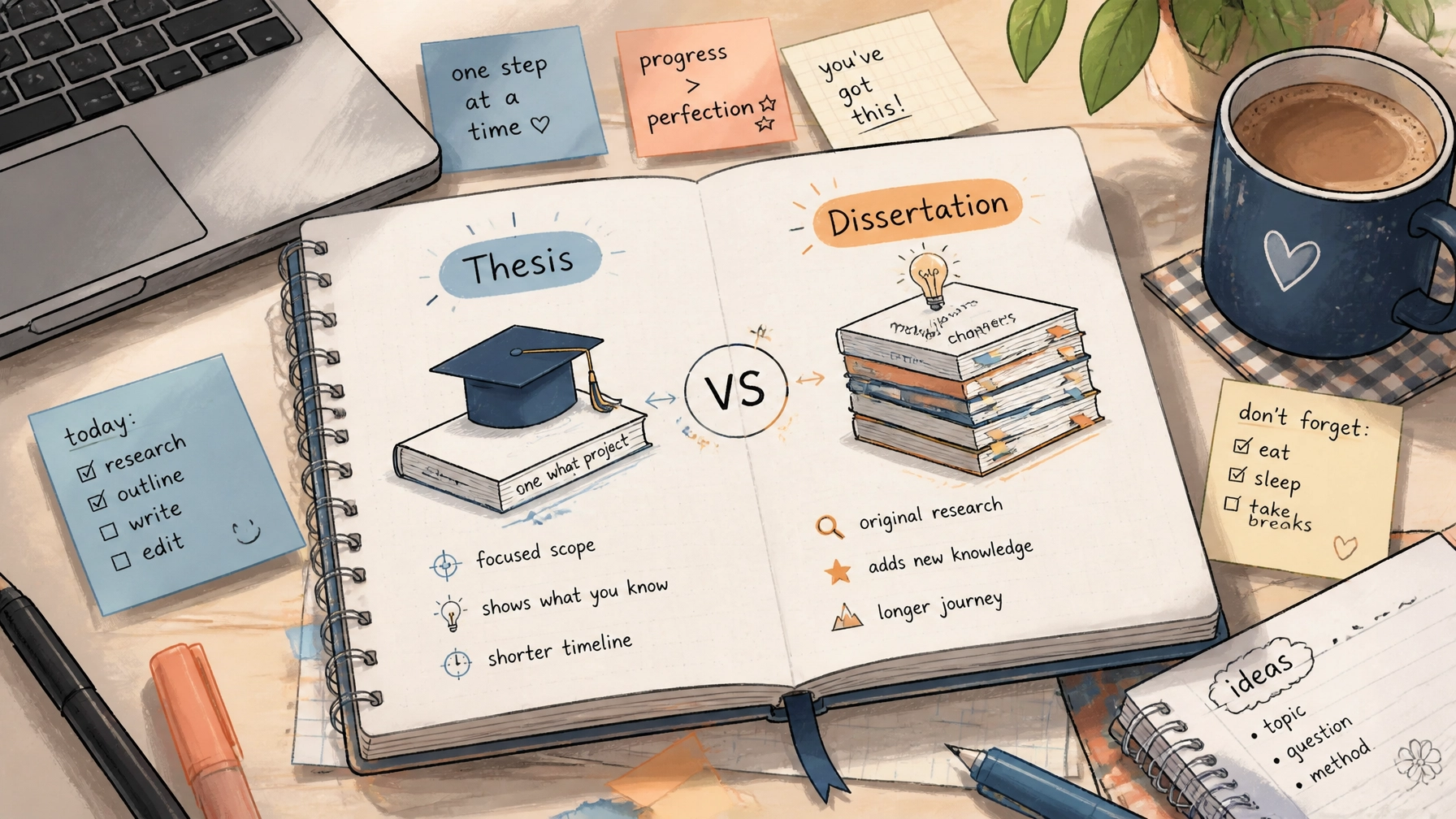
You’ve spent years in class, survived too many midterms, and finally reached the part of your degree where the vibes turn hostile. Then you spot it in the requirements: "Final Thesis" or "Doctoral Dissertation." And suddenly you’re staring at your laptop at 2 AM thinking, “Wait… are these actually different, or is academia just being dramatic again?”
If you’re confused, you’re in very good company. Whether you’re studying in Houston or grinding through an online program in sweatpants, these two terms trip people up all the time. They’re both big, important final projects. They are not, however, the same beast.
So let’s make this simple, fast, and way less stuffy so you can get back to finishing your degree and living your life.
Quick Writing Tips for Your Final Project
Before we get into it, here are a few quick tips to help you keep the panic from driving the bus:
- Start with a Skeleton: Don’t open a blank document and hope for a miracle. Build a chapter outline first so the project feels less like a wall and more like a checklist.
- Try the 25-Minute Rule: Set a timer, write for 25 minutes, then take a 5-minute break. It keeps you moving without frying your brain.
- Write the Intro Last: You usually understand your project better after you’ve written the middle parts. Save yourself the spiral.
- Use Strong Reference Materials: A solid example or model paper can help you figure out structure, tone, and what goes where.
The Master’s Thesis: Showing You Know Your Stuff
Think of the Master’s thesis as the academic version of saying, “Yes, I know what I’m doing, and yes, I can prove it.” At this level, your professors usually are not asking you to invent a brand-new theory in a candlelit library tower. They want to see that you understand the research already out there and can work with it in a smart, organized way.
Purpose and Scope
The main goal of a thesis is to show mastery. You’re proving to your committee that you understand the existing research and can use solid research methods on a focused topic. You might test a theory, repeat a study, or analyze data to see how it fits with what scholars already know.
Typical Length
This depends on your department, but a Master’s thesis usually lands around 50 to 100 pages, or roughly 10,000 to 25,000 words. That’s still a lot. But compared to a dissertation, it’s the smaller monster.

The Doctoral Dissertation: Bringing Something New to the Table
Now for the big one. If you’re doing a PhD, the expectation changes. You’re not just showing that you understand your field. You’re expected to add something to it. That’s where the Doctoral Dissertation comes in.
Purpose and Scope
The big thing that makes a dissertation different is originality. You’re not just pulling together what other people have already said. You’re expected to find a gap in the research and do something useful with it. That could mean a new study, a fresh argument, or original findings that add new knowledge to your field.
That’s also why dissertations can take years. You usually have to run your own research, gather your own data, and defend your conclusions in front of experts who will absolutely have questions.
Typical Length
Brace yourself: a dissertation is usually 200 to 300+ pages. It’s a huge project with a long literature review, a detailed methods section, and multiple chapters of analysis. At some point, it stops feeling like a paper and starts feeling like a roommate.
Comparing the Two: A Side-by-Side Look
If you want the quick version, here it is:
| Feature | Master's Thesis | Doctoral Dissertation |
|---|---|---|
| Primary Goal | Show you understand a subject really well. | Add original research or ideas to the field. |
| Length | 50–100 pages. | 200–300+ pages. |
| Independence | More guidance from a supervisor. | Much more independent. |
| Timeframe | Usually 1–2 years. | Usually 3–7 years. |
| Defense | Often a presentation or oral exam. | A tougher defense of original work. |

Why the Struggle is Real (And How to Handle It)
Does the thought of writing 200 pages make your stomach drop a little? Totally normal. Students run into all kinds of problems at this stage, like:
- Imposter syndrome: Feeling like you don’t have anything new or smart enough to say.
- The structure mess: Knowing what you mean, but having no clue how to organize it.
- The formal tone problem: Trying to sound polished without sounding like a robot in a blazer.
- Real life chaos: Work, family, bills, deadlines, and this giant project all fighting for your attention at once.
With that being said, you do not have to figure it all out alone. At Submit Your Assignments, we see ourselves as your academic support crew. Sometimes you just need help getting unstuck so you can keep moving.
How We Support Your Academic Journey
We don’t just offer writing help. We offer relief. Our team of experienced writers and editors supports students who are under pressure and short on time.
- Custom Outlining: If you’re stuck on structure, we can help you brainstorm and build an outline that makes sense to both you and your committee.
- Research Support & Reference Materials: Need help finding solid peer-reviewed sources? We can give you reference materials that help you start strong.
- Editing & Proofreading: Your ideas matter, but clean formatting matters too. Our editing services help you polish your work.
- Model Papers: Sometimes one strong example makes everything click. We provide custom model papers for research and educational purposes.
Stop stressing over formatting, missing sources, or messy structure. Trust our writers to help you sort through your final project without losing your mind. We “charge like a bird” because student budgets are already doing the most.

The Final Defense: Crossing the Finish Line
Whether you’re writing a thesis or a dissertation, the last step is usually the "defense." That means sitting in front of a committee and answering questions about your work. Sounds scary? Sure. But by that point, you know more about your exact topic than anyone else in the room.
Preparation helps a lot. If you’ve built a strong project, the defense becomes less of an ambush and more of a conversation.
In addition to the writing itself, make sure you have a clear understanding of the process. The more you know going in, the calmer you’ll feel when it’s time to defend your work and collect that diploma.
Final Thoughts
So, what’s the actual difference? A thesis shows you’ve learned the field. A dissertation shows you’ve added something new to it. Same family. Very different energy.
If a deadline is creeping up or your prompt feels like chaos in paragraph form, remember that help is close by. You’ve already done a lot to get here. Don’t let the last big project knock you off course.
Listen up: You can do this. Whether you need a full brainstorming session or just a second set of eyes on your references, we’re here to help you move forward with more confidence and less stress.
Penny’s Summary
A thesis is you proving you know the group chat lore, and a dissertation is you showing up with fresh receipts, a new theory, and enough evidence to survive getting grilled by a committee in business casual.
Fun Facts & Local Notes
- Houston Pride: Did you know that the Texas Medical Center in Houston is the largest medical complex in the world? We help a lot of nursing and med students from the area with care plans and research papers.
- Word Power: The word "dissertation" comes from the Latin dissertare, which means "to continue to discuss." Which feels accurate, honestly.
- The Longest Dissertation: Some doctoral dissertations in the humanities have gone past 800 pages. We are all hoping that is not your future.
Submit Your Assignments provides custom reference materials and tutoring services for research and educational purposes only. We encourage all students to follow their institution's academic integrity policies.