Blog

Humanize AI Text: The Ultimate AI Humanization Service for Students

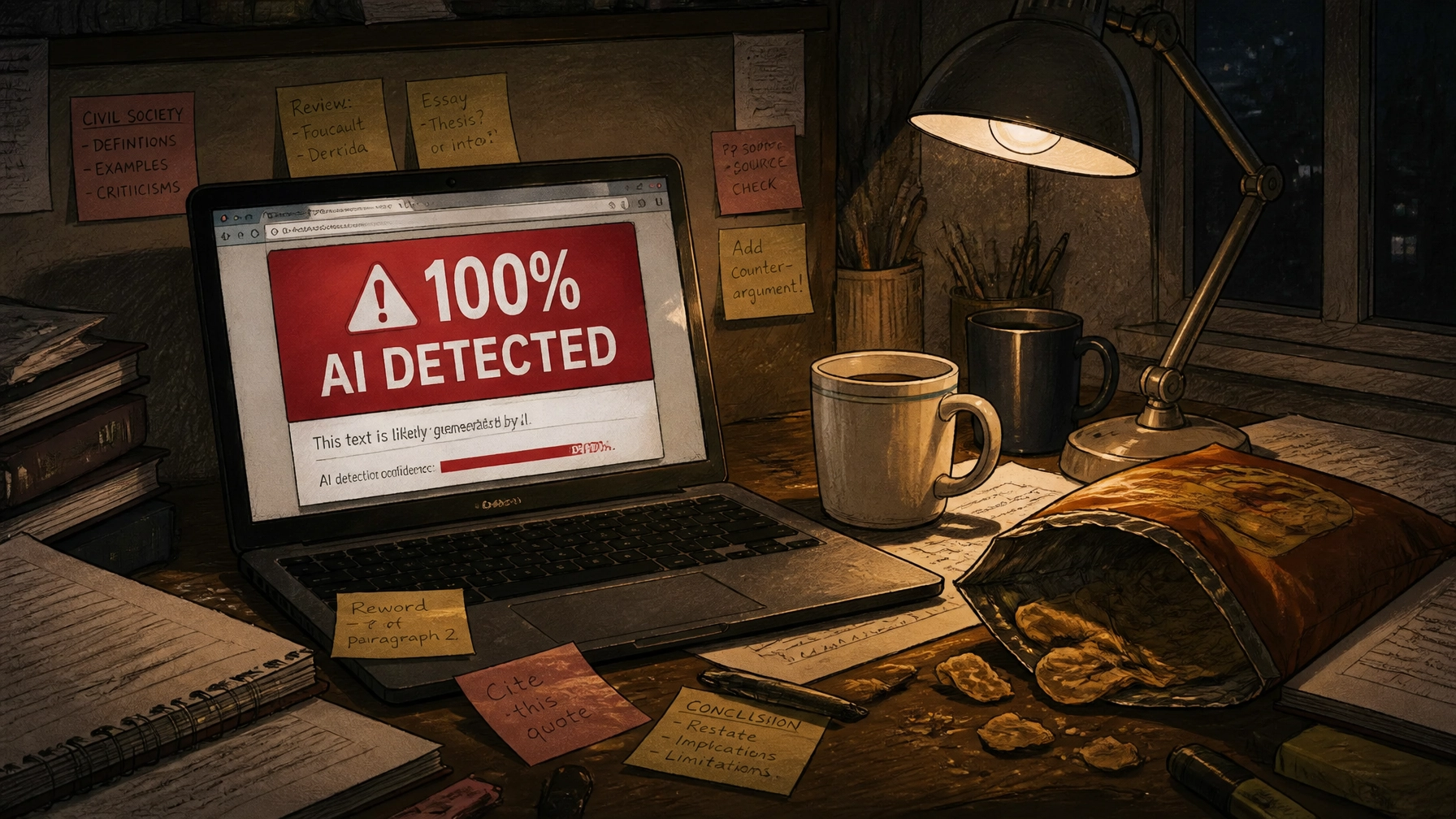
You’ve been there. It’s 3 AM, your eyelids are heavier than your GPA, and you just finished using ChatGPT to help you outline that 2,000-word sociology paper. You read it back and… yikes. It sounds like a legal manual written by a toaster. It’s stiff, repetitive, and practically screams, "I was generated by an algorithm!" Even worse, you know that if you submit it as-is, the AI detection in university essays is going to flag you faster than a "Reply All" mistake.

If you’re looking for a professional AI humanization service that actually works, you’re in the right place. At Submit Your Assignments, we don’t just "spin" text; we inject soul, voice, and personality back into your work so it sounds like you: only on your best writing day.

The Problem: When AI Detectors Kill Your Vibe

A student looking frustrated at a laptop screen with red highlights

Let’s be real: AI is a tool, but professors are treating it like a crime. Schools are leaning hard on software like Turnitin and GPTZero, and those bots are notoriously picky. They look for "burstiness" and "perplexity": technical terms for how predictable and boring your sentences are. If every sentence is the same length and your vocabulary is too "perfect," you’re going to get flagged.

This creates a massive amount of stress. You might have done the research and used AI just to organize your thoughts, but now you’re stuck wondering how to humanize ChatGPT essay drafts without spending another ten hours rewriting every single line. You need an AI detector bypass that isn't some sketchy software: you need a human touch.

Quick Writing Tips to Beat the Bot:

  • Vary your sentence length: Follow a long, descriptive sentence with a short, punchy one. Like this.
  • Add "Human" Imperfections: Real people use "and" or "but" at the start of sentences sometimes. It adds flow.
  • Use Personal Anecdotes: AI can’t talk about that one time you got lost in downtown Houston looking for a breakfast taco. Adding specific, quirky details is the best way to prove a human wrote it.

The Solution: Our Human Sounding Essay Service

We know you’re looking for a cheap essay option that doesn’t sacrifice quality. That’s why we’ve perfected our humanization workflow. When you send us your AI-generated draft, we don’t just run it through another bot (which usually just makes it worse). Instead, our real-world editors take over.

We provide custom reference materials and editing that transforms robotic phrasing into something that passes the "vibe check" of even the strictest professors. Whether you’re trying to figure out rewriting AI text for college or need a completely original model paper, we’ve got your back. We "charge like a bird": light on your wallet, but high on quality: ensuring you get the support you need without the financial crisis.

Deep Dive: Prompt Engineering for the Human Touch

If you’re DIY-ing your first draft, the secret is in the prompt. Most students just say, "Write an essay about X." That’s a one-way ticket to Academic Probation Town. To get something usable, you need to know how to prompt AI to write like a college senior.

Best ChatGPT Prompts to Make Essays Sound Human

If you want to try prompt engineering for human-sounding academic essays, try using these specific constraints:

  1. The "Neurodivergent" Prompt: Many students find that prompts to make AI text pass as neurodivergent writing actually result in more authentic, less "clinical" text. Try telling the AI: "Write this with a direct, occasionally tangential style. Use varied sentence structures and avoid transition words like 'furthermore' or 'moreover.' Keep the tone conversational yet academic."
  2. The Nursing Student Special: If you’re bypassing AI detection prompts for nursing students, you need to focus on clinical realism. Try: "Explain this patient care plan using specific medical terminology, but structure the analysis like a reflection on a real clinical shift. Include the 'chaos' of a busy ward environment."
  3. The Senior Voice: Instead of "academic," ask for "seasoned." Try: "Write this personal statement as a college senior who has experienced three years of growth. Avoid clichés like 'ever-evolving' and focus on specific, gritty lessons learned in the lab or the field."

A flat lay of a coffee mug, a smartphone, and a notebook

Expert Insights: Why Bots Can’t Beat Turnitin (But Humans Can)

The truth is, even the most advanced "AI humanizer" apps often leave digital footprints that sophisticated detectors can find. They replace words with synonyms that don't quite fit the context, making your essay sound like a bad translation. Beating Turnitin consistently requires an understanding of nuance, culture, and specific grading rubrics that bots just don't have.

Our team understands the local culture of universities across the country: from the competitive energy in Dallas to the laid-back but rigorous standards in Los Angeles. We know that a professor at a top-tier school in Chicago expects a different "voice" than a community college instructor in Atlanta. We tailor the humanization to your specific situation. Plus, we offer official Turnitin/Originality Reports for just $5.00, so you can see exactly what your professor will see before you hit submit.

Why Choose Submit Your Assignments?

We aren't just another faceless website. We are a team of dedicated writers and editors who believe in "Human Excellence." While AI companies use "human-in-the-loop" systems to train their bots, we keep humans in the driver's seat for your success.

  • 94% Average Customer Rating: Our students love us because we actually deliver on our promises. Check our Google reviews to see the hundreds of students we've helped reclaim their freedom.
  • Originality Guarantee: We take academic integrity seriously. Every piece of work is checked for uniqueness. Check out our originality guarantee for peace of mind.
  • Price Match Blitz: Found a better price for a cheap affordable essay? We’ll match it. Check our Price Match Blitz policy.
  • Nationwide Reach: Whether you're at a big state school or a small private college, we support students nationwide.

A group of happy students walking across a sunny campus

Fun Facts About Student Life in 2026:

  • The average college student now spends 4 hours a week just trying to "fix" AI-generated text.
  • Iced coffee is still the unofficial fuel of every 4.0 GPA.
  • "Academic Hype Women" (like us!) are the new secret weapon for surviving finals week.

Let's Get You That A!

Stop stressing over robotic text and red flags. Whether you’re attending college in Houston, Dallas, Los Angeles, Atlanta, Chicago, or anywhere else in the U.S., our team is available to help. We’ll take that "bot-speak" and turn it into a masterpiece that showcases your true potential. It’s time to stop worrying about AI detectors and start living your life.

Connect with us today:

Submit Your Assignments


All university names, logos, and trademarks mentioned in this post are the property of their respective owners. Use of these names does not imply any affiliation with or endorsement by the institutions.

Submit Your Assignments provides custom reference materials and tutoring services for research and educational purposes only. We encourage all students to follow their institution's academic integrity policies.

XSj CHMia21

Clinical Case Study Writing Service: Professional Help for Nursing & Medical Students

You’ve just finished a twelve-hour shift. Your feet are aching, your head is spinning with patient stats, and all you want to do is collapse into bed. But then you remember: that massive clinical case study is due in forty-eight hours. You look at your scattered notes: a mix of vitals, messy SOAP notes, and scribbled observations: and wonder, “How am I supposed to turn this into a professional, academic masterpiece?”

If you’ve ever felt the panic of a looming deadline while staring at a complex patient profile, you aren't alone. Writing a clinical case study is one of the most challenging tasks in nursing school because it requires more than just summarizing facts; it demands deep critical thinking, evidence-based rationales, and a perfect application of the nursing process.

At Submit Your Assignments, we understand the unique pressure of nursing education. Whether you need guidance with a care plan, support with case study organization, or help polishing a nursing paper, you can use our homepage, learn more about our team, or review our originality guarantee. We are here to support your journey from student to healthcare professional.

Quick Writing Tips for Instant Success

Before we dive into the deep end, here are a few quick wins to help you structure your thoughts right now:

Protect Patient Privacy: Always de-identify your data. Use "Patient X" or "Mr. A." Never use real names or specific birthdates.

Think in ADPIE: Organize your entire paper around the nursing process. It’s the skeleton of every great case study.

Rationales Matter Most: Don't just list an intervention. Explain why you chose it using a peer-reviewed source.

Start with the Why: Why is this specific case significant? Is it a rare condition, or a classic case with a complex social twist?

What Exactly is a Clinical Case Study?

In the world of nursing, a clinical case study is a detailed narrative of a real (or realistic) patient encounter. It’s your chance to demonstrate that you don’t just "do" nursing tasks: you understand the clinical reasoning behind them.

Think of it as a bridge between the classroom and the bedside. You are taking the theories you learned in a textbook and showing how they apply to a living, breathing human being with a complex medical history. It’s about the "so what?": so the patient has a high respiratory rate, so what are you going to do about it, and why does that action matter?

The Nursing Process ADPIE

Breaking Down the Structure: Step-by-Step

To help you stay organized, follow this standard clinical structure. This is the same logic students use when building strong drafts, outlines, and revisions. If you want broader academic support, you can also review our Price Match Blitz and explore related help through our academic writing services.

1. The Introduction and Patient Background

Start by setting the scene. Who is your patient? What brought them to the hospital?

Demographics: Age, gender, and social history such as living situation and occupation.

Presenting Complaint: The chief concern in the patient's own words.

Medical History: Chronic conditions, previous surgeries, and current medications.

2. The Comprehensive Nursing Assessment

This is where you present your subjective and objective data. Avoid writing a data dump. Instead, focus on the information that is relevant to the patient's current problem.

Subjective: What the patient tells you, such as chest pressure, fatigue, nausea, or shortness of breath.

Objective: What you observe, including vitals, lab results, and physical exam findings.

3. Nursing Diagnoses (NANDA-I)

Identify the priority problems. For example, instead of just saying difficulty breathing, use the formal diagnosis "Impaired Gas Exchange related to ventilation-perfusion imbalance." Always prioritize your diagnoses. Airway and breathing usually come first.

4. The Care Plan: Interventions and Rationales

This is the heart of your assignment. For every diagnosis, you need a plan.

Goal: What do you want to achieve? Make sure it’s SMART: Specific, Measurable, Achievable, Relevant, and Time-bound.

Intervention: What did you, or what would you, do?

Rationale: This is the science part. Cite a nursing textbook or a clinical guideline to justify your action.

Clinical Case Study Documentation

The Hurdle of Critical Thinking

Why do professors flag so many nursing papers? It’s usually because of a lack of clinical synthesis. They don't want to see a list of things you did. They want to see the connection between the patient’s symptoms and your nursing actions.

If you are struggling to connect the dots, pause and ask yourself three questions:

What changed first? Identify the earliest sign that the patient’s condition was shifting.

What matters most right now? Prioritize safety, airway, circulation, pain, and time-sensitive risks.

Why does this intervention fit this patient? Tie every action to patient-specific evidence, not generic textbook language.

Deep Dive: What Clinical Instructors Actually Look For

A strong case study usually earns better marks because it shows judgment, not just documentation. Your instructor is often scanning for patterns like these:

Clear prioritization: You explain why one issue comes before another instead of treating every symptom equally.

Evidence-based reasoning: You connect interventions to credible sources and patient findings.

Cause-and-effect thinking: You show how assessment findings support the diagnosis and how the diagnosis drives the care plan.

Evaluation: You don't stop at what you planned. You explain whether the intervention worked, what changed, and what you would monitor next.

That last part gets missed a lot during an all-nighter. But it matters. A polished clinical paper should read like you understand the patient story from admission to response, not like you copied isolated notes into separate sections.

Transitioning from Panic to Peace of Mind

With that being said, we know that sometimes, life just gets in the way. You might be a parent, a full-time worker, and a student all at once. The freedom to actually get a full night's sleep shouldn't be a luxury.

If you need a reset, break the assignment into small moves. Draft the patient background first. Then group your assessment findings by system. Then match each diagnosis to one goal, a few interventions, and a rationale. And yes, save formatting for last. That one tip alone can save you from a 4 AM spiral.

If you want extra guidance, our blog also covers practical student support topics like how to manage assignment stress, writing stronger research papers, and getting organized before a deadline crunch.

Human Authenticity Certificate

Why Trust Submit Your Assignments?

We focus on support that is actually useful when your schedule is wild and your brain is fried after clinicals.

Our students regularly mention strong experiences in Google reviews, and we maintain a 94% average customer rating.

Our writers and editors focus on clear structure, research support, outlining, editing, and model-paper guidance.

We charge like a bird, which means you can get help without wrecking your budget. If you are comparing options, a cheap affordable essay or cheap essay search should still lead you to quality, not stress.

24/7 Support Icon

Final Thoughts: You've Got This!

Writing a clinical case study is a marathon, not a sprint. Take it one section at a time, follow the ADPIE process, and don't be afraid to ask for help when the technical jargon gets overwhelming. You are already doing the hard part in class and in clinicals. Now you just need your paper to reflect that same level of thinking.

Fun Facts & Local Touches

Did you know? The first recorded nursing case studies go back to Florence Nightingale’s careful notes during the Crimean War.

Coffee is basically part of the nursing student grind. No surprise there.

And around Houston, the pace of healthcare culture is fast, demanding, and serious. That energy shows up in the way many students approach case-study assignments too.

Let's Get You That A!

Stop worrying. Start moving.

If you need help with brainstorming, outlining, editing, reference materials, or model papers for your clinical case study, trust our writers to help you create something clear, organized, and submission-ready. You deserve peace of mind, more freedom, and one less all-nighter.

Reach out now:
iMessage: info@submityourassignments.org
WhatsApp: wa.me/13466176123
Call Only: 346-603-6340
Email: info@submityourassignments.org

You can also visit our homepage, read more about us, review our originality guarantee, and compare rates with our Price Match Blitz. Turnitin/Originality Reports are $5.00.


Submit Your Assignments

Submit Your Assignments provides custom reference materials and tutoring services for research and educational purposes only. We encourage all students to follow their institution's academic integrity policies.

Nursing Care Plans for UTMB Students: Bypassing AI Detection Prompts for Nursing Students

You’ve spent the entire day on your feet at the University of Texas Medical Branch (UTMB), navigating the high-stakes environment of the NICU or a busy med-surg floor. Your scrubs are tired, your brain is foggy, and you’ve just realized you have a stack of nursing care plans due by tomorrow morning. Nursing care plans for UTMB students can pile up fast when you’re already running on fumes. And bypassing AI detection prompts for nursing students becomes a real worry when you’re tempted to use generic tools just to survive the week.

If you’re feeling the pressure, you aren’t alone. Nursing care plans for UTMB students are notoriously rigorous, requiring a specific blend of clinical reasoning, medical terminology, and evidence-based rationales. Whether you’re struggling to prioritize NANDA diagnoses or you're just plain exhausted, there’s a better way to handle the workload.

Before you pull another all-nighter in Galveston, here are five essential things you should know about mastering nursing care plans and handling AI-related pressure without making your paper sound generic or risky.

1. The ADPIE Struggle is Real (And It’s Okay to Ask for Help)

The nursing process: Assessment, Diagnosis, Planning, Implementation, and Evaluation (ADPIE): is the backbone of your career, but translating that process onto paper is a whole different beast. UTMB nursing care plans help often starts here, because UTMB instructors don’t just want to see that you know what a patient needs; they want to see the why behind every single intervention.

Writing a care plan requires you to cluster data like a pro. You have to look at a lot of cues: like a respiratory rate of 58 or nasal flaring: and instantly connect them to the right pathophysiology. It’s mentally taxing work!

Quick Writing Tip: When you’re stuck, start with the "Evaluation" in mind. Ask yourself: "What do I want my patient to look like in four hours?" Working backward from a SMART goal can often make the "Intervention" phase feel much more intuitive.

2. Why AI "Humanizers" Often Fail Nursing Students

In the age of ChatGPT, it might be tempting to plug your clinical notes into a prompt and hope for the best. However, generic AI often struggles with the specific nuances of clinical reasoning. Professors are increasingly flagging AI-generated work because it lacks the "human touch": that unique ability to connect a specific patient’s labs to a personalized nursing intervention.

If you’re searching terms like AI detector bypass or beating Turnitin, pause for a second. What usually helps more is rewriting with real clinical specificity, accurate rationale chains, and natural sentence variation. That matters way more than gimmicky tools.

This is where a human sounding essay service can be useful as a support option. Our writers are real people with backgrounds in healthcare and academic writing. They understand that a care plan for a geriatric patient with COPD looks vastly different from a pediatric patient in respiratory distress. Instead of relying on generic output, you can use model papers, outlines, and editing support that reflect the clinical judgment your professors expect to see.

Deep Dive: What AI Usually Misses in a Nursing Care Plan

Most AI-generated care plans sound polished at first glance. But nursing faculty usually notice deeper issues fast.

A weak draft often:
Lumps assessment findings together without priority logic
Chooses a diagnosis that doesn’t match the strongest patient cues
Writes interventions that sound nice but don’t connect to the goal
Uses rationales that are too broad to fit the actual scenario

A stronger draft usually:
Ranks patient problems based on safety and immediacy
Ties each intervention to one concrete assessment pattern
Explains why the intervention fits that patient, not just any patient
Ends with an evaluation statement that can actually be measured

As we said earlier, the real challenge is not filling the template. It’s showing clinical reasoning on paper.

Human Authenticity Certificate

3. The Deadline Panic: Same Day Essay Help

We’ve all been there: you thought you had the clinical worksheet under control, but then a family emergency or a sudden shift change threw your schedule into chaos. When the deadline is looming and you still haven't written your rationales, you need a plan that moves as fast as you do.

If you’re in crunch mode, start here:
Write your top 3 abnormal findings first
Pick the patient problem with the clearest safety impact
Draft one measurable goal before writing interventions
Use one current source for each major rationale if your instructor expects evidence support

With that being said, if you still need backup, our same day essay help can support you with reference materials, outlines, and editing guidance in high-pressure moments.

Stop worrying about the ticking clock. While you focus on getting some much-needed sleep or prepping for your next shift, our writers can help you structure your thoughts and organize the evidence-based research you need to succeed.

Fast Delivery Icon

4. We "Charge Like a Bird" (Student-Friendly Pricing)

You’re a student, not a corporate executive. We know that between tuition, scrubs, and those expensive nursing textbooks, your budget is tight. At Submit Your Assignments, we pride ourselves on pricing that is accessible. We often say we "charge like a bird": light on your wallet but high on value.

If you’ve been searching for a cheap affordable essay option or even just a cheap essay support service for nursing coursework, what you really need is something clear, practical, and student-friendly. You shouldn't have to choose between getting academic support and being able to afford dinner. Our straightforward process makes it easy to get a quote and see exactly how affordable professional editing, brainstorming, and model paper support can be.

And if you need an originality check, Turnitin/Originality Reports are $5.00.

5. Focus on Freedom, Not Just the Grade

Why did you choose nursing? Likely because you wanted to help people and live a fulfilling life. But it’s hard to feel like you’re "living your life" when you’re chained to a desk writing APA-formatted rationales for hours on end.

Using academic support for consultation, outlining, and editing isn't just about the assignment; it's about your well-being. It’s about having the freedom to grab coffee at a local Galveston spot, spend time with your family, or simply breathe. Trust our writers to provide helpful reference materials and structure support, so you can focus on the hands-on clinical skills that will make you a great nurse.

Student studying in library

How Our Process Expedites Your Success

Getting help shouldn't be another chore on your to-do list. We’ve kept our process simple so you can get back to what matters:

  1. Share your prompt. Tell us about your patient scenario or the specific requirements for your UTMB care plan.
  2. Expert matching. We pair you with a writer who understands medical terminology and nursing standards.
  3. Review your model paper. Receive a high-quality, human-written draft or outline that you can use as a reference for your own work.
  4. Peace of mind. Submit your work with confidence, knowing you have a solid, evidence-based foundation.

Trust the Process, Trust Your Ally

Are you ready to stop the midnight panic? Whether you need help with a complex pediatric care plan or a detailed med-surg outline, we are here to support you. Our Google reviews and 94% average customer rating show that students trust us when the semester gets chaotic.

If you want to learn more, you can visit our homepage, read about who we are on the About Us page, review our originality guarantee, or check the Price Match Blitz. If you need assignment-specific support, our nursing assignment help services may be relevant too.

You may also find these resources helpful:
How to write a nursing paper without sounding robotic
What to do when Turnitin keeps flagging your draft
Last-minute assignment planning tips for busy students

Fun Facts and Local Tips for UTMB Nursing Students

The "Seawall Run": Did you know that taking a 15-minute walk on the Galveston Seawall can help lower stress? Perfect for a mid-study break.
Oldest Medical School: UTMB was the first medical school in Texas, established in 1891. You’re walking through a lot of history every time you head to class.
Coffee is Key: Many students swear by the local roasters in downtown Galveston for that extra clinical-day boost.
Clinical Reasoning: Verbalizing your care plan to a friend can help solidify the logic better than just rereading it silently.

Let's Get You That A!

Stop stressing. Start moving smarter. If your nursing care plan is due soon and your brain is fried, trust our writers to help you with consultation, outlining, editing, and strong reference materials that actually make sense.

Reach out now:
iMessage: info@submityourassignments.org
WhatsApp: wa.me/13466176123
Call Only: 346-603-6340
Email: info@submityourassignments.org

You deserve peace of mind, better structure, and a little freedom in your week.

Submit Your Assignments

All university names, logos, and trademarks mentioned in this post are the property of their respective owners. Use of these names does not imply any affiliation with or endorsement by the institutions.

Submit Your Assignments provides custom reference materials and tutoring services for research and educational purposes only. We encourage all students to follow their institution's academic integrity policies.

vwU9h8kO95E

How to Win Your Turnitin AI Appeal: The 2026 Student Guide to Fighting False Accusations


author: Shannon Nicole

You know that feeling. It’s 11:00 PM on a Tuesday, you finally submitted that 2,000-word research paper you spent three days caffeinating over, and you’re ready to “No Homework and Chill.” Then, the notification pings. You open Turnitin, expecting a sea of green, but instead, you’re staring at a neon-red box: 98% AI Detected.

Wait, what? Your heart does a triple-axel into your stomach. You wrote every single word. You researched the sources. You even argued with yourself over the comma placement in the third paragraph. Yet, a faceless algorithm has just labeled you a “cheater.”

Does this sound like a nightmare? For thousands of students in 2026, it’s a daily reality. But before you spiral into a panic-induced breakdown, listen up: You can fight this, and you can win.

The 2026 Reality: You Aren’t Alone (And the Law is on Your Side)

If you feel like the world is out to get you, take a deep breath. You are part of a growing movement of students who are standing up to “The Bot.” By early 2026, the cracks in AI detection software have become massive canyons.

Take the landmark case of Orion Newby v. Adelphi University. Orion, a student who spent nearly 20 hours working with university tutors on a history paper, was slapped with a 100% AI flag. The university upheld the accusation: until a New York State Supreme Court judge stepped in. In February 2026, the court ruled the accusation was “without valid basis and devoid of reason,” ordering the school to expunge his record.

Or look at the ongoing battles at Yale University and the University of Michigan. These schools are facing lawsuits because their reliance on unreliable AI scores has allegedly violated due process and discriminated against students with disabilities.

The message is clear: AI detection in university essays is flawed, and the courts are starting to agree.

Turnitin Panic

Why is Turnitin So Bad? (Hint: It’s Not You, It’s the Math)

You might be asking, “Why did it flag my paper?” The truth is that AI detectors don’t actually “know” what AI writing looks like. They look for “perplexity” and “burstiness”, basically, how predictable your sentence structure is.

  • Non-native English Speakers: Studies in 2026 show that detectors flag non-native writers at a staggering rate: sometimes up to 98% of the time. Why? Because non-native speakers often use more formal, consistent grammar that the bot mistakes for machine-generated text.
  • Neurodivergent Writers: If you have ADHD or OCD and you “hyper-edit” your work until every sentence is perfectly structured, the bot might flag you. At Michigan, a student with OCD was accused multiple times simply because her writing was “too polished.”
  • Academic Rigor: If you’re writing for a high-level course at Rice University, you’re supposed to use technical vocabulary and a formal tone. Unfortunately, that’s exactly what Turnitin thinks a bot does.

The “AI Humanizer” Trap: Don’t Fall For It

When that red flag pops up, your first instinct might be to search for “how to humanize Chat GPT essay” or use an “AI rewriter.” Stop right there.

Using an automated “humanizer” tool is like trying to put out a fire with gasoline. These tools often use “spinning” techniques that create weird phrasing, grammatical errors, and: ironically: more patterns that modern detectors are trained to catch. If you try to “humanize” AI content for professors using another bot, you’re just handing them more evidence that you didn’t write the paper yourself.

True human authenticity can’t be faked by an algorithm. It requires a pulse, a brain, and a personality.

The Evidence Locker

Your 5-Step AI Appeal Guide: Build Your “Evidence Locker”

If you’ve been wrongly accused, you need to stop worrying and start documenting. Here is how you build a defense that a professor can’t ignore:

  1. Export Your Version History: This is your “smoking gun.” Whether you use Google Docs or Microsoft Word, export the version history. Show the timestamps of when you started, how the paper grew over three days, and the specific edits you made. A bot generates 2,000 words in 10 seconds; a human takes hours.
  2. Gather Your “Paper Trail”: Collect your rough outlines, messy brainstorm notes, and your browser history showing the research articles you visited.
  3. The Reference List: Show the specific library databases or physical books you used. If you can explain why you chose a specific quote from a 1994 sociology journal, you prove the intellectual work was yours.
  4. Request the Full Report: Don’t just accept the percentage. Ask your professor for the full Turnitin report. Which specific sentences were flagged? Often, common phrases or properly cited quotes are what trigger the bot.
  5. Focus on “Human Authenticity”: Remind your professor that “AI detector output is not proof.” Mention the Adelphi case and the fact that major institutions like MIT and Yale have restricted these tools because they are unreliable.

Navigating the Appeal at Rice or HCC

Whether you are at Rice University or Houston Community College (HCC), the appeal process usually starts with a conversation. Don’t go in swinging; go in prepared.

  • At Rice: The Honor Code is taken very seriously. If you’re flagged, lean into your research process. Rice professors value original thought. Show them your “brainstorming” notes and explain your thesis development.
  • At HCC: With a diverse student body, many students are non-native speakers. If you feel you’ve been flagged due to your writing style, point to the 2026 data regarding the 61%–98% false-positive rate for ESL students.

Human vs Bot

How “Submit Your Assignments” Can Be Your Ally

At Submit Your Assignments, we keep it human. Real writers. Real editors. Real support. We know the pressure of 2026 academia can wreck your whole vibe fast. That’s why we step in as your supportive ally, not with robot shortcuts, but with thoughtful help you can actually use.

We provide custom reference materials and expert editing that are 100% human-verified. When you work with us, you aren’t getting a generic, bot-spun essay. You are getting a model paper crafted by a professional writer who understands your specific prompt.

In addition, every piece of work we provide can come with a Turnitin/Originality Report for $5.00. We show you the “why” and “how” behind the writing, giving you peace of mind while you focus on learning instead of stressing over a machine score.

Think of us as your personal consultation team. We help with:

  • Outlining complex topics so you have a solid foundation.
  • Editing and proofreading your own drafts to ensure they meet academic standards.
  • Providing reference materials that you can use to build your own authentic arguments.

And if you want extra reassurance, check out our About Us, read our originality guarantee, and see how our Price Match Blitz helps you keep things student-budget friendly. We charge like a bird, and that matters when you need a cheap affordable essay, cheap essay support, or clean academic guidance without the drama.

Stop letting a faulty algorithm dictate your future. You deserve the freedom to live your life without the constant shadow of a false accusation.

Houston Education

Quick Tips for “Human-Proofing” Your Next Paper

  • Always use Google Docs: The version history is your best friend.
  • Keep your tabs open: Take screenshots of your research tabs before you close them.
  • Write an “ugly” first draft: If your first draft is a bit messy, it actually helps prove it’s human. Bots don’t make “human” mistakes.
  • Voice-to-text: Try dictating a paragraph. It keeps your natural “voice” intact, which is much harder for Turnitin to flag as “robotic.”

Fun Facts: The Houston Student Life

  • Did you know? The first word spoken from the moon was “Houston.” We’ve been solving “problems” since 1969.
  • Local Fuel: Students at the University of Houston swear by the coffee at The Nook to survive finals week.
  • Hidden Gem: If you need a break from the screen, the James Turrell “Twilight Epiphany” Skyspace at Rice is the best place to reset your brain.

Let’s Get You That A!

Stop stressing. Start moving smart. If you need human support with brainstorming, outlining, editing, reference materials, or a model paper that actually makes sense, trust our writers to help you get back your time, your focus, and your peace of mind.

You can reach us fast here:

Before you go, take a minute to explore Submit Your Assignments, learn more on our About Us page, review our originality guarantee, and check out the Price Match Blitz. You can also browse helpful student resources like our blog posts on cheap essay writing support, editing and proofreading help, and research paper guidance, plus our relevant service page for essay writing help.

Submit Your Assignments

All university names, logos, and trademarks mentioned in this post are the property of their respective owners. Use of these names does not imply any affiliation with or endorsement by the institutions.

Submit Your Assignments provides custom reference materials and tutoring services for research and educational purposes only. We encourage all students to follow their institution’s academic integrity policies.

The Dissertation Trap: Why AI Detectors Love Your ‘Original’ Research

You’ve been there. It’s 3:00 AM, the third empty coffee cup is staring you down, and you just finished rewriting that one stubborn paragraph for the fiftieth time. You spent weeks on the research, months on the data, and an eternity just trying to make the introduction sound like you didn’t lose your mind during the process.

Then, you run it through a detector just for peace of mind.

Flash. "90% AI Confidence Detected."

Your heart does that weird sinky thing. You know you wrote it. You know every citation is real. So why is a piece of software telling your professor that a robot did the heavy lifting?

Welcome to the dissertation trap. It’s a place where "perfect" writing actually gets you in trouble, and where the very tools meant to help you "clean up" your work are the ones snitching on you. Honestly, it’s a mess. But there’s a reason for it, and it’s not just because the AI detectors are out to get you (though it feels like it).

Quick Tips: How to Humanize Your Writing Right Now

Before we get into the math and the "why," here are three quick ways to make your paper sound less like a machine and more like a person who actually cares about the topic:

  • Break the Rhythm: AI loves medium-length sentences. It’s a total vibe killer. Throw in a short, punchy sentence. Then go long. Variety is the spice of human life.
  • Use "Low-Frequency" Words: Robots stick to the most likely word choices. If you can use a specific, slightly weird (but accurate) term instead of the generic one, do it.
  • Show the Struggle: Mention why a certain theory was difficult to apply or why you chose one method over another. AI doesn't have "opinions" or "struggles", you do.

The Math of Being Boring: Perplexity and Burstiness

A hand-drawn sketch explaining Perplexity and Burstiness

Here’s the thing: AI detectors don't actually "know" anything. They don't read your work and think, "Hmm, this sounds like ChatGPT." Instead, they use math to measure two things: Perplexity and Burstiness.

Perplexity is just a fancy word for predictability. If you’re writing a sentence like, "The results of the study indicate that…" the detector already knows the next words are probably "…further research is needed." Because AI is trained on basically the entire internet, it always picks the most "likely" next word. If your writing is too smooth and too predictable, the detector thinks you’re a bot.

Burstiness is about your sentence structure. Think about how you talk to your friends. You might say something short. Then you might go on a long, rambling tangent about how the campus parking situation is a literal nightmare. Then you stop. That "bursty" energy is uniquely human. AI, on the other hand, tends to write sentences that are all roughly the same length and rhythm. It’s like listening to a metronome. It’s steady, it’s "perfect," and it’s a massive red flag.

When you’re writing a dissertation, you’re often trying to be as professional as possible. You’re mimicking the dry, academic tone of the papers you’ve been reading for years. But by being "perfectly academic," you’re accidentally lowering your perplexity and burstiness. You’re essentially training yourself to write like an AI.

Why "Vibes" Aren't Enough for a Dissertation

A realistic messy study environment with textbooks and index cards

A dissertation isn't just a long essay. It’s supposed to be original research. That means you’re contributing something new to the world.

AI is great at summarizing things that already exist. It’s a master of the "vibe." You can ask it to explain a theory, and it’ll give you a decent, C+ level summary. But it can’t do the heavy lifting of a dissertation because it lacks nuance.

Nuance is that annoying little detail that makes your research matter. It’s the "but" or the "however" in your data. Maybe your survey results didn't match the existing literature. A robot might try to smooth that over to make the text sound "better." But a human researcher (that’s you) knows that the mismatch is actually the most interesting part of the paper.

When professors flag dissertations for AI, they aren't always looking at a detector score. They’re looking for a lack of depth. If your literature review sounds like a Wikipedia summary rather than a critical engagement with the experts, it feels "AI-like." If your discussion section doesn't connect your specific data to the real world, it’s going to raise eyebrows.

The Hallucination Nightmare

Abstract art of a graduation cap tangled in red digital lines

We’ve all heard the stories. A student uses AI to help with a bibliography, and the bot just… makes stuff up. It creates "perfect" citations for papers that don't exist, written by authors who never said those things.

In a dissertation, this is the kiss of death. Your committee is going to check your sources. They know the field. If you cite "Smith & Wesson (2022) on the impact of TikTok on neurobiology," and that paper doesn't exist, your credibility is gone.

AI "hallucinates" because it doesn't actually understand facts. It just understands patterns. It knows what a citation should look like, so it builds one out of thin air. This is why you can’t just "prompt" your way to a doctorate. You need real research, real sources, and a human eye to make sure everything actually exists in the physical world.

How the SYA Team Keeps it Real

A hand-drawn illustration of a student in a library

At Submit Your Assignments, we get the grind. We know that sometimes you aren't trying to "cheat": you’re just stuck. You’ve been staring at the same 50 pages for so long that they don't even look like English anymore.

When you work with us for custom research and editing, you aren't getting a bot-generated template. You’re getting a real person who actually knows how to write. Our writers have Bachelors, Masters, and even Doctorates, so they understand the level of nuance required for a dissertation.

Our workflow is built on trust and actual human effort:

  1. Brainstorming & Outlining: We help you map out your ideas so you don't get lost in the "predictability" trap.
  2. Original Research: Our team digs into the real databases (not just what’s on the surface web) to find legitimate, high-quality sources.
  3. Human Editing: Our editors look for that "burstiness" we talked about. They make sure the voice sounds authentic, critical, and: most importantly: like a human wrote it.

We believe in the "No Homework & Chill" lifestyle. That doesn't mean skipping the work; it means working smarter so you can actually live your life. Whether you need an assignment breakdown or someone to help you refine your discussion board posts, we’ve got your back.

Stop Worrying, Start Living

The stress of an AI flag shouldn't be the thing that keeps you up at night. You’ve worked too hard on your degree to let a buggy algorithm ruin your peace of mind.

If you’re feeling the pressure of a deadline or just can’t seem to get that one chapter right, check out our services. We’re here to be the supportive, expert tutors you need to get over the finish line.

Wait, why should you trust us?

  • 94% average customer rating (we don't miss).
  • Google reviews are our main social proof because students actually tell the story there.
  • We "charge like a bird" (student-friendly pricing, always).
  • 24/7 support because we know your panic doesn't keep office hours.

A few fun facts about the SYA family:

  • We've written over 22,000 pages this year alone.
  • Our owner, Shannon, is a writing pro who actually cares about your success.
  • We have a 5% cashback program in our "Wallet" because who doesn't like free money?
  • We’re based in Texas, but our writers are everywhere you need them to be.

Trust our writers. Ensure your work is authentic. Get your freedom back.

For immediate assistance, use iMessage: info@submityourassignments.org or WhatsApp: wa.me/13466176123. Call Only: 346-603-6340

Submit Your Assignments provides custom reference materials and tutoring services for research and educational purposes only. We encourage all students to follow their institution's academic integrity policies.

Submit Your Assignments

PSK8nPualch

Score Like a Pro: Breaking Down the ‘Critical Thinking’ Rubric Category


author: Shannon

You’ve been there. It’s 3 AM, your third cup of lukewarm coffee is staring back at you, and you’re looking at a grading rubric that might as well be written in ancient hieroglyphics. You see the words "Critical Thinking" and "Logical Organization" under the 20-point section, and you realize you have no idea what your professor actually wants.

Does "Critical Thinking" mean just having an opinion? Does "Organization" just mean using a couple of transition words like "however" and "therefore"?

Spoiler: Usually, it’s a bit more than that.

Most students lose points not because they don't know the material, but because they don't know how to "check the boxes" that professors use to grade. If you’re tired of getting a "B" on a paper you worked on for ten hours, it’s time to stop guessing and start writing for the rubric.

Quick Writing Tips to Save Your Grade

Before we dive into the deep end, here are three things you can do right now to boost your score:

  • The "So What?" Test: After every paragraph, ask yourself, "So what?" If your paragraph doesn't answer why this information matters to your main argument, delete it or fix it.
  • Reverse Outlining: Once you finish your first draft, write down the main point of every paragraph in a separate list. If the list looks like a jumbled mess of unrelated thoughts, your organization is off.
  • Stop Using "I Think": Professors already know it’s your paper. Instead of saying "I think the data shows," just say "The data shows." It sounds more authoritative and "critical."

Decoding "Critical Thinking" (The 40% Heavy Hitter)

C+ grade being replaced by an A in red pen

When a professor looks at the "Critical Thinking" category, they aren't looking for how many facts you can list. They are looking for what you do with those facts.

In most rubrics, the "Exemplary" or "Advanced" column asks for things like "demonstrates a deep understanding of complexity" or "evaluates context and assumptions."

What does that actually look like in a paper?

It’s Not Just a Summary

The biggest mistake students make is summarizing. If you’re writing about a historical event or a business case study, don’t just tell the reader what happened. They already know. Critical thinking happens when you explain why it happened and what the long-term implications are.

Think of it like this: Summary is "The sky is blue." Critical thinking is "The sky appears blue because of Rayleigh scattering, which suggests that our atmosphere plays a vital role in filtering light: a fact that is often overlooked when discussing climate change."

See the difference? One is a fact; the other is a connection.

The "Counterargument" Cheat Code

One of the easiest ways to prove you are "critically thinking" is to bring up the other side. Professors love when you acknowledge that your argument isn't the only one.

If you are arguing that remote work is the future of business, spend a paragraph talking about the downsides: like "Zoom fatigue" or the loss of office culture. Then, explain why your original point is still stronger. This shows you’ve looked at the "complexity" the rubric keeps mentioning.

Evidence vs. Analysis

Using a quote from a peer-reviewed journal is great, but that’s only half the battle. If you just drop a quote and move on, you’re missing the analysis part. You need to "sandwich" your evidence:

  1. Top Bun: Introduce the point.
  2. The Meat: The quote or data.
  3. Bottom Bun: Explain how that quote proves your thesis.

If you're struggling to find that "bottom bun" explanation, you might need a bit of a consultation or brainstorming session to get your thoughts organized.


Organization: The "Roadmap" Your Professor Needs

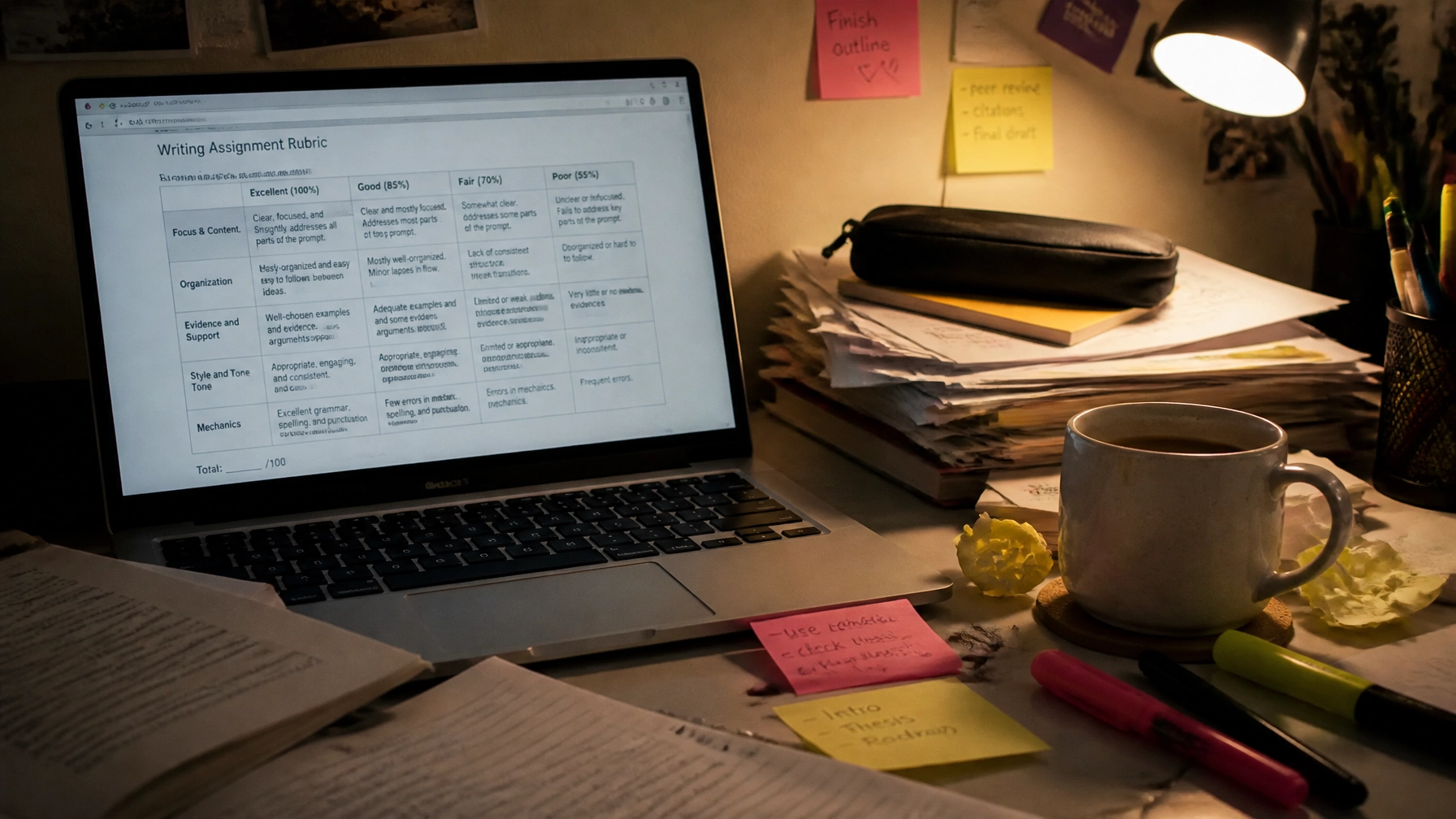
Confusing grading rubric on a laptop screen

Have you ever read something and had to restart the paragraph three times because you got lost? That’s poor organization.

When a rubric mentions "Organization" or "Structure," they are checking if your paper has a logical flow. If your paper feels like a collection of random "fun facts" about a topic, you’re going to get dinged.

The Thesis is Your North Star

Your thesis statement shouldn't just be at the end of the first paragraph; it should be the "vibe" of the entire paper. Every single topic sentence in your body paragraphs should link back to it.

If your thesis says "Social media is harmful to teens because of sleep deprivation and body image issues," your first paragraph better be about sleep and your second better be about body image. If you suddenly start talking about the history of MySpace, you’ve lost the plot.

Transitions That Actually Work

Most of us were taught to use "First," "Second," and "Finally." Those are fine, but they’re a little basic. If you want to hit that "Exemplary" column, you need transitions that connect the ideas, not just the order.

Try phrases like:

  • "Building on this idea…"
  • "While the previous point focused on X, the following data suggests Y…"
  • "This conflict leads directly to…"

These transitions act like a "roadmap" for your professor. It makes the paper easy to read, which usually leads to a much better grade. If your ideas are feeling a bit jumbled, looking into professional editing services can help smooth out those rough edges.

The Conclusion: More Than a Recap

Stop starting your last paragraph with "In conclusion." It’s a bit of a cliché. Instead, use the conclusion to talk about the "big picture." If everything you’ve said is true, what does it mean for the future? Why should the reader care?

Think of the conclusion as your final mic drop. You’ve presented the evidence, you’ve analyzed the data, now tell them why it matters in the real world.


Why Rubrics Feel Like a Trap

Abstract digital illustration of a paper roadmap

Let’s be real: rubrics can feel like they were designed to make you fail. They use vague words like "substantive" and "appropriate" that mean different things to different professors.

This is where the "grind" gets exhausting. You spend hours researching, but you still feel like you're missing some secret ingredient. The truth is, academic writing is a specific skill. It’s not just about being "smart": it’s about knowing the rules of the game.

At Submit Your Assignments, we’ve spent years decoding these rubrics. We know what a "Level 4" critical thinking section looks like because we’ve helped thousands of students move from "Developing" to "Exemplary."

Whether you need a model paper to see how an expert structures an argument or you need a tutor to help you outline your research, we’ve got your back. We’re here to help you get that "No Homework and Chill" vibe back into your life.

How to Use Our Help for Your Rubric

  1. Upload Your Rubric: When you work with our writers, send the rubric along with your prompt. We’ll make sure every "Critical Thinking" box is checked.
  2. Review the Flow: Our editors look specifically for organizational gaps that might confuse a reader.
  3. Learn the Style: Use our reference materials to see how a professional handles complex analysis. It’s like having a "cheat sheet" for your specific class.

Fun Facts & Quick Wins

Just to keep things light, here are a few random things we’ve noticed over the years:

  • The "Page 3" Slump: Most students' organization falls apart on page 3. That’s usually where the "brain fog" sets in. Check your transitions extra carefully there.
  • Word Count vs. Quality: Adding "filler" words to meet a length requirement is the fastest way to kill your "Organization" score. Be punchy, not wordy.
  • Font Choice: While it’s not usually on the rubric, a clean, standard font (like Times New Roman or Arial) makes your paper look more professional, which can subconsciously bias a grader in your favor.
  • Houston Pride: Since we’re based in the HTX area, we know the "grind" of the local universities. Whether you're a Cougar or an Owl, we know the academic standards you're facing.

Stop letting a vague rubric keep you up at night. You have a life to live, and staring at a blinking cursor isn't part of it. Trust our writers to help you navigate the complexity and deliver a paper that checks every single box.

For immediate assistance, iMessage us at info@submityourassignments.org or WhatsApp us at https://wa.me/13466176123. Call Only: 346-603-6340

Submit Your Assignments provides custom reference materials and tutoring services for research and educational purposes only. We encourage all students to follow their institution's academic integrity policies.

f91I2nn4V2z

Precision in Practice: How We Clarified a Complex Business Thesis

You’ve been staring at the same paragraph for forty-five minutes. Your MBA thesis is due in three days, and honestly? It sounds like a dictionary threw up on a spreadsheet. You know what you’re trying to say, something about "leveraging synergistic vertical integrations to optimize stakeholder equity", but even you aren't sure what that means anymore.

When you’re deep in the grind of a complex business paper, it’s easy to lose the plot. You start using "big words" because you think they sound professional, but you end up burying your actual genius under a mountain of jargon.

We see this all the time. A student comes to us with a brilliant idea that’s currently trapped in a cage of confusing sentences. They’re stressed, they’re tired, and they just want to submit the thing without getting a "Please rewrite for clarity" comment from their professor.

That’s where we come in. At Submit Your Assignments, we don’t just "fix typos." We perform academic surgery to make sure your message hits hard and clear.

Quick Tips for Instant Clarity

Before we show you how we transformed a real-world MBA disaster into a polished masterpiece, here are a few quick hacks you can use right now to stop the bleeding:

  • The "Manager" Test: If a busy manager couldn't understand your sentence on the first read, it’s too long. Chop it in half.
  • Active Over Passive: Don't say "The data was analyzed by the team." Say "The team analyzed the data." It’s punchier and saves you words.
  • Kill the "Zombie" Nouns: Words like "implementation," "utilization," and "optimization" often hide the action. Instead of "The implementation of the strategy was successful," try "The strategy worked."
  • One Idea per Sentence: Seriously. If you have two commas and a semi-colon in one sentence, you’re doing too much. Give your reader a break.

untangling the mess

The Case Study: From Word Salad to Executive Summary

Let’s look at a real example of a business thesis we recently helped "un-stick." The student was writing about supply chain disruptions in the post-pandemic retail sector. Their original draft was… a lot.

The "Before" (The Struggle)

"It is highly probable that the multifaceted nature of contemporary supply chain logistics, when viewed through the lens of post-pandemic recovery, necessitates a fundamental paradigm shift in how organizations leverage technological infrastructures to mitigate unforeseen operational volatilities."

The Verdict: Ouch. Our brains hurt just reading that. It’s a "word salad" that says very little with a lot of syllables.

The SYA Treatment (The Precision)

Our editor sat down with this and asked the student: "What are you actually trying to say?"
The answer: "Companies need better tech to handle the chaos left by the pandemic."

The "After": "To recover from the pandemic, retail companies must upgrade their technology to handle unpredictable supply chain shocks."

The Result: The word count dropped, but the impact skyrocketed. The professor finally understood the core argument, and the student stopped getting "Vague" circled in red ink.

How Our Process Actually Works

When you send us your draft for a "clarity check" or ask us to help build your term paper, we don't just run it through a basic spellchecker. We have a specific workflow that ensures your voice stays intact while your logic gets sharpened.

  1. The Logic Audit: We read your paper to find the "red thread." If your introduction promises one thing but your conclusion says another, we flag it immediately.
  2. The Jargon Cull: We look for those "filler" words that students use to sound smart. We replace them with precise, professional language that actually means something.
  3. The Flow Check: We make sure your paragraphs aren't just isolated islands of information. We build bridges (transitions) so the reader can follow your thoughts without needing a map.
  4. The Human Touch: Unlike some AI tools that produce weirdly robotic sentences, our writers are real humans who understand the nuances of business school expectations. We know the difference between a "good" sentence and a "grade-A" sentence.

editing with precision

Why AI Often Fails at MBA Clarity

You might be thinking, "Can't I just throw this into a chatbot?"

Well, sure. But AI has a habit of making things more generic. It loves words like "delve" and "comprehensive" but often misses the specific context of your research. A chatbot doesn't know that your professor specifically hates the word "leverage" or that your specific case study requires a very particular tone.

Our team provides custom reference materials and tutoring that feel human because they are human. We don't just give you a generic output; we provide a model paper that shows you exactly how to structure your arguments for maximum impact.

Freedom is the Goal

Let’s be real: you didn't go to business school to spend 4:00 AM fighting with a Word document. You went there to learn how to lead, innovate, and maybe actually have a life outside of the library.

When you trust us with the heavy lifting of editing and outlining, you aren't just getting a better paper. You’re getting your Friday night back. You’re getting the peace of mind that comes with knowing your work is professional, precise, and ready to impress.

Stop worrying about the "multifaceted nature of paradigms" and start living your life. We’ll handle the "word salad" for you.

the feeling of freedom

Fun Facts About Our SYA Writers

  • One of our top business writers has a collection of over 50 vintage fountain pens (she’s obsessed with the "feel" of writing).
  • We've helped students from nearly every major business school in the country.
  • Our average "turnaround" for a clarity edit is faster than most people can finish a Netflix binge.
  • We drink an alarming amount of coffee, but we never use those boring corporate mugs. It's strictly "weird thrift store finds" only.

Listen up: you’ve worked too hard on your research to let bad writing ruin your grade. Trust our writers to give your thesis the precision it deserves.

For immediate assistance, iMessage us at info@submityourassignments.org or WhatsApp us at https://wa.me/13466176123. Call Only: 346-603-6340

Submit Your Assignments provides custom reference materials and tutoring services for research and educational purposes only. We encourage all students to follow their institution's academic integrity policies.

Rubric Roulette: How to Read Between the Lines of Your Assignment Sheet

It’s 11:42 PM on a Tuesday. You’ve finally finished the third cup of coffee, the one that tastes more like burnt beans and desperation than actual caffeine, and you open the assignment portal. There it is: The Rubric.

Four pages of tiny font, grids, and academic jargon that feels more like a legal contract than a guide to writing a paper. You see words like "Synthesizes," "Critical Evaluation," and the dreaded "Substantive Analysis." Your brain is already fried, and honestly, you just want to know how many paragraphs you need so you can go to sleep.

But here’s the thing: that rubric is actually your best friend. It’s the literal map to your professor’s brain. If you know how to read it, you aren't just guessing what they want; you’re checking boxes for an A.

Stop staring at the screen in a panic. Let's break down how to stop playing "Rubric Roulette" and actually win.

Quick Wins for the Rubric Grind

Before we get into the heavy stuff, here are a few "cheat codes" to use the next time you're staring down a complex assignment sheet:

  • Read the "A" Column First: Forget the "C" or "B" columns. Go straight to the "Exemplary" or "Advanced" section. That’s your target. Anything less is just a list of ways to lose points.
  • Highlight the "Action Verbs": Are they asking you to list, describe, or evaluate? These words aren't interchangeable. If you "describe" when they asked you to "evaluate," you’re leaving points on the table.
  • Check the Weighting: If "Organization" is worth 10% but "Content Analysis" is worth 60%, don't spend three hours obsessing over your font choice while your main argument is still thin.
  • Count the "Must-Haves": Most rubrics have a "Formatting" or "Mechanics" section. This is basically free money. Use a spellchecker, fix your APA citations, and boom, you just secured 10-20% of your grade without even trying.

Tips Icon

The Great Divide: Analysis vs. Description

This is where most students lose the "vibes" of their paper. You spend hours researching, you find great quotes, and you write a solid summary of what happened. Then the paper comes back with a "C" and a comment like: "Too descriptive. Needs more analysis."

What does that even mean? Is your professor just being a hater?

Not exactly. In the world of academic rubrics, "Description" and "Analysis" are two completely different beasts.

Description is the "What"

Description is safe. It’s when you tell the professor what the book said, what the experiment showed, or what the history textbook says about the Civil War. It’s a summary. It proves you read the material.

Example of Description: "The author states that social media causes anxiety because people compare their lives to others."

Cool. The professor knows that. They probably assigned the book. They don't need you to tell them what’s in it, they want to know what you think about it.

Analysis is the "So What?"

Analysis is where the real points live. This is where you explain how and why something matters. You aren't just repeating the info; you're breaking it down and building something new with it.

Example of Analysis: "By highlighting the link between social media and anxiety, the author implies that digital platforms have shifted from tools of connection to tools of performance. This suggests that the psychological cost of 'staying connected' might actually be the erosion of authentic self-image."

See the difference? One is just a report. The other is a thought. Analysis requires you to take a risk and make an argument.

Analysis vs Description Illustration

How to "Hack" Your Way to Better Analysis

If you’re struggling to move past the summary stage, try using the "Because, So What, Compared to" method.

After every descriptive sentence you write, ask yourself:

  1. Because of what? (What’s the cause behind this fact?)
  2. So what? (Why should the reader care about this?)
  3. Compared to what? (How does this idea stack up against another one?)

If you can answer those, you’re officially analyzing. You’re no longer just a student repeating facts; you’re a researcher providing insight. And that, my friend, is what the "A" column in your rubric is looking for.

Reading Between the Lines: The Secret Rubric Language

Sometimes, professors use code words. If you see these in your rubric, here is what they actually mean:

  • "Synthesizes Sources": Don't just give me a list of what five different authors said. Show me how Author A and Author B agree, or how Author C totally disagrees with both of them. It's a conversation, not a monologue.
  • "Demonstrates Critical Thinking": This is professor-speak for "Don't just agree with everything you read." Find a flaw in the argument. Suggest a different perspective. Show that you have an original thought.
  • "Logical Flow": This isn't just about grammar. It means your paragraphs should actually talk to each other. Don't jump from Topic A to Topic Q without a transition.

Why Rubrics Feel Like a Trap

Let’s be real: sometimes rubrics are just poorly written. You might have a professor who uses a generic rubric for every single assignment, even if half the criteria don't apply. Or maybe the rubric says "APA Style," but the prompt says "MLA."

This is where the panic sets in. You’re trying to do the right thing, but the instructions are a mess.

When you're in the middle of a late-night grind, the last thing you need is a riddle. You need clarity. You need someone to look at that rubric and say, "Okay, here is exactly what they are looking for."

Student Studying

How We Bridge the Gap at SYA

At Submit Your Assignments, we don't just "write papers." We're essentially professional rubric-readers. When you send us an assignment, the first thing our writers do isn't writing: it's analyzing that rubric.

We look at the "Exemplary" column and build the paper from there. Our goal is to provide you with a model paper that shows you exactly how to hit those "Analysis" points.

Our process is built on trust and authenticity. We know how stressful it is to worry about AI flags or generic content. That's why we focus on custom, human-led research that mirrors the way a real student would think and write: just with a little more "Analysis" sprinkled on top for those extra points.

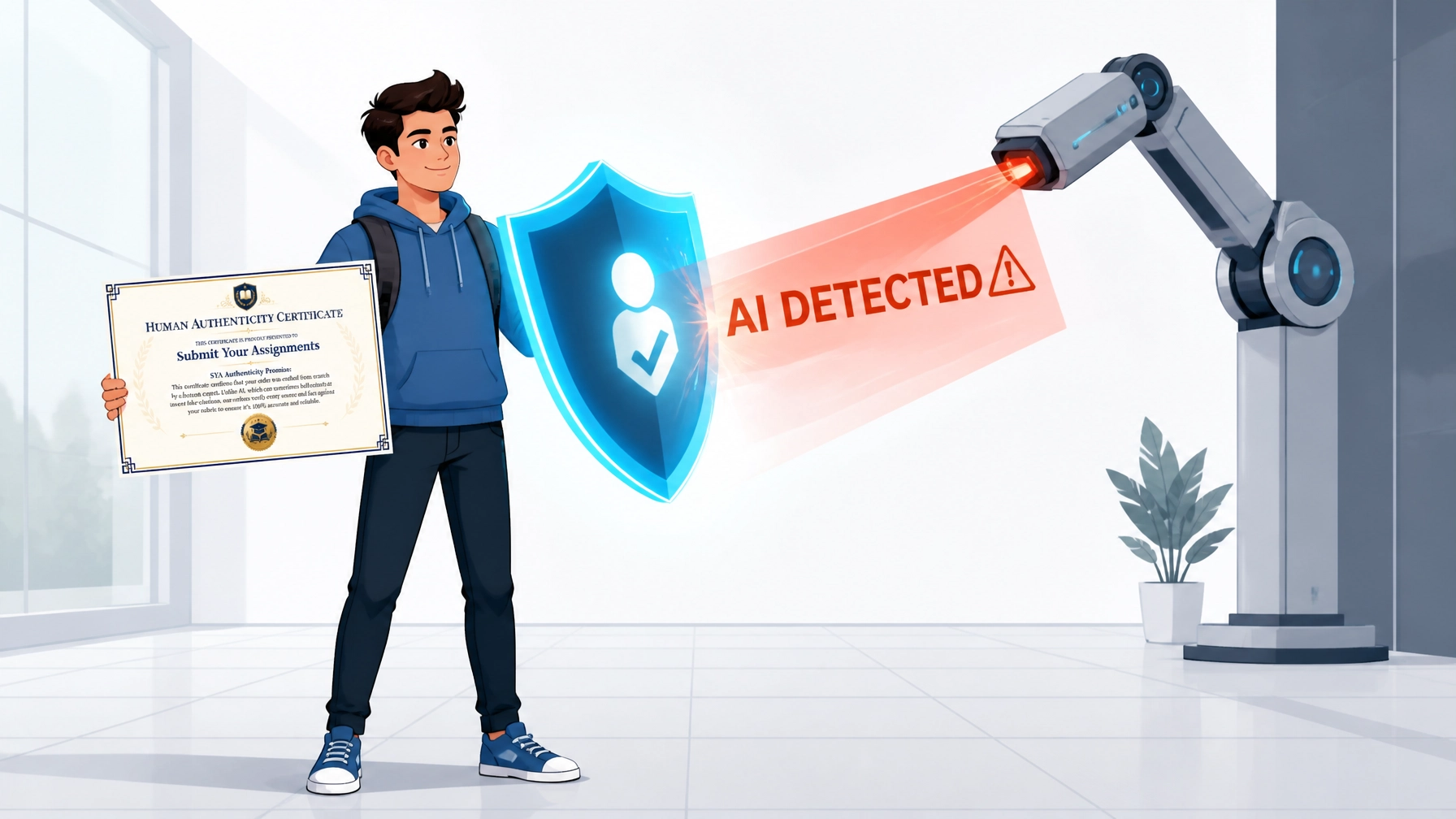
We even provide a human authenticity certificate because we want you to have peace of mind. You aren't just getting a document; you're getting a roadmap for your own academic success.

Human Authenticity

Stop Worrying and Start Winning

You don't have to stay up until 4 AM trying to figure out if your "Discussion Board" post sounds "authentic" enough. You don't have to play the Rubric Roulette alone.

Whether you need help brainstorming an outline or you want a full reference paper to show you how to structure that MBA dissertation, we've got your back.

A Few Fun Facts About Academic Life (Because you need a break):

  • Did you know the average student spends about 15% of their study time just trying to understand what the assignment is asking for?
  • Research shows that students who use rubrics as a checklist while writing score significantly higher than those who only look at it before they start.
  • The term "Rubric" actually comes from the Latin word for "red," because early academic instructions were often written in red ink. (Fitting, since that's usually the color of the marks we're trying to avoid!)

Listen up: you’ve got this. The rubric is just a puzzle, and now you have the pieces. Stop stressing over the tiny details and focus on the big picture. And if you ever feel like the puzzle is missing a few parts, you know where to find us.

Trust our writers to help you navigate the chaos. Let’s get that "A" column checked off.

For immediate assistance, iMessage us at info@submityourassignments.org or WhatsApp us at https://wa.me/13466176123. Call Only: 346-603-6340

Submit Your Assignments provides custom reference materials and tutoring services for research and educational purposes only. We encourage all students to follow their institution's academic integrity policies.
jhvckED3gfX

The Art of the Reply: Making Discussion Posts Sound Like You, Not a Bot

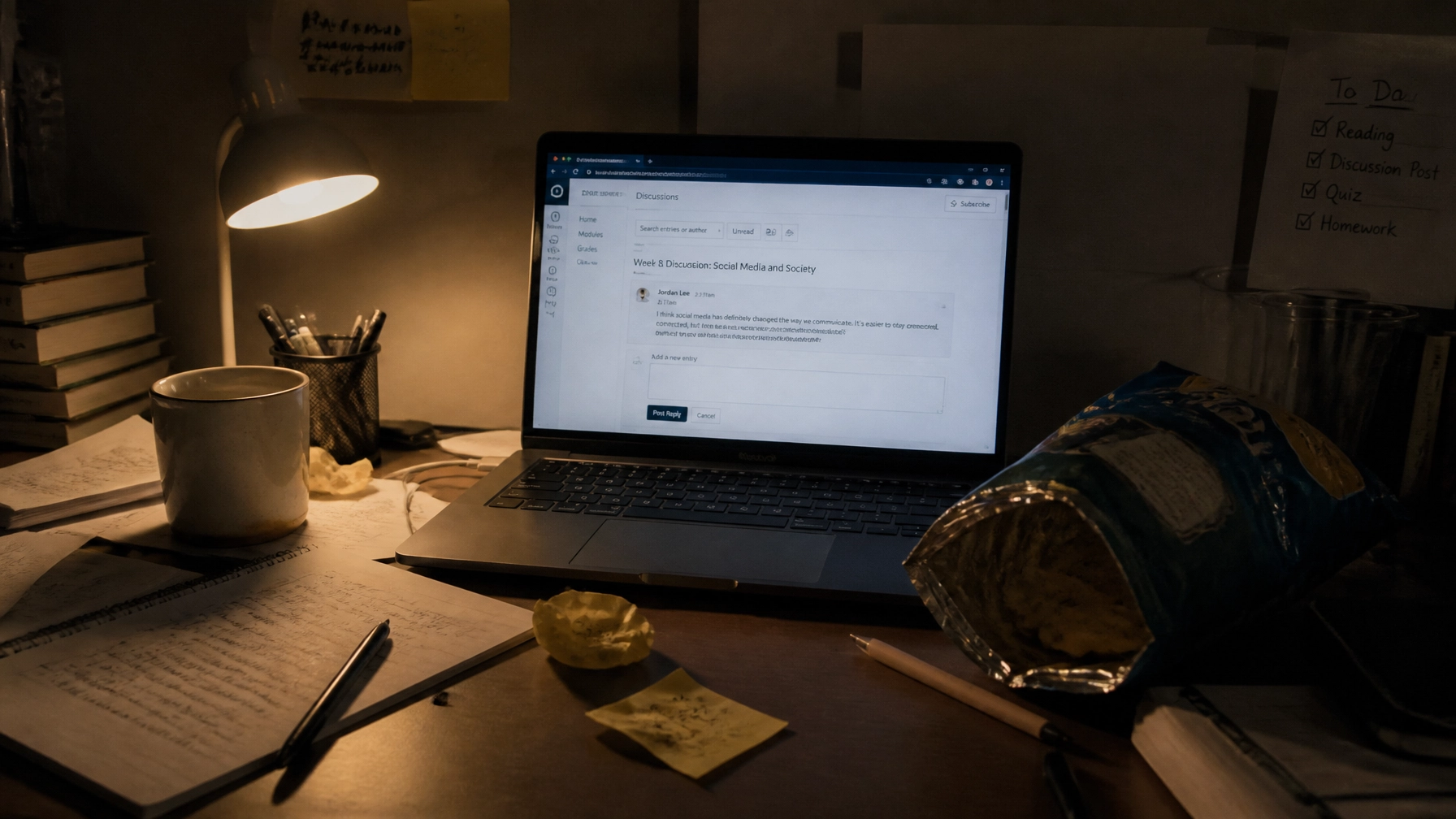
It’s 11:42 PM on a Sunday. You’re staring at a blinking cursor on Canvas, and the dread is setting in. You’ve finished the main post, that was the "easy" part. But now, you see the instruction that haunts every college student’s dreams: “Please respond to at least two of your peers’ posts with a substantive comment of 150 words or more.”

Your brain is fried. You look at Tyler’s post about "The Socio-Economic Impact of the Industrial Revolution" and your only organic thought is “Yeah, Tyler, work was hard back then. Same.” But you can’t say that. You need to sound smart. You need to sound academic. And lately, everyone is terrified that if they sound too academic, the professor’s AI detector is going to start screaming.

How do you write a reply that actually adds value without sounding like a generic corporate training manual or a robot that just learned what "synergy" means? Trust us, we’ve seen the "AI smell" a mile away, and it’s usually because the writing lacks a heartbeat.

Let's fix that.

Why "Good" AI Writing Often Fails the Vibe Check

If you’ve ever messed around with a chatbot to help you "brainstorm," you know the drill. It churns out stuff like: "It is important to consider the multifaceted nature of this issue…" or "One must acknowledge the significant impact of…"

Stop right there. Do you talk like that? Does anyone in your 9:00 AM lecture talk like that? Probably not unless they’re trying to win a "Most Likely to Work in Middle Management" award.

The problem isn't that AI is bad at grammar; it’s that it’s too "perfect." It’s clinical. It lacks the messy, beautiful chaos of a human brain that just spent three hours caffeinating. When you submit a discussion post that sounds like a textbook, your professor, who has read 400 of these things, starts to get suspicious. Or worse, they just get bored.

A close-up of a student's hand and notes with a phone notification

Quick Tips to De-Bot Your Discussion Replies

Before we dive into the deep end, here are a few fast ways to inject some life into your writing immediately:

  • Use Contractions: "Do not" sounds like a robot. "Don't" sounds like a person. It's a small shift, but it makes a massive difference in the flow of your "voice."
  • The "I" Factor: Don't be afraid to use "I." Say "I found this interesting because…" or "I disagreed with the part where…" Discussion boards are meant to be a conversation, not a peer-reviewed journal entry.
  • Anchor in the Mess: Mention something specific from the week's lecture or a page number. AI struggles with specific, localized context. If you mention that "the video from Wednesday's module about the squirrels was weird," a bot could never fake that.
  • Keep it Punchy: Short sentences are your friend. They create rhythm. They show you’re making a point, not just filling space.

The "Anchor" Technique: How to Sound Authentic

The biggest "tell" of a generic post is vagueness. To beat the bot allegations and actually get that high engagement from your peers, you need to anchor your post in reality.

Think of your reply like a three-layer cake:

  1. The Recognition: Call out something specific your classmate said. Use their name. "Hey Sarah, I really liked your point about the psychological impact of remote work."
  2. The Anchor: Bring in a specific detail from the reading or your life. "It reminded me of the case study on page 42 where the author mentions 'digital fatigue.'"
  3. The Perspective: Add your own spin or a question. "I wonder if that fatigue is worse for students who also work full-time?"

This structure shows you actually read their post, you actually read the material, and you have an actual brain. It’s a triple threat.

Avoid the "Discussion Board Cliches"

We all know the phrases. They are the "Live, Laugh, Love" of the academic world. If you find yourself typing these, hit backspace immediately:

  • "I really like how you said…" (Try: "Your point about X actually changed how I thought about Y.")
  • "You made some very good points." (Try: "The way you framed the argument about Z was something I hadn't considered.")
  • "In conclusion, this was a great post." (Just… don't. You don't need a conclusion for a 150-word reply.)

Sketchy hand-drawn digital art representing a conversation

Let’s Talk About "The Grind"

We get it. You’re juggling a part-time job, maybe some family stuff, and a full-time course load. Sometimes you just want to get the post done so you can finally close your laptop and sleep. That’s where the temptation to use a template or a bot comes from.

But here’s the secret: writing authentically is actually faster than trying to polish a robotic draft into something human. When you stop worrying about "sounding academic" and start focusing on "sounding like you," the words usually come easier.

At Submit Your Assignments, we talk to students every day who are burnt out. Our writers don't just "crank out papers": they act as tutors and consultants. When we help a student with custom reference materials, we’re looking at the prompt from a human perspective. We ask: "What would a student actually think about this?"

Behind the Scenes: How We Help You Find Your Voice

Ever wonder how professional academic consultants approach a discussion board? We don't use magic, and we definitely don't use generic AI prompts. We use a "Brainstorming and Outlining" workflow.

When a student comes to us for help with a challenging subject, we don't just hand over a finished product. We provide model papers and outlines that serve as a roadmap. For a discussion board, we might outline three different "angles" you could take based on your actual experiences. Maybe one angle is "The Skeptic" and another is "The Real-World Application." This helps you stay in the driver's seat of your own education.

We’ve helped thousands of students in Houston and beyond navigate the stress of the digital classroom. Our goal is to give you the "No Homework and Chill" vibe by taking the mystery out of complex assignments.

Is Your Post Too "Bot-y"? A Quick Checklist

Before you hit "Post," run through this mental checklist:

  • Did I use their name? (Humans use names. Bots use "The author of the post.")
  • Is there a typo? (Seriously, one or two tiny typos: like "it's" instead of "its": can actually make you look more human. Don't be a perfectionist.)
  • Did I ask a real question? (Not "What do you think?" but something like "Do you think this theory applies to our current economy?")
  • Do I sound like I’m at a party? (Maybe not a wild party, but at least a friendly coffee shop. If you sound like you're in a boardroom, tone it down.)

A student in a hoodie looking tired but determined at a laptop

The Freedom to Live Your Life

At the end of the day, your grades matter, but your mental health matters more. Spending six hours agonizing over a two-paragraph reply to Tyler is not a good use of your "grind."

Stop worrying about whether you're "smart enough" to sound academic. You are. The most brilliant scholars are the ones who can explain complex ideas simply. Use our tutoring services or consultation tools to get the baseline you need, then add your own flair.

Listen up: you’ve got this. Whether you're a high school senior or a grad student finishing an MBA, the art of the reply is just the art of being yourself.

Fun Facts for the Houston Grind

  • Coffee is King: Did you know there are over 200 local coffee shops in the Houston area? If you’re struggling with a post, a change of scenery might be all you need.
  • The Late Night Crowd: According to our data, the most common time for Houston students to submit assignments is between 10:00 PM and 1:00 AM. You are definitely not alone in that "midnight panic."
  • Bird's Eye View: We call our pricing "charge like a bird" because we keep it light and student-friendly. No corporate bloat here!

Stop struggling with the blinking cursor. Trust our writers to help you find the right direction and get your peace of mind back.

For immediate assistance, iMessage us at info@submityourassignments.org or WhatsApp us at wa.me/13466176123. Call Only: 346-603-6340


Author: Shannon Nicole

Submit Your Assignments provides custom reference materials and tutoring services for research and educational purposes only. We encourage all students to follow their institution's academic integrity policies.

Submit Your Assignments

oN pfJ4PbQL

Galveston College Research Paper Support: Professional Writing Help for Local Students

So, you’re sitting in the library, or maybe at a table at MOD Coffee, staring at a blank screen. The cursor is blinking at you like it’s mocking your entire existence. You’ve got a 10-page research paper due for your History or English class at Galveston College, and the only thing you’ve written so far is your name.

And let’s be real: the weather outside is perfect. The seawall is calling your name, and the last thing you want to do is spend your Saturday afternoon arguing with a database that won't give you the PDF you need.

We’ve all been there. The "I'll start it after this one YouTube video" trap is real. But eventually, the deadline starts breathing down your neck, and the panic sets in. If you’re looking for Galveston College research paper support, you actually have a lot of options before you totally lose your mind.

Whether you just need a nudge in the right direction or you’re at the "please help me, I have three hours left" stage, here is your survival guide to getting that paper done without the mental breakdown.

Hit Up the David Glenn Hunt Memorial Library

First things first: you can’t write a research paper without, well, research. If you’re struggling to find sources that aren’t just random blogs or Wikipedia pages, the GC Library is your best friend.

Located right on campus, the David Glenn Hunt Memorial Library is more than just a place to hide between classes. The librarians there are basically research ninjas. You can actually book a one-on-one appointment with them (up to an hour!) to help you find sources, navigate those confusing databases, or figure out why your MLA citations look like a bowl of alphabet soup.

Quick Tip: If you’re stuck at home and don’t want to drive to campus, they have a "Library Chat" widget on their website. It’s like texting a genius who knows exactly where all the peer-reviewed articles are hidden.

A student works at a library table with a laptop, printed journal articles, sticky notes, and highlighters, while other students study in the background. The scene feels focused, real, and grounded in academic support.

Swing by the Tutoring Center (N-200)

Once you have your sources, the next hurdle is actually putting words on the page. This is where the Career Placement & Tutoring Center comes in. You’ll find them in Mary Moody Northen Hall, Room N-200.

A lot of students think tutoring is just for people who are failing. Not true. The writing tutors there can help you with:

  • The "Vibe Check": Does your thesis actually make sense?
  • The Outline: Mapping out your points so you don't repeat yourself for five pages.
  • Grammar & Flow: Making sure you don't sound like a robot (or a first-grader).

Just remember to bring your GC student ID with the current semester sticker. They’re big on that.

Use the "Upswing" Online Tutoring

If it’s 11:00 PM on a Tuesday and the campus is closed, don't forget about Upswing. Galveston College gives every student access to this online platform through Canvas.

You can upload your draft and get feedback, or even meet with a live tutor virtually. It’s a lifesaver when you’re doing the classic "all-nighter grind" and need a second pair of eyes on your work before you hit submit.

3 Quick Writing Tips to Get You Unstuck

Before you throw your laptop into the Gulf, try these three things:

  1. Reverse Outline: If you’ve already written a few pages but they feel messy, go through and write one sentence summarizing each paragraph. If the summary doesn't match your thesis, delete it.
  2. Talk it Out: Record yourself explaining your paper topic to a friend (or your dog). Often, we speak much more clearly than we write. Transcribe those notes, and boom: you have a draft.
  3. The "Shitty First Draft" Method: Just write. Don't edit. Don't worry about citations yet. Just get the ideas out. You can't fix a blank page, but you can fix a bad one.

When the Grind Becomes Too Much

With that being said, sometimes life just hits you all at once. Maybe you’re working a double shift at a restaurant on the Strand, or you’ve got family stuff piling up, and that 2,000-word paper feels like a mountain you just can’t climb.

As we said earlier, your mental health and "living your life" matter just as much as your GPA. If you’ve tried the library, you’ve tried the tutoring center, and you’re still staring at a screen in a cold sweat, that’s where we come in.

At Submit Your Assignments, we provide the backup you need when you're truly stuck. We don't just "give you a paper": we provide custom reference materials, professional editing, and detailed outlines that act as a roadmap for your success.

A student uses a phone and laptop late at night at a cluttered desk with a planner and coffee cup. Warm lamp light and a chill coastal apartment vibe make it feel like real Galveston study life.

Why Trust Us for Your Research Paper Support?

We know the "writing service" world can feel sketchy. That’s why we’ve built our whole vibe around being the most transparent, human-centered team out there.

  • 100% Human-Written: In the age of ChatGPT, professors are on high alert. We don't use AI. Our writers are real people who know how to research and write with a human voice. You can even check out our Authenticity Promise.
  • Student-Friendly Pricing: We "charge like a bird": light and fair. We know the student budget is tight (especially with Galveston rent prices). You can also review our Price Match Blitz if you want the best value.
  • Peace of Mind: Our Google reviews and 94% average customer rating show how often students trust us when the semester gets wild. And if you want extra reassurance, you can read more about our originality guarantee.

Think of us as your academic consultants. If you’re struggling with a complex nursing care plan or a dense political science research paper, we can provide a high-quality model paper that shows you exactly how to structure your arguments and cite your sources. It’s like having a personal tutor who does the heavy lifting for you.

How to Get Started

The process is stupidly simple. You can start at our homepage, learn more about our team, or submit your assignment details on our site. Get a quote. Check in anytime. And ensure everything is on the right track.

Stop worrying about the deadline and start enjoying your time on the island. Whether you need a full reference paper, a detailed outline, or just someone to edit your messy draft, we’ve got your back.

A close-up desk scene with a checklist, draft pages, sticky notes, a laptop, and a pen laid out in a slightly messy but organized setup. The mood says academic support, less stress, and getting your paper back on track.

Quick Recap of GC Resources:

Fun Facts about Galveston for Your Study Break:

  • Did you know Galveston was once the "Wall Street of the South"? (Great topic for a history paper!)
  • The Maceo family once ran the island as a "Free State" during Prohibition.
  • The library's namesake, David Glenn Hunt, was a beloved GC professor.

Listen up: you don't have to do this alone. Galveston College has the tools, and we have the experts. Take a breath, grab some coffee, and let's get that paper finished so you can get back to the beach.

Questions? Need help with an assignment? Shoot me a message on iMessage at info@submityourassignments.org or WhatsApp me at https://wa.me/13466176123. Call Only: 346-603-6340.


Submit Your Assignments provides custom reference materials and tutoring services for research and educational purposes only. We encourage all students to follow their institution's academic integrity policies.